Blog
On-Page SEO in the Era of Helpful Content and AI-Mediated Search: An Evidence-Based Framework for Content, Structure and Trust (2026)
By Emily Thompson, Content Writer Published Updated 58 min read
1. Abstract and Keywords
On-page search engine optimization is the discipline of shaping what a single web page says, how it says it, and how a search system can read it. For most of the history of search it was treated as a list of tags and keyword placements. This paper argues that such a list no longer describes what matters. Google’s ranking systems now evaluate pages through a stack that includes language-understanding models, site-level quality classifiers, written spam policies and, since 2024, generative answer layers that use pages as source material. The practical question for an author has therefore changed from “where do I place the keyword?” to “what does a reader need, what evidence shows that this page can be trusted to provide it, and how is the page built so that both people and machines can use it?”
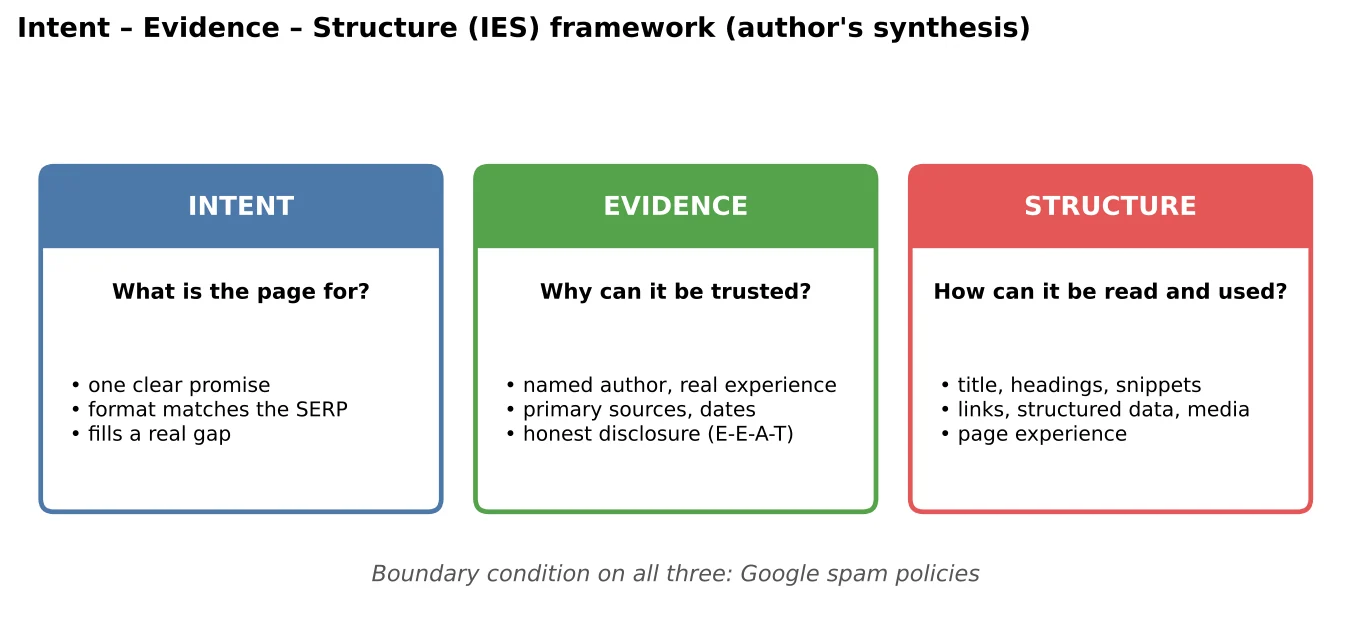
The paper develops a framework with three layers, called here Intent, Evidence and Structure (IES). Intent concerns what the searcher is trying to accomplish and what content format satisfies that goal. Evidence concerns the first-hand experience, expertise, sourcing and accountability that make a page worth trusting, which corresponds to the Experience, Expertise, Authoritativeness and Trustworthiness (E-E-A-T) framework in Google’s quality rater guidelines. Structure concerns the technical and editorial form of the page: title and heading architecture, snippet-ready passages, internal links, structured data, media, and page experience. Each layer is linked to the history of Google’s ranking updates, so that every recommendation can be read as a response to a documented pressure and not as folklore.
The study is a synthesis of public documentation from Google Search Central, the published history of ranking updates, the information-retrieval literature, and trade reporting through November 2026. It does not use proprietary ranking data, and it does not claim to reveal ranking weights. Where the evidence is thin or comes from secondary sources, the text says so. The paper closes with an implementation protocol, a diagnostic checklist, and an explicit statement of what on-page work can and cannot promise. In particular, no on-page method can guarantee a particular position within a particular number of days, and the paper explains why.
Keywords: on-page SEO; Google ranking systems; E-E-A-T; helpful content; search intent; title links; snippets; structured data; Core Web Vitals; AI Overviews; AI Mode; content quality; information retrieval.
2. Introduction
2.1 What “on-page” means and why the boundary is blurry
On-page SEO covers the elements that a site owner controls on the page itself, as distinct from off-page factors such as links from other sites and brand mentions elsewhere. The conventional list includes the title element, headings, body copy, meta description, URL, images, internal links and structured data. Technical conditions such as speed, mobile rendering and crawlability are sometimes grouped under “technical SEO” and sometimes under “on-page”, depending on the author.
The boundary is unstable for a simple reason. Google’s systems judge the page in its context. A page that is well written but sits on a site with a large share of unhelpful content may be assessed differently from the same page on a site of consistently good material, because several quality systems have operated at site level. A page that reads as authoritative to a human may still lack the verifiable signals, such as an identifiable author and clear sourcing, that let a system or a rater recognize that authority. This paper therefore treats on-page SEO broadly: everything that is visible in the page’s content, markup and delivery, plus the minimum site-level context needed to interpret it.
2.2 Why the discipline changed
Three developments explain why on-page advice from the early 2010s fails today.
The first is the move from keyword matching to meaning. Systems such as Hummingbird in 2013, RankBrain in 2015, BERT in 2019 and later multimodal models allowed Google to match a query to a page by meaning, so that exact repetition of a phrase stopped being a reliable advantage. The second is the move from page-level to site-level and entity-level judgment. Panda in 2011 and the helpful content system in 2022 evaluated quality across a site, and the E-E-A-T framework directed attention to the author and the organization. The third is the arrival of generative answers. AI Overviews and AI Mode synthesize responses from multiple sources, using a technique that Google calls query fan-out, in which a complex question is broken into several related searches. A page must now be useful not only as a destination but as a source.
Google’s own guidance on this third development is notable for what it declines to say. Its documentation on AI features states that there are no additional requirements for appearing in AI Overviews or AI Mode and no special optimizations beyond the existing fundamentals. A page must be indexed and eligible to appear in Search with a snippet. A consolidated guide to generative features, published in May 2026, repeats the theme that the best approach is to focus on what visitors find helpful and satisfying. Readers who have seen marketing claims about secret formats for AI visibility should weigh them against this primary source.
2.3 Research questions
The paper pursues five questions.
RQ1. What does Google state, in its own documentation, about how a page is understood and presented? RQ2. How do the major ranking updates of 2011 to 2026 translate into concrete on-page requirements? RQ3. What does it mean, operationally, for a page to satisfy E-E-A-T, given that E-E-A-T is a rater framework and not a ranking score? RQ4. How should a page be structured so that it serves classic results, rich results and generative answers without separate versions? RQ5. What can on-page optimization realistically promise, and how should its results be measured?
2.4 Method, sources and limits
The method is documentary synthesis. Primary sources are Google Search Central documentation, Google’s blog posts and the Search Status Dashboard, together with the Search Quality Rater Guidelines. Secondary sources are the trade press and practitioner studies, used mainly for dates and for descriptions of observed behavior. The information-retrieval literature is used for concepts such as relevance, query intent and passage retrieval.
Four limits apply. First, Google does not publish ranking weights, so no statement here about relative importance is a measurement. Second, trade-press figures vary and some are commercially motivated. Third, documentation changes: several recommendations in older guides, such as those about FAQ markup, are now obsolete, and this paper dates the changes it cites. Fourth, the framework proposed here is the author’s synthesis. It has not been tested in a controlled experiment, and the paper presents it as a structured way to apply the documentation and not as a proven formula.
2.5 Structure of the paper
Section 3 describes how Google reads a page. Section 4 treats search intent and content strategy. Section 5 develops evidence and E-E-A-T. Section 6 covers titles, headings and snippets. Section 7 covers semantic structure, entities and internal links. Section 8 treats structured data. Section 9 covers media and page experience. Section 10 addresses AI-mediated search. Section 11 deals with measurement and the realism of timelines. Section 12 catalogues anti-patterns and spam boundaries. Section 13 gives an implementation protocol, and Section 14 concludes.
3. How Google Reads a Page
3.1 From URL to indexed document
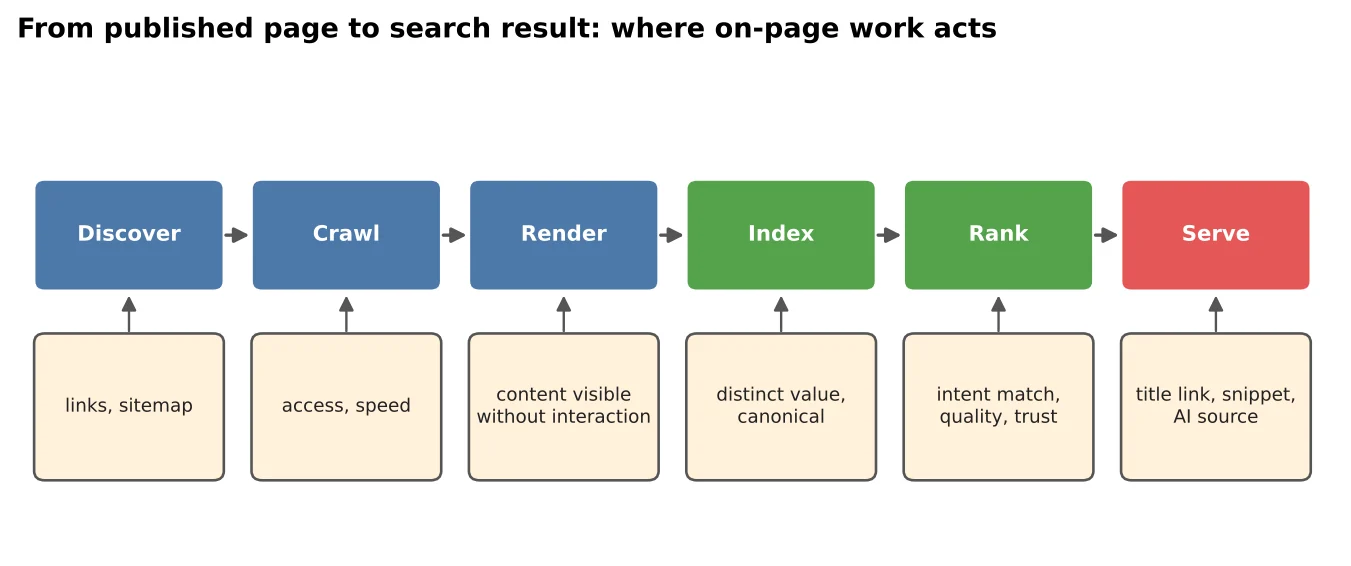
A page enters Google’s results by passing through stages. It is discovered through links or a sitemap, fetched by the crawler, rendered so that script-generated content is visible, parsed and analyzed, stored in the index, and then retrieved and ranked in response to queries. The on-page author influences each stage, though in different ways.
At the discovery and crawl stages, the author’s tools are links, sitemaps and access rules. A page that cannot be fetched cannot be assessed. At rendering, the question is whether the main content is available without requiring unusual user action. Content that appears only after interaction, or that is injected in ways the renderer cannot process, may be missed. At the indexing stage, Google analyzes the text, headings, images, structured data and language, and decides whether the page adds enough that is distinct to be stored. Pages that duplicate others or add little can be left out of the index. At the ranking stage, many systems operate at once, and the page’s content, links, context and the searcher’s situation all contribute.
For AI features, Google’s documentation states one technical gate: the page must be indexed and eligible to show in Search with a snippet. A page that has been blocked from snippets, or from indexing, is not eligible to serve as a supporting link. This is a rare case in which a technical statement is also a strategic one, because it means that over-aggressive snippet restrictions have a cost.
3.2 What the systems appear to evaluate
Google describes its ranking as the work of many automated systems, and it has named several: language-understanding systems, a helpful content system folded into the core in 2024, a reviews system, spam-prevention systems and others. The public descriptions suggest that the page is evaluated along several dimensions at once.
- Relevance: does the page’s meaning match the query’s meaning and intent?
- Quality and helpfulness: is the content original, complete and satisfying for a person?
- Trust and reputation: can the source be identified and trusted, and does it have a reputation outside its own claims?
- Experience: is the page usable, fast, stable and free of intrusive elements?
- Policy compliance: does the page avoid practices that Google’s spam policies prohibit?
These dimensions map to the three IES layers. Intent addresses relevance. Evidence addresses quality and trust. Structure addresses experience, comprehension by machines, and the legibility of the page to the systems that extract and summarize it. Policy compliance is a boundary condition on all three.
3.3 The lesson of the update history
The history of Google’s updates, treated in detail in the companion paper on that subject, yields four lessons for on-page work.
First, tactics aimed at a single signal have short lives. Keyword stuffing was addressed by the early named updates; thin affiliate content by Panda and later by the reviews and helpful content systems; manipulative linking by Penguin and SpamBrain. Second, the unit of evaluation widened from page to site to author and organization, so that the quality of the surrounding site matters. Third, the vocabulary of quality was published but the mechanism was not. Google released the rater guidelines in 2015 and questions for self-assessment in 2019 and 2022, but not signals or weights. Fourth, the interface changed faster than the ranking calendar. Featured snippets, knowledge panels and AI answers alter what users see without being logged as ranking updates.
An on-page strategy that respects these lessons will invest in what has persisted: a clear purpose, original substance, credible authorship, honest presentation, technical soundness and a page that is easy to use and to quote.
3.4 A note on keywords
Keywords remain useful, but their role has changed. They are evidence of how people describe a need, and they help an author choose vocabulary the audience recognizes. They are not a quantity to be matched. Language models can connect different expressions of the same idea, so the primary question is whether the page covers the topic and its likely follow-up questions in the language its audience uses. Repeating a phrase beyond natural usage is a risk, since keyword stuffing is listed among Google’s spam policies and degrades readability. A practical standard is to use the primary phrase where it fits naturally in the title, a main heading and the opening, then write for completeness, and let secondary terms arise from the subject.
4. Intent: Deciding What the Page Is For
4.1 Why intent comes first
A page can be well written and still fail because it answers a question nobody was asking, or answers it in a form that searchers do not want. Search intent is the goal behind a query. The information-retrieval tradition has long distinguished informational, navigational and transactional queries, and practitioners later subdivided these into more specific types. For the purposes of on-page work, the useful discovery is empirical: the results page already shows what kinds of content Google has learned to associate with the query.
4.2 A practical intent taxonomy
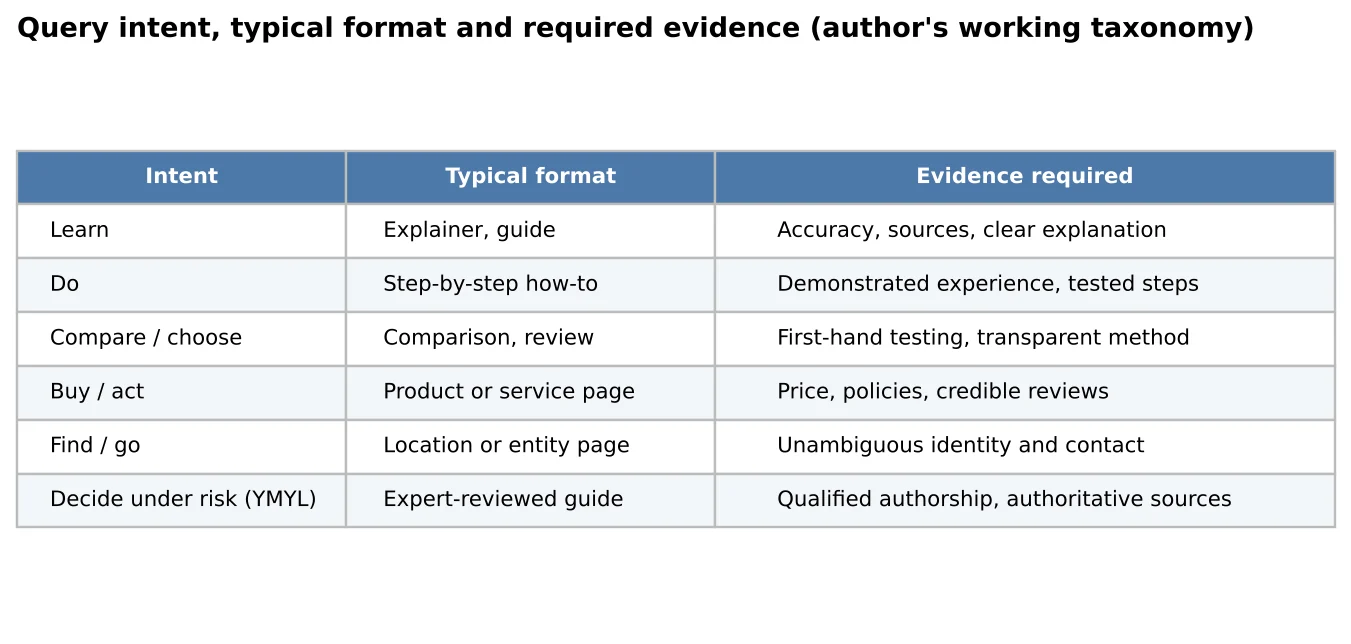
This paper uses six working intent types.
- Learn: the searcher wants to understand a concept. The page should define, explain, give examples and indicate limits. Evidence takes the form of accuracy, sourcing and clear explanation.
- Do: the searcher wants to complete a task. The page should give ordered steps, prerequisites, expected results and troubleshooting. Evidence is demonstrated experience that the steps work.
- Compare or choose: the searcher is weighing options. The page should state criteria, compare on them, disclose how the evaluation was made, and say who each option suits. Evidence is first-hand testing and transparent method, which the reviews system was built to reward.
- Buy or act: the searcher is ready to transact. The page should give price, availability, terms, trust signals and a clear action. Evidence includes policies, contact details and credible reviews.
- Find or go: the searcher wants a specific destination or place. The page should make identity, location, access and contact details unmistakable.
- Troubleshoot or decide under risk: the searcher is dealing with a problem that may affect health, money, legal standing or safety. These are the topics that the rater guidelines call Your Money or Your Life. The page needs the highest standard of accuracy, sourcing, authorship and review.
Most queries are mixed. A query such as “how to choose a standing desk” combines learning and comparison, and a good page covers both in a deliberate order.
4.3 Reading the results page as data
Before writing, the author should study the top results for the target query along four dimensions: the dominant format (guide, list, tool, product page, forum thread), the typical depth, the questions addressed, and the evidence offered (original images, data, named authors). The point is not to imitate the pages but to identify what a searcher evidently needs and where existing pages leave gaps. A gap may be missing first-hand evidence, missing recent information, an unanswered follow-up question, a missing comparison criterion, or an explanation pitched at the wrong level. The page that fills a genuine gap is the one with a reason to exist, and Google’s own guidance on helpful content asks authors to consider whether a page provides substantial value beyond other pages in the results.
4.4 The “non-commodity” test
Google’s guidance on generative features stresses valuable, unique, non-commodity content. A practical formulation for authors is a three-part test applied before drafting.
- Substitution test: if this page vanished, would a searcher lose anything that other pages provide equally well?
- Contribution test: what does this page contribute that is specific to its author (experience, data, method, perspective)?
- Reuse test: could a competent person produce the same page by summarizing the top five results? If yes, the page is commodity content and is at risk in a system that can synthesize such summaries itself.
A page that fails these tests may still be necessary on a commercial site, for example a basic definition. It should then be short, accurate and linked to the deeper original material, and not inflated.
4.5 Topic scope and the single-page promise
Each page should make one clear promise to the reader, expressed in its title and opening. The promise defines scope. A page that tries to rank for several unrelated intents tends to serve none of them well. Conversely, a promise can be broad if the page is organized into clearly labeled parts that correspond to the sub-questions a searcher is likely to have. Query fan-out in AI features illustrates this: a complex question is broken into subtopics, and a page that covers a subtopic in a clearly delineated passage is easier to use as a source than a page that blurs several topics together.
4.6 Keyword research as listening
Keyword tools estimate how often phrases are searched, and the volumes are approximations. The more valuable research activity is listening: reading the questions in forums and reviews, support tickets, sales conversations and the “People also ask” prompts. These sources reveal the vocabulary, worries and misconceptions of real people, which supply both the language and the evidence-worthy content. An author who works from real questions is also better placed to include genuine experience, which is hard to simulate.
5. Evidence: Building Trust into the Page
5.1 What E-E-A-T is and is not
E-E-A-T stands for Experience, Expertise, Authoritativeness and Trustworthiness. It appears in the Search Quality Rater Guidelines, where evaluators use it to assess pages, and Google has said that trust is the most important of the four, with the others contributing to it. The framework gained its extra “E” for Experience in December 2022. Google’s representatives have said that E-E-A-T is not a single ranking factor and has no score; its systems use a mix of signals that tend to correlate with the qualities the framework describes.
The consequence for authors is subtle. There is no tag or field that “adds E-E-A-T”. What an author can do is make the real qualities visible and verifiable, so that people and systems find the signals that reflect them. A page that has genuine expertise but conceals who wrote it and where the information came from gives readers little basis for trust. A page that displays credentials without substance misleads. The task is to align reality and presentation.
5.2 The Who, How and Why of a page
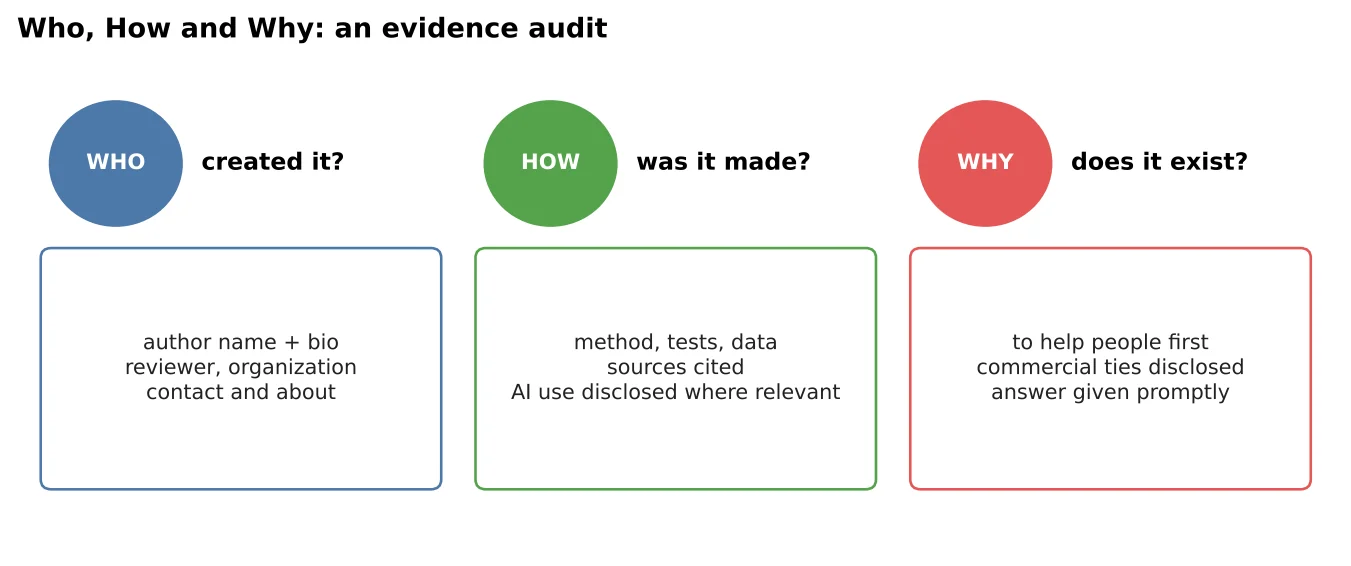
Google’s guidance on helpful content suggests that authors assess content through three questions: Who created it, How was it created, and Why was it created. The questions are not requirements, but they are a convenient structure for an evidence audit.
Who. Is it clear who produced the content? Readers should be able to find an author name, a short biography that explains why this person is qualified to write on the topic, and, where appropriate, a link to a fuller profile. For organizations, an about page, contact details and editorial policy serve the same function. Where a page is reviewed by a qualified person (for example a clinician reviewing health content), that fact and the reviewer’s identity should be stated.
How. Does the page explain how the content was produced where that matters? A product review should say what was tested, how, for how long and against which criteria. A data-based article should explain the data source and method. Where automation or AI assistance played a role, Google’s guidance suggests that disclosure is helpful when readers would reasonably expect to know how the content was produced, and the content must still meet the standards for helpfulness and the spam policies.
Why. Is the page’s purpose to help people? Content created primarily to attract search traffic, or to sell without informing, is the pattern the helpful content system and the spam policies address. The “why” is visible in the page: whether it answers the question promptly, whether commercial intent is disclosed, and whether the reader leaves informed.
5.3 Showing experience
The addition of Experience recognized that some content is valuable because the author has done the thing: used the product, visited the place, treated the condition, built the tool. The page can show experience in ways that are hard to counterfeit at scale:
- original photographs, screenshots or recordings that show the actual process or product;
- specific observations that only someone who did it would know, such as a failure mode, a surprise, a measurement;
- process documentation, for example a dated log of a test;
- named, accountable first-person statements, with the limits of the experience stated honestly.
Authors should resist the temptation to invent experience. Fabricated first-person claims are a trust failure and, in some domains, a legal and ethical one. If the author has not used the product, the honest framing is a research-based comparison that cites the sources it relies on, and not a pretended hands-on review.
5.4 Expertise and sourcing
Expertise is demonstrated by accuracy, depth and a sound handling of uncertainty. Four practices help.
Cite primary sources. When a claim depends on a study, regulation, specification or official documentation, link to the original and state what it says in the author’s own words. This allows readers to verify and signals care. The citation should be to the most authoritative available source, not to another summary.
Date the information. Pages on subjects that change, such as search guidance, tax rules or product specifications, should show when they were published and last reviewed, and the review should be genuine. Changing a date without changing content misleads readers and wastes the signal.
State limits and disagreements. An honest page says where evidence is weak, where experts disagree and where the advice does not apply. Overstated certainty is a trust risk.
Calibrate depth to the audience. Expertise is not jargon. A page that explains a difficult subject precisely in the audience’s language shows more command than one that displays terminology.
5.5 Authoritativeness and reputation beyond the page
Authoritativeness is the part of E-E-A-T that the page alone cannot supply, because it concerns recognition by others. On-page work can still prepare for it. A page can make it easy to find the author’s other work, affiliations and mentions; it can link to the organization’s credentials and independent profiles; it can use consistent names and descriptions so that the author or organization is recognizable as the same entity across the web. These measures do not create reputation, but they remove friction in recognizing the reputation that exists, and they are the on-page counterpart of the off-page work of earning mentions and citations.
5.6 Trust signals that are not decoration
Trust is conveyed through ordinary, concrete elements.
- Clear identification of the business or publisher, with contact information that works.
- Transparent policies on returns, privacy, advertising and corrections where relevant.
- Honest disclosure of commercial relationships, including affiliate links and sponsorship.
- A security baseline: HTTPS, no deceptive interstitials, no hidden or misleading elements.
- A correction practice: a way to report errors and a record of fixes.
- Moderation and quality control for user-generated content.
For high-risk topics, additional elements apply: a named qualified reviewer, citations to authoritative bodies, and explicit statements about when to consult a professional. The rater guidelines treat the lack of such elements on YMYL pages as a quality shortfall.
5.7 Counterfeit E-E-A-T
Because E-E-A-T became a popular topic, a cargo-cult version of it spread: invented author personas, stock-photo headshots, boilerplate “reviewed by” lines with no actual review, fake awards, and hundreds of near-identical author pages. Such practices conflict with the premise of the framework. They are also risky. Google’s spam policies prohibit deceptive practices, and the 2024 policies address scaled content and the exploitation of a site’s reputation. A page that displays an expert’s name without the expert’s involvement may mislead readers on a topic in which misleading them has consequences. The standard to apply is the reverse test: if a reader checked every claim of identity and process on the page, would each claim hold?
6. Structure I: Title Links, Headings, Snippets and the Opening
6.1 The title element and the title link
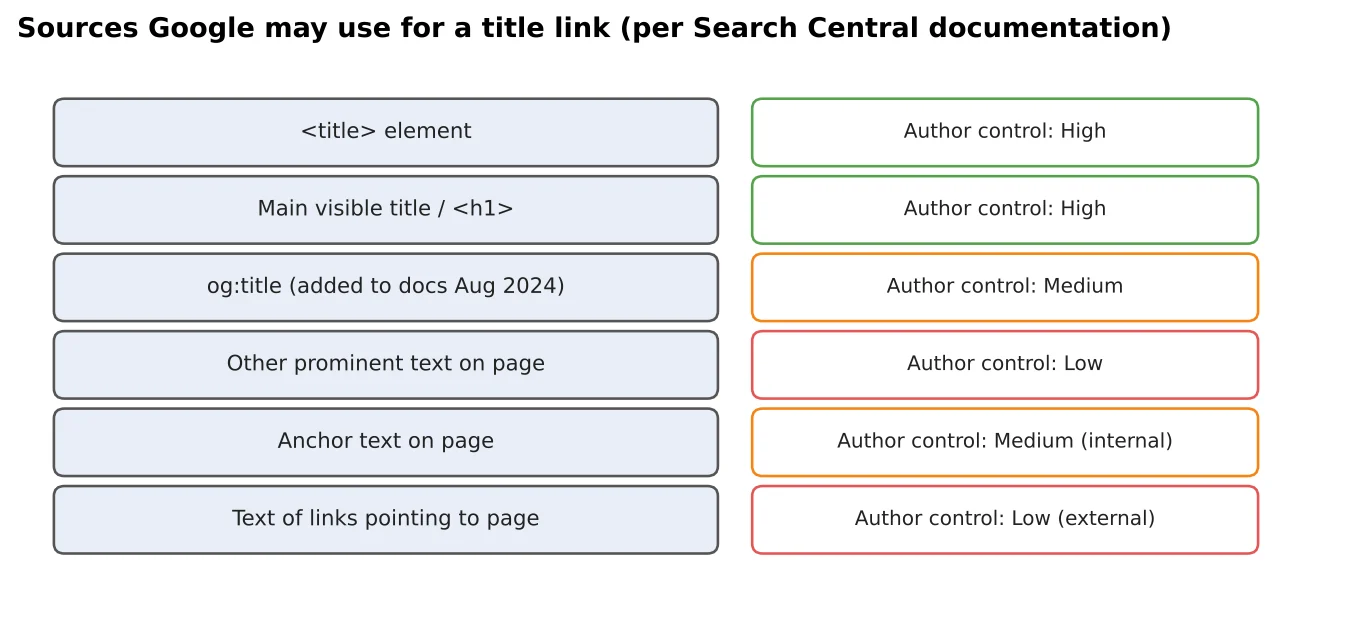
Google calls the clickable title of a search result a title link. Its documentation explains that the system builds title links automatically from several sources: the content of the page’s title element, the main visible title or headline, heading elements such as the first-level heading, and, since an August 2024 documentation update, the Open Graph title tag. Other prominent text, anchor text on the page and text in links pointing to the page can also contribute. Google has said that it cannot hand-edit the title link of an individual site, and that it generally replaces the title element only when the element has a problem, such as being missing, empty, stuffed with keywords, repeated across pages or not describing the page.
Three practical rules follow.
Make the title element describe the page. It should state what the page is about in specific, natural language. A title that is faithful to the page and distinctive within the site gives Google little reason to rewrite it.
Make the main title obvious. The page’s visible headline, normally the first-level heading, should agree with the title element in meaning. Google’s guidance clarifies the instruction as making it clear which text is the main title of the page. When the title element and the headline disagree, the system has to choose, and the author loses control.
Keep length within what displays. Google gives no character limit; titles are truncated to fit the available space, which varies by device. A common working range is to keep the essential words within roughly fifty to sixty characters, or about six hundred pixels, so that the meaningful part survives truncation. This is a practical convention drawn from display behavior, not a Google rule. Longer titles are not penalized as such, but the end of a long title may not be seen.
Beyond these rules, the title is also the first promise to the reader. A title that overpromises produces clicks and then immediate exits, which defeats its purpose even if it does not cause a direct ranking penalty. The standard is accuracy with specificity: state the topic, and where it helps, the type of content or the distinguishing feature, such as a year for time-sensitive material, “checklist”, “comparison” or “step by step”.
6.2 Meta descriptions and snippets
Google’s snippet documentation says that the snippet is generated primarily from the page’s content, chosen to be relevant to the query, and that the meta description element is used when Google judges it to describe the page more accurately than text taken from the page. Google states that there is no length limit for the meta description, but that snippets are truncated as needed for the device. A clarification published in documentation updates made it explicit that structured data and the meta description are not the primary source of snippets; an earlier wording had implied the contrary.
This has three consequences.
First, the meta description is a proposal. It is useful because on some queries it will be used and because it forces the author to state the page’s value concisely. A working length of roughly one hundred twenty to one hundred fifty-five characters keeps the useful part visible on most displays. It should be a faithful summary, written for the reader, with the page’s distinctive contribution stated plainly.
Second, the first lines of the page matter more than many authors assume. Because the snippet is usually drawn from content, the opening paragraph and the answer-bearing sentences under each heading are the text most likely to be shown. Authors can therefore improve snippets by writing clear, self-contained answers early, instead of by tuning the tag alone.
Third, different queries produce different snippets. A page may show different excerpts for different searches. An author who wants control over the displayed text for a specific purpose can use the documented controls, such as nosnippet, data-nosnippet and max-snippet, but these controls restrict how content can be shown and, as noted in Section 3, restricting snippets can reduce eligibility to appear in some features. Their use should be deliberate.
6.3 The heading architecture
Headings divide a page into labeled parts. They serve readers who scan, assistive technology that navigates by heading, and search systems that use headings as cues to the structure and subject of passages. A sound heading architecture has four properties.
- One main heading that names the page’s subject, matching the title in meaning.
- Hierarchical order, with second-level headings for major parts and third-level headings for subparts, without skipping levels for visual effect.
- Descriptive text that tells a reader what the part contains, preferably phrased as the topic, question or task it covers. A heading such as “Costs” is weaker than “What the repair costs and what changes the price”.
- Parallel construction among siblings, so that the page reads as a coherent outline.
Headings should not be used for styling, and keywords should not be added to them unnaturally. The test is whether a reader could understand the page’s shape from the headings alone. A useful exercise is to extract the outline and read it. If it reads as a clear argument or a complete procedure, the structure is sound. If it reads as a list of keyword variations, the page is organized around search engines and not around the reader.
6.4 The opening: answer first, then context
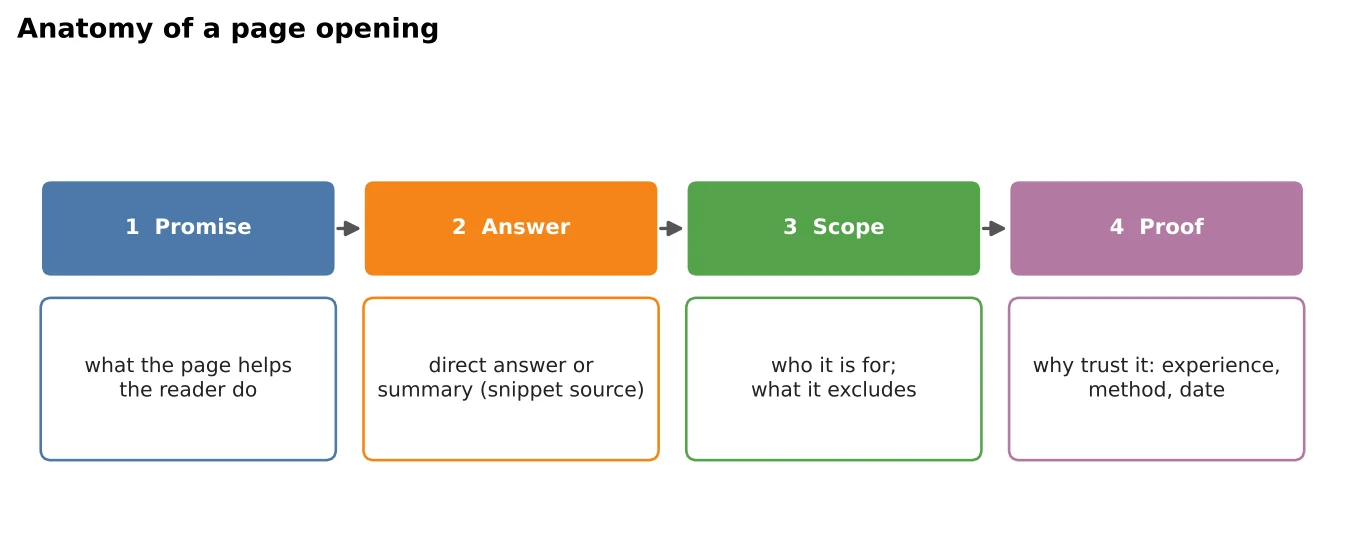
The opening of a page does several jobs at once. It confirms to the reader that they are in the right place, gives the core answer or the path to it, establishes scope, and signals credibility. A four-part opening serves these jobs.
- Promise: one sentence stating what the page will help the reader do or understand.
- Answer or summary: the direct answer to the main question, in a few sentences, which is also the most likely source of a snippet or an extracted answer.
- Scope: what the page covers and for whom, including what it does not cover.
- Proof: a brief indication of why the reader can trust this page, such as the author’s experience, the method or the date of the information.
This pattern avoids two common failures: the long preamble that delays the answer, and the bare answer that gives no reason to trust it. It also suits readers who skim, since the page is useful even if the first screen is all that is read.
6.5 Writing for passage-level retrieval
Google announced passage ranking in 2020 and has described systems that can understand individual passages of a page. Query fan-out in AI features retrieves information for sub-questions, which means a page is often used at the level of a section. Authors can support this by making each section self-contained: a heading that states the subtopic, an opening sentence that answers it, and then the support. A section that depends on unstated context from three screens earlier is harder to use as an excerpt. The aim is not to write in fragments but to ensure that each part can stand on its own when quoted.
7. Structure II: Semantics, Entities, Internal Links and URLs
7.1 Semantic completeness
Semantic completeness means that the page addresses the subject as a competent expert would, including the concepts, terms, distinctions and follow-up questions that belong to it. It is not the same as length. A short page may be semantically complete for a narrow question, and a long page may be thin if it repeats a few ideas. Authors can check completeness by listing the questions a knowledgeable reader would expect to be answered, and then confirming that each is addressed or deliberately placed on another page. Sources for the list include the top results, forum and support questions, and the author’s own client conversations.
The use of related terms should come from the subject and not from a tool’s list of “NLP keywords”. Tools that suggest terms can be useful for noticing omissions, but inserting terms mechanically produces text that reads badly and adds nothing. The test is editorial: does each term appear because the explanation needs it?
7.2 Entities and disambiguation
Google’s Knowledge Graph, introduced in 2012, represents entities such as people, organizations, places and concepts and their relationships. For on-page work, the implication is that clarity about which thing a page discusses helps. Where a name is ambiguous, the page should provide context that disambiguates it: the full name on first mention, the category, the location, the relationship to other known entities. For a business page, consistency of the name, address and description across the site and its profiles helps systems recognize that references point to the same entity.
7.3 Internal links as editorial structure
Internal links connect pages within a site. They help crawlers discover pages, help readers navigate, and communicate the relationships among topics. Their text, called anchor text, gives an indication of what the target page is about. Google’s documentation recommends descriptive link text, and its systems use anchor text as one of several signals about the target.
Good internal linking follows editorial logic. A page links to material that helps the reader at the point of need: a definition, a deeper treatment, a related task, a next step. Links are placed in the body where they are relevant, not only in navigation and footers. The anchor text says what the reader will find. Important pages receive links from related pages, and pages that matter to the reader are reachable in a small number of steps from the main navigation. Pages that nothing links to, so-called orphans, are harder to discover and are signals that the site’s structure has a gap.
Two cautions apply. Excessive exact-match anchors repeated mechanically across many pages look manipulative and read poorly. And link equity, the idea that links pass value, should be thought of as a metaphor and not as a budget to be engineered; the better practice is to link where it helps the reader and to let that structure reflect the site’s priorities.
7.4 Topic clusters and hub pages
A common organizing model is the topic cluster: a comprehensive hub page on a broad subject that links to detailed pages on its subtopics, which link back to the hub and to each other where relevant. The model has value because it mirrors how readers move from overview to detail and because it makes the site’s expertise on a subject visible and navigable. It becomes harmful when pursued mechanically, by creating many thin pages to fill a template. The helpful content system and the 2024 scaled content abuse policy target exactly that pattern. A cluster should be built from pages that each deserve to exist, and the hub should add synthesis and not only a list of links.
7.5 URLs
URLs should be readable, stable and descriptive. A short URL that reflects the page’s subject helps readers and is used by Google as a minor contextual cue. Practical rules include using lowercase words separated by hyphens, avoiding unnecessary parameters and session identifiers, keeping a consistent structure, and not changing URLs without a permanent redirect. When pages move, the redirect should point to the closest equivalent, and internal links should be updated to the new address. The URL is the least powerful of the on-page elements, and the most frequent errors involve instability, not wording.
7.6 Canonicalization and duplication
When the same or very similar content is reachable at several URLs, Google chooses a canonical version for indexing. The author can signal the preferred version with a canonical link element, redirects and consistent internal linking. Duplicate content is not in itself a penalty in most cases, but it dilutes signals and can lead to the wrong version being shown. More important for on-page strategy is internal near-duplication: several pages that address the same intent with slightly different wording. These compete with each other and, at scale, can signal thin content. The remedy is to consolidate such pages into one stronger page, with redirects from the others.
8. Structure III: Structured Data
8.1 What structured data does
Structured data is machine-readable markup, most commonly in the JSON-LD format using the Schema.org vocabulary, that labels the entities and attributes on a page. Google uses it to understand page content and to make a page eligible for certain enhanced displays, called rich results. Google’s general guidelines state that valid markup does not guarantee a rich result, that the markup must reflect the content visible to users, and that it must not be used to mislead. Violations can result in a manual action that removes rich result eligibility. According to Google’s documentation, a manual action for structured data removes eligibility for rich results but does not affect how the page ranks in ordinary web results.
8.2 A landscape that changed
The usefulness of structured data has been affected by repeated changes in what Google displays. Several types were restricted or removed over the years: in 2023 the visibility of FAQ and HowTo rich results was sharply reduced, in 2025 Google announced the removal of several lesser-used types, and, as of 7 May 2026, FAQ rich results no longer appear in Google Search, with the corresponding Search Console report ending in June 2026. Trade reports note that this sequence is consistent with a policy of simplifying the results page, in a period when AI features occupy more of it.
Three lessons follow for authors.
First, do not build strategy on a rich result that Google can retire. Markup should be justified by the value of describing the content accurately, and any rich result is a bonus. Second, retain markup that describes real, visible content, since correct markup remains harmless and may help machine understanding, but do not expect a display effect for types that are no longer supported. Third, audit old advice. Many guides still recommend FAQ and HowTo markup as a route to enhanced listings. Such advice is obsolete for display purposes, and teams that run automated checks for retired types should update them.
8.3 Types that remain useful
The most broadly applicable types for content sites and businesses include the following, subject to the current feature documentation.
- Article or BlogPosting: identifies the headline, author, publication and modification dates, and images. Its value is mainly in clarifying authorship and dates, which supports the Who part of the evidence audit.
- Organization and LocalBusiness: identifies the entity, its name, logo, contact points and profiles, supporting entity recognition.
- Person: identifies authors and links them to their profiles.
- Breadcrumb: describes the page’s position in the site and can influence how the path is displayed.
- Product, Offer and Review snippets: for commerce, supporting displays of price, availability and ratings, subject to strict content policies. Google’s review snippet guidelines, updated in 2026 as reported in the trade press, address undisclosed incentivized reviews and warn that violations may lead to manual action.
- Video and image metadata: where relevant, to support discovery in those formats.
The decision should rest on the content: mark up what the page really contains, in the required format, with the required properties, and test with the available validation tools. Because structured-data quality guidelines are not fully testable by tools, human review matters.
8.4 Structured data and AI features
A recurring claim in the industry is that schema markup improves inclusion in AI-generated answers. Google’s documentation on AI features states that no new machine-readable files, AI-specific text files or special markup are needed to appear in those features. The reasonable reading is that structured data is a tool for rich results eligibility and for clarifying content to machines, and that no public evidence from Google shows that it affects AI inclusion. Authors should adopt markup for the reasons it is documented to serve and treat claims of AI-citation benefits as unproven.
8.5 Implementation discipline
Structured data fails more often through carelessness than through ignorance. Common faults are markup that describes content absent from the page, outdated prices or availability, reviews marked up for the business’s own self-written testimonials, duplicate or conflicting markup from plugins, and required properties missing. A disciplined approach generates markup from the same data that produces the visible page, so that the two cannot diverge, and includes the markup in the review process when content is updated.
9. Structure IV: Media, Page Experience and Accessibility
9.1 Images and video as content
Images and video are part of the page’s content, and Google’s documentation treats them as sources of discovery in their own right. For authors, five practices matter.
- Use original, relevant media where it adds evidence or clarity, such as real photographs of the product or process, diagrams that explain, and screenshots that show steps. Original media is one of the clearest on-page signals of experience.
- Write useful alternative text that describes the image’s content and function for people who cannot see it. Alternative text is an accessibility feature first; its value for image understanding follows from describing the image accurately and not from stuffing keywords.
- Choose descriptive file names and place images near the text they illustrate.
- Optimize delivery: modern formats, appropriate dimensions and responsive sizes, so that images do not harm loading performance.
- Provide captions or surrounding text that explain what the media shows, since context helps both readers and systems.
Video benefits from transcripts or summaries on the page and from markup where eligible. Google’s guidance on generative features notes that these features can surface images and video, widening the opportunities for a page to appear.
9.2 Page experience and Core Web Vitals
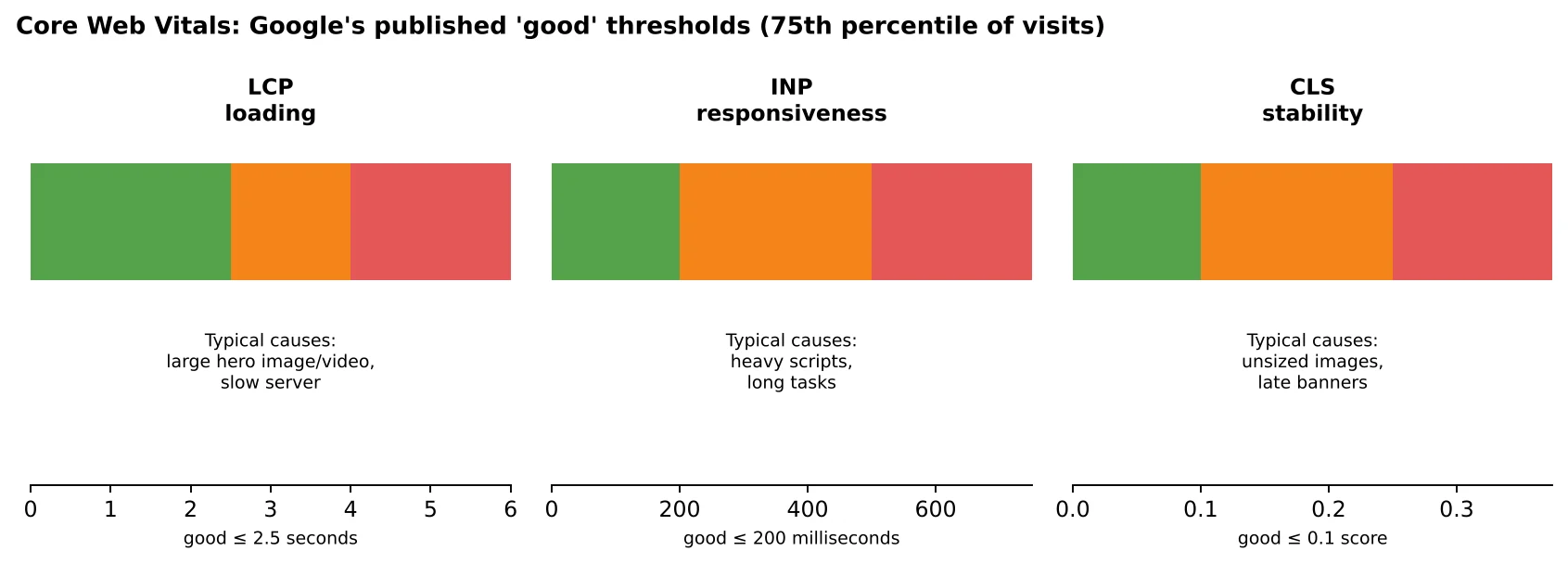
Google’s page experience framework combines a set of signals about how a page feels to use. Its Core Web Vitals measure loading (Largest Contentful Paint), responsiveness (Interaction to Next Paint, which replaced First Input Delay in March 2024) and visual stability (Cumulative Layout Shift). Google’s published thresholds for a good experience are an LCP of 2.5 seconds or less, an INP of 200 milliseconds or less and a CLS of 0.1 or less, assessed at the 75th percentile of real-user visits. Google has said that page experience is one signal among many and that content relevance remains primary, and that great content can rank well despite a poor page experience.
The on-page author influences these metrics through decisions that are often made at the design and template level: the size and format of the largest element, whether it is prioritized in loading, how much script runs before the page responds, whether space is reserved for images, advertisements and embeds so that content does not shift, and whether fonts load without disruptive changes. A heavy hero video, an unsized image, a late-loading banner or an aggressive third-party script is a typical cause of failure. The sensible approach is to measure with real-user data (for example the Chrome User Experience Report and Search Console’s Core Web Vitals report) and to fix the most common causes on the templates that serve the most pages, rather than tuning single pages.
9.3 Mobile presentation
Since mobile-first indexing, Google primarily uses the mobile version of a page for indexing and ranking. The mobile version should therefore contain the same primary content, headings, structured data and links as the desktop version. Common faults include content hidden or removed on mobile, lazy-loaded content that never loads without interaction, tap targets too close together and text too small to read. Responsive design that serves one set of content to all devices avoids most of these issues.
9.4 Intrusive elements and clarity of purpose
Google has treated intrusive interstitials as a negative experience since its 2017 signal, and its spam and quality guidance addresses deceptive layouts and excessive advertising. Pages that bury the main content under pop-ups, place advertisements where they are easily mistaken for content, or require sign-up before any value is shown are at risk of both poor user reactions and weaker assessment. Legitimate consent notices and age-gates required by law are different; they should be implemented to interfere as little as possible with access to the content.
9.5 Accessibility as an on-page quality signal
Accessibility is a matter of respect for readers and, in many places, a legal duty. It also overlaps with SEO. Semantic headings, descriptive link text, alternative text, adequate color contrast, keyboard operability and clear form labels improve usability for all readers and give machines a cleaner reading of the page. Google has not said that accessibility is a direct ranking factor. It is, however, a reliable indicator of care, and many accessibility fixes coincide with the structural recommendations of this section.
10. Writing for AI-Mediated Search Without Writing for Machines
10.1 What Google says
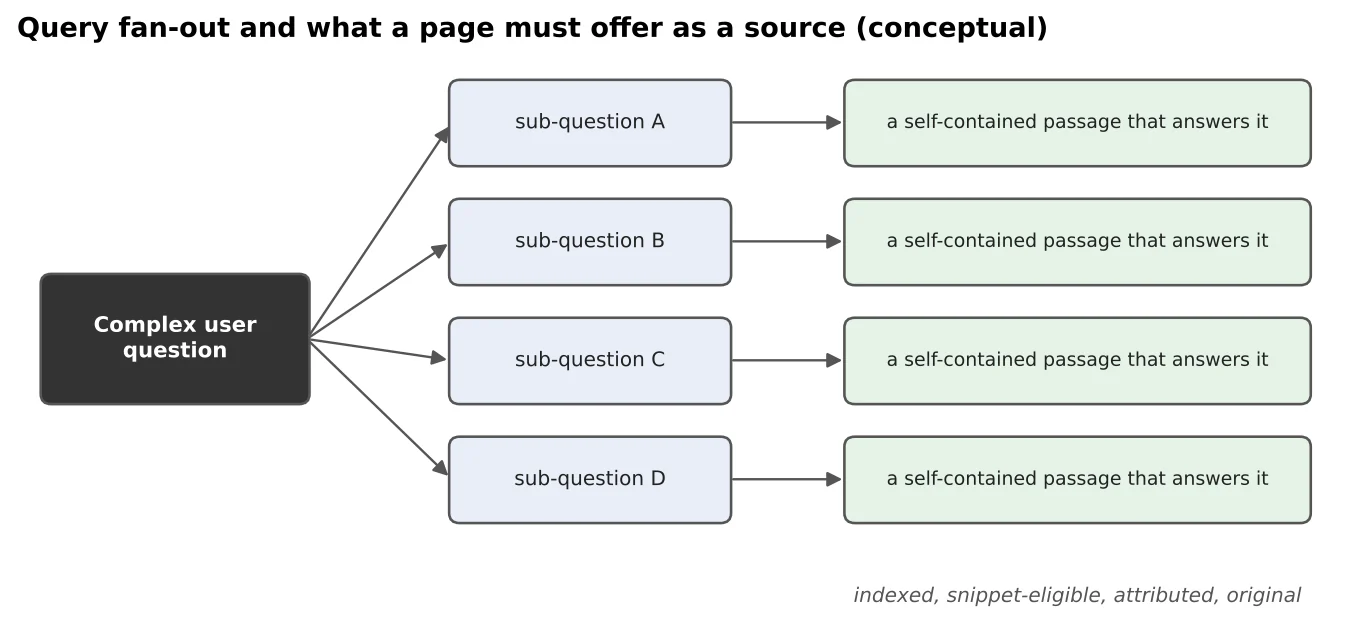
Google’s documentation on AI features describes AI Overviews and AI Mode as experiences that may use query fan-out, issuing related searches across subtopics and data sources to develop a response, and it notes that the two features may use different models and techniques, so the links they show can differ. It states that AI Overviews appear only when the system judges them additive to classic Search. It also states that sites appearing in these features are counted within the overall search traffic reported in Search Console, and, as reported in the trade press, that a dedicated report for generative AI performance has since been added, although the scope of that report should be checked in Google’s current documentation. Google further says that clicks from results pages with AI Overviews tend to be of higher quality, a company claim that third parties have contested and that the evidence reviewed here cannot settle.
The consolidated guide of May 2026, as described by trade sources, adds three themes: provide valuable, unique, non-commodity content; meet technical requirements and keep pages eligible for snippets; and attend to images, video and business profiles that the features can draw upon. It does not offer a mechanism to control participation in AI features separately from classic Search, beyond existing controls such as noindex and snippet directives.
10.2 An honest reading
Two readings of this guidance are tempting, and both are wrong. The first is that nothing has changed, so AI search needs no attention. The second is that a new set of hidden tricks governs AI inclusion. The documented position lies between them. The foundations are the same: indexed, snippet-eligible pages with helpful, original, trustworthy content. The consequences differ: a page can now influence a user without being visited, a sub-question may be answered from a passage in the middle of a page, and commodity summaries can be produced by the system itself, which lowers the value of generic content.
For authors the sensible response is to improve the qualities that make a page worth citing, and to avoid theater. Practices promoted as “generative engine optimization” include writing in a question-and-answer rhythm, adding summaries, using lists and tables, presenting data with sources and building recognizable authorship. Most of these are ordinary good editing and are consistent with Google’s guidance. Others, such as inserting hidden text for crawlers, writing in unnatural phrasing in the hope of being quoted, or creating many near-identical pages for each variant of a question, fall under existing spam policies. No public independent evidence shows that any specific formatting trick raises the probability of inclusion, and the paper recommends that authors test claims against their own data before building on them.
10.3 Making a page citable
A page is useful as a source when a system, or a person who reads an excerpt, can extract a correct and complete answer to a sub-question, and can see who stands behind it. Several editorial practices serve this without distorting the writing.
- Answer-bearing sentences. Under each heading, state the answer to the heading’s question in the first sentence or two, then expand. Avoid burying key facts in long paragraphs.
- Precise claims with attribution. Make statements specific and say where they come from, which also protects the page when excerpted.
- Self-contained passages. Use the full name of the subject at the start of a section instead of pronouns that depend on earlier text.
- Tables for comparison, lists for sequences. Use the form that matches the content, and keep a table’s headings meaningful.
- Definitions of terms. A clear definition at the point of first use helps readers and is the kind of passage that is often extracted.
- Dates and versions. State the date of facts that change and keep them current.
- Original data and examples. Content that exists only on your page, such as your own measurements or case material, cannot be reproduced from elsewhere, and is the clearest form of non-commodity value.
10.4 Preserving the reason to click
If a system can answer a simple question from your page without a visit, the page’s business value must come from what a visit offers beyond the excerpt: depth, tools, context, community, a transaction, or a trusted relationship. Authors should consider, for each page, what a reader who has seen only the excerpt would still need, and make that need visible: the calculation, the template, the full comparison, the demonstration, the next step. Google’s own guidance encourages site owners to look beyond clicks to outcomes such as signups and sales, in line with this approach. The strategic implication is that pages designed only to harvest simple informational queries are the most exposed, while pages that combine a clear answer with something worth visiting for are the most defensible.
10.5 Controls and their costs
The documented controls for how content appears, including nosnippet, data-nosnippet, max-snippet and noindex, let a site owner limit use of its content in features. They carry costs: a page restricted from snippets is not eligible to appear as a supporting link in AI features, and a restricted page loses visibility in classic results formats as well. Authors and publishers must weigh the value of control against the value of visibility, page by page, and revisit the decision as the policy and licensing environment evolves.
11. Measurement, Experimentation and the Realism of Timelines
11.1 What “ranking first” depends on
The request that appears most often in client work is to reach the first position within a stated number of days. The evidence in this paper explains why no responsible practitioner can promise this. Position depends on many factors outside the page: the strength and reputation of the whole site, the links and mentions it has earned, the competition for the query, the searcher’s location and history, the query’s intent and the layout of the results page, and the state of Google’s systems on that day. On-page work affects the page’s eligibility and quality, the part the author controls. It cannot by itself overcome large gaps in the others.
11.2 The stages and their time scales
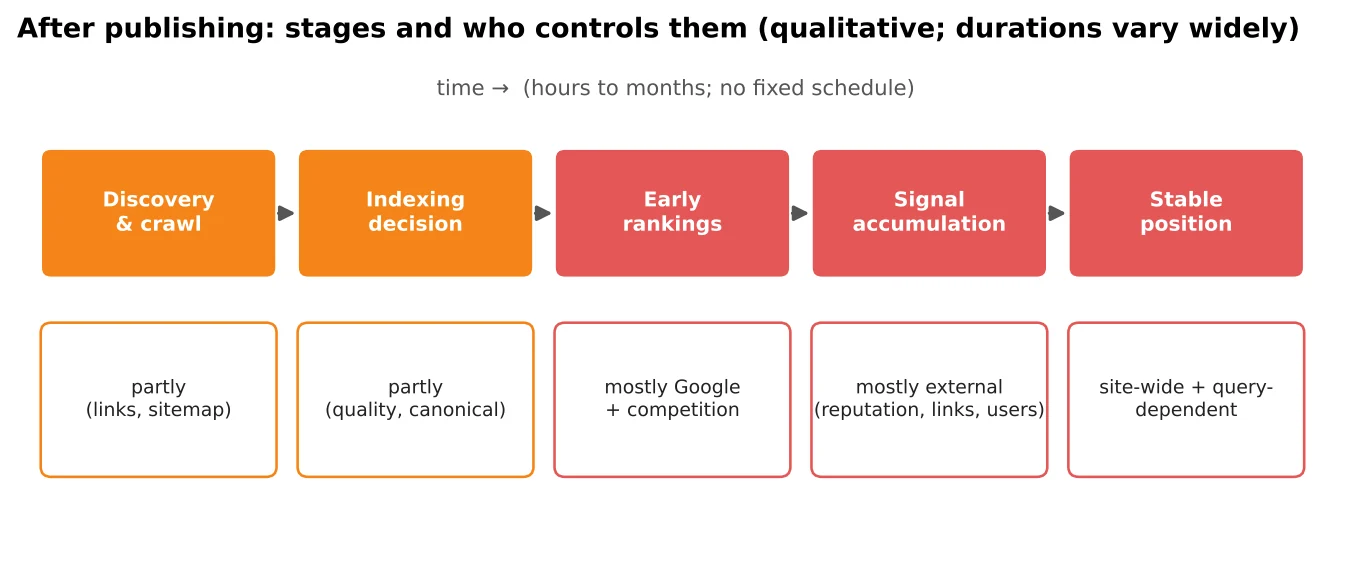
After a page is published, several stages occur, each with variable and uncertain duration. Discovery and crawling can take from hours to weeks depending on the site’s crawl demand, internal links, sitemaps and server responsiveness. Indexing is not guaranteed; Google may decline to index a page it judges to add little. Once indexed, a new page often shows volatile positions as the systems gather signals about it, and its ranking can change as user behavior and competitor pages change. Google’s own guidance on core updates emphasizes that improvements may take time to be reflected, and quality classifiers have historically reassessed sites over periods of months. The figure shows these stages as a qualitative sequence and not as measured durations, because durations differ enormously among sites.
A new page on a strong, trusted, frequently crawled site, targeting a low-competition query, can appear in results within days and can reach high positions quickly. A new page on a new or weak site, targeting a competitive query against established publishers, may take months, or may not reach the top at all without off-page support. Claims of guaranteed rapid results should be treated as a warning sign about the claimant’s methods.
11.3 What can be influenced within days
Within a short window, the author can achieve the following:
- ensure the page is crawlable, indexable and canonical, and submit it for inspection through Search Console;
- link to it from relevant, well-crawled pages on the site and include it in the sitemap;
- make the page meet the quality and structure standards of this paper;
- verify rendering, mobile presentation and Core Web Vitals;
- check that the title link, snippet and structured data display as intended.
These steps remove avoidable obstacles. They do not guarantee position, but they ensure that the page is judged on its merits.
11.4 Metrics that matter
Measurement should reflect outcomes and not vanity. The primary tools are Search Console and analytics. Useful measures include:
- Impressions and average position for the target queries, interpreted over a window of weeks and segmented by device and country.
- Click-through rate against the position, which tests the title link and snippet.
- Engagement and conversion measures, such as scroll depth, time on page, task completion and sign-ups, interpreted cautiously because they depend on the page type.
- Indexing status and any manual-action or security notices.
- Referral from other sources, including mentions in AI features where the reporting allows.
Position should be read as a distribution and not a single number, since personalization and location produce variation. A one-day check of the “rank” on a single device is a poor measure.
11.5 Experiments and their limits
Because on-page changes have noisy effects, the best evidence of what works comes from disciplined testing. Page-level experiments that vary one element, such as the title, across comparable pages and measure click-through over matched periods, can give useful evidence for the site in question. Site-level changes are harder to test, and before-and-after comparisons are vulnerable to seasonality, competitor changes and updates in Google’s systems. Authors should log each change with its date, compare with similar unchanged pages, and avoid concluding from a single week of data. The principle from the update history applies: any statement of the form “factor X caused ranking Y” should be treated as a hypothesis unless it is supported by a controlled comparison.
11.6 Plagiarism, originality and what can be verified
A question often put alongside ranking claims is whether content is “100% unique”. Two meanings must be separated. Textual originality means that the wording is not copied from other sources. It can be approached by writing from understanding, in the author’s own words, with attributed paraphrase of sources and no reproduction of passages, and it can be checked with similarity-detection tools, though such tools report overlap percentages and are not proof of originality. Substantive originality means that the page contributes something not available elsewhere: its own data, experience, analysis, examples or synthesis. This second kind is what Google’s guidance on helpful content and on non-commodity content is concerned with, and it cannot be certified by a tool. A page can pass a similarity check and still be commodity content, and a page that quotes a standard definition may still be valuable if it adds original analysis. A responsible workflow therefore combines original drafting, attributed sourcing, an overlap scan with a recognized tool, and an editorial judgment of what the page adds.
12. Anti-Patterns and the Boundaries of Spam Policy
12.1 A map from practice to policy
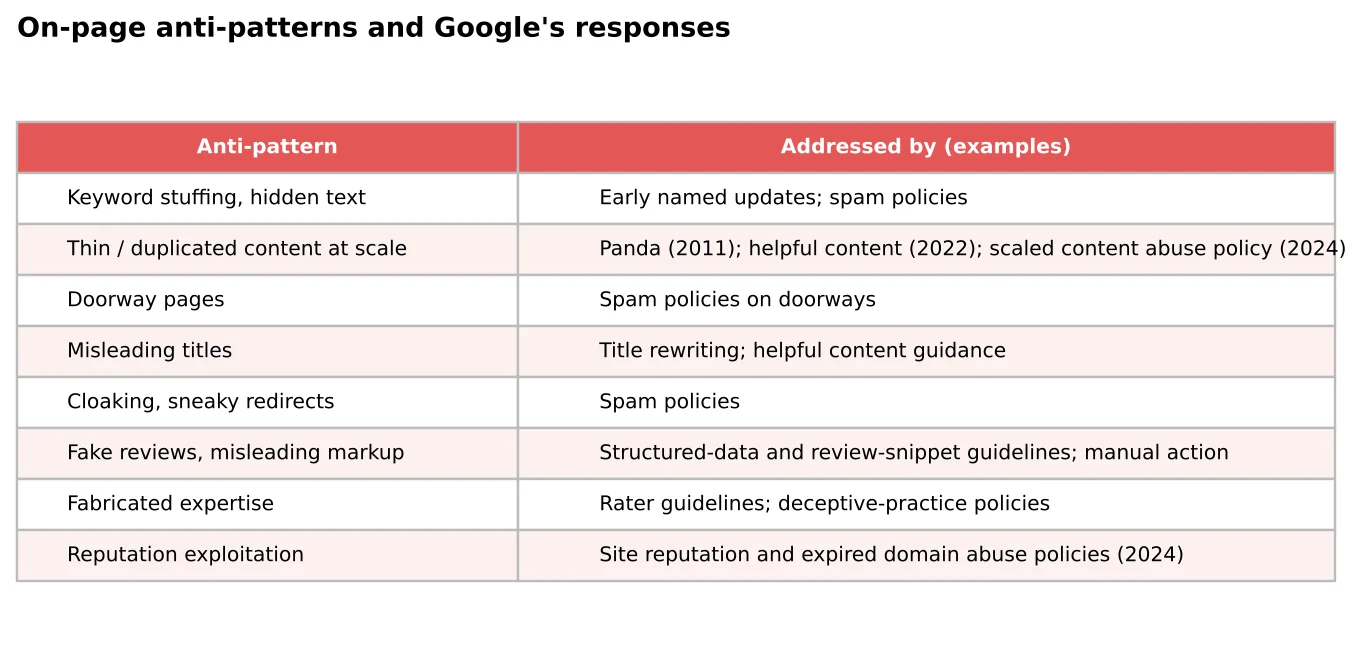
Google’s spam policies define practices that can lead to demotion or removal from results. Many on-page practices fall within them, and the history of updates shows a consistent pattern: practices that offered a quick advantage were later addressed by a named update or policy. The following list maps frequent anti-patterns to the relevant responses.
Keyword stuffing and hidden text. Repeating terms unnaturally or hiding text from users were addressed in the earliest named updates and remain prohibited. The remedy is natural writing and visible content only.
Thin or duplicated content at scale. Pages produced in volume with little original value, including spun and scraped material, were targeted by Panda and later by the helpful content system and the scaled content abuse policy of 2024. The remedy is fewer, better pages, with consolidation or removal of weak ones.
Doorway pages. Many near-identical pages targeting variations of a query, such as city names, that funnel users to the same destination, are prohibited. Where location pages are legitimate, each must provide distinct, real value for that location.
Misleading titles and clickbait. Titles that do not reflect the content cause rewriting and reader distrust. The remedy is accuracy.
Cloaking and sneaky redirects. Showing search engines different content from users is prohibited. The remedy is to serve the same content to both.
Manipulative structured data. Markup that describes content not on the page, or fabricated reviews, can lead to a manual action. The remedy is truthful markup generated from the visible content.
Fabricated expertise. Invented authors, false credentials and fake reviews undermine trust and may violate policies on deceptive practices. The remedy is real authorship and honest presentation.
Expired-domain and reputation exploitation. Using a domain’s or a site’s reputation to host unrelated low-value content is addressed by the 2024 policies on expired domain abuse and site reputation abuse.
Intrusive advertising and interstitials. Layouts that obstruct the content are addressed by page experience signals and quality assessment.
12.2 Gray areas
Some practices are not clearly prohibited but are risky because their value to readers is doubtful. AI-assisted drafting is permitted in principle, provided that the content is helpful and original and does not breach the spam policies. The risk lies in producing large volumes of unedited material. Programmatic pages built from structured data can be useful, for example a directory of real businesses with real information, but become spam if they merely recombine templates around keywords. The distinguishing question, which Google’s guidance repeatedly poses, is whether the page exists primarily to help people or primarily to capture search traffic.
12.3 A note on “SEO text”
The practice of adding a block of keyword-oriented text at the bottom of a page, written for search engines and not for readers, is a legacy habit. It adds length without value, and under a system that evaluates helpfulness it is more likely to hurt than help. The better practice is to place any useful information, such as a short explainer or a set of common questions, where a reader would look for it and to write it as real content.
13. An Implementation Protocol
13.1 The protocol
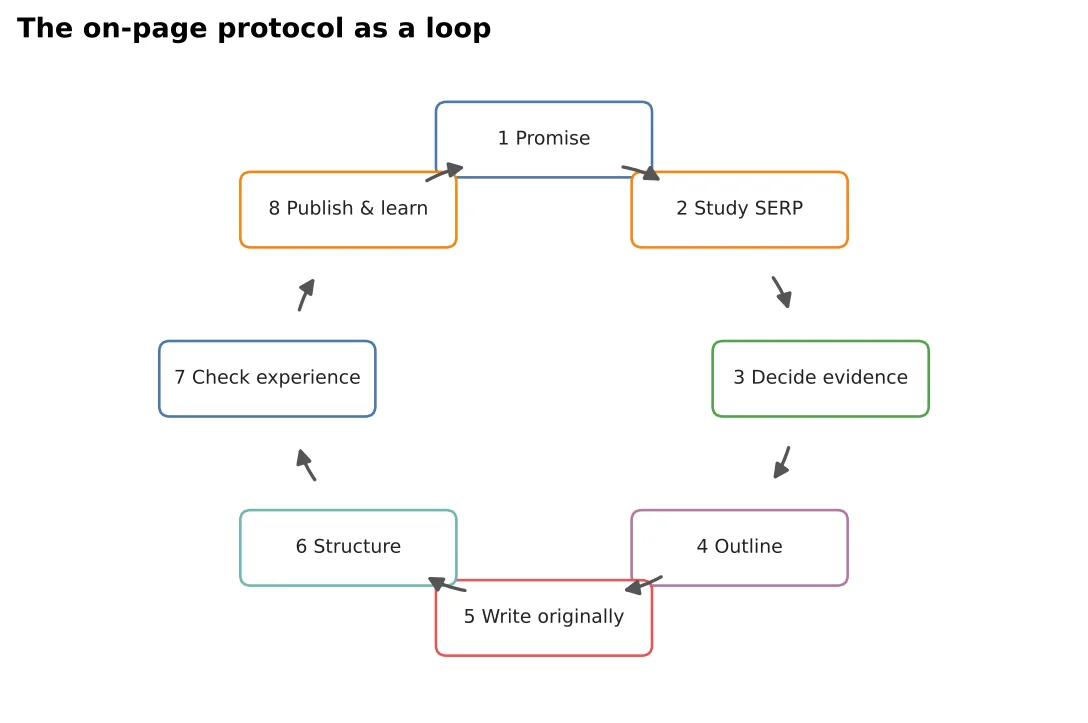
The framework of the paper can be applied as an eight-step protocol. It is offered as a method for disciplined work and not as a guarantee.
- Define the promise. State in one sentence what the page helps a reader do or understand, for whom.
- Study the results. Examine the top results for the target query: format, depth, questions answered, evidence offered. Identify the gap the page will fill.
- Decide the evidence. List what original material the page will contain: first-hand experience, data, method, expert input, primary sources.
- Outline from questions. Build the heading outline from the reader’s questions in a sensible order. Place the direct answer first.
- Write originally. Draft in your own words, from understanding, attributing sources and avoiding reproduction. Add real examples. Disclose commercial relationships and the method where relevant.
- Structure the page. Write the title and headline to agree; add the meta description; set the heading hierarchy; add descriptive internal links; include relevant, truthful structured data; add original media with alternative text.
- Check the experience. Test rendering, mobile layout and Core Web Vitals; check that nothing obstructs the content.
- Publish, inspect and learn. Ensure the page is indexable; link to it from relevant pages; submit for inspection; log the change; review Search Console data over weeks and revise.
13.2 A worked illustration (hypothetical)
To show the protocol in use, consider a hypothetical small business, a repair shop for bicycles, wishing to rank for a page about fixing a slipping chain. The following is an illustration constructed for this paper. It does not describe a real site, and it contains no performance data.
Promise: “How to diagnose and fix a bicycle chain that slips under load, with the tools you need and when to see a mechanic.”
Gap analysis: Suppose the top results are generic lists of causes without ways to tell which cause applies, no photographs of worn parts, and no indication of when a repair is unsafe. The gap is a diagnostic sequence backed by original photographs.
Evidence plan: Photographs of worn and new chainrings and cassettes taken in the shop; a tested sequence of checks by the shop’s mechanic, who is named with a short biography; a measurement step using a chain-wear tool; links to the component manufacturers’ published service guidance; a short statement of safety limits.
Outline: What slipping means and why it matters; quick check in five minutes; diagnosing by symptom; step-by-step fixes with photographs; when to replace the chain, cassette and chainring together; what a shop visit costs and what affects the price; when it is unsafe to keep riding.
Structure: A title that states the problem and the solution type; a headline matching it; an opening that gives the most common cause and the first check; headings phrased as questions; a comparison table of symptoms and likely causes; original images with descriptive alternative text; Article and Person markup for the author, LocalBusiness markup for the shop, all matching visible content; internal links to related pages on chain care and bike fitting.
Experience: A lightweight page, images sized and compressed, no intrusive pop-ups.
The illustration shows the principle of the framework: the ranking potential of the page comes from a real gap, real evidence and a clear structure, not from keyword placement.
13.3 An audit checklist
The checklist below turns the protocol into a quick review. Each item should be answerable with yes, no or not applicable.
Intent and scope – The page makes one clear promise, stated early. – The main format matches what the results page shows for the query. – The page fills an identifiable gap and passes the substitution, contribution and reuse tests.
Evidence – The author is named, with a relevant biography, and the organization is identifiable. – Original experience, data or media is present and honestly described. – Claims are sourced to primary or authoritative sources; dates are shown and accurate. – Commercial relationships, method and any AI assistance are disclosed where readers would expect it. – For high-risk topics, review by a qualified person is stated and real.
Structure – The title element describes the page and agrees with the main headline. – The meta description is a faithful summary; the opening contains a direct answer. – Headings form a clear hierarchy of descriptive text; sections are self-contained. – Internal links are descriptive and placed where they help the reader. – Structured data is valid, relevant, and matches visible content. – Images are original where possible, with alternative text and efficient delivery.
Experience and eligibility – The page is indexable, canonical and not blocked from snippets without reason. – Mobile content matches desktop content. – Core Web Vitals are within the published thresholds, or a plan exists to correct failures. – No intrusive interstitials or deceptive layout elements are present.
Policy – No keyword stuffing, hidden text, doorway patterns, cloaking or fabricated reviews. – The page would still make sense if search engines did not exist.
14. Discussion, Limitations and Conclusion
14.1 Findings
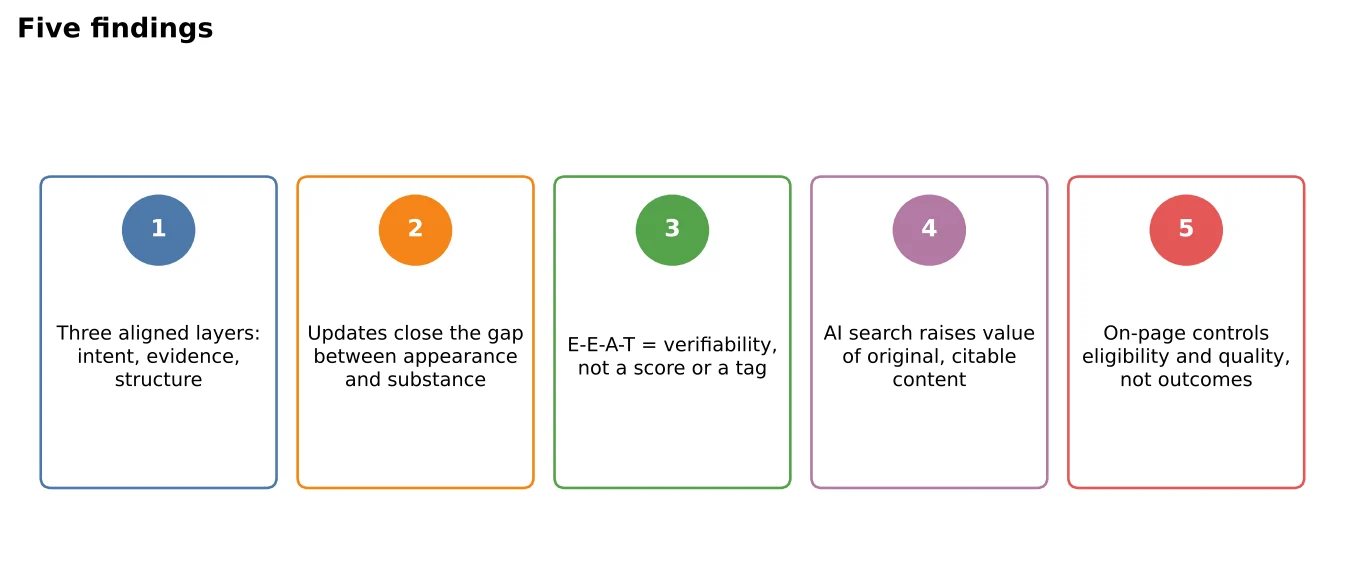
The synthesis supports five conclusions.
First, on-page SEO is best understood as the alignment of three layers: intent (what the page is for), evidence (why it can be trusted) and structure (how it can be read and used). A weakness in any layer limits the others. A perfectly structured page with no evidence is commodity content; strong evidence in a page with no clear intent is hard to find and use.
Second, the history of Google’s updates is a history of closing gaps between appearance and substance. Keyword stuffing, thin pages, manipulative links, scaled content and counterfeit expertise each produced an advantage that Google’s systems and policies later removed. The durable strategy is to have the substance that appearances imitate.
Third, E-E-A-T is a standard of verifiability. Because it is not a score, it cannot be added by markup. It is satisfied by real authorship, real experience, accurate and sourced content, honest disclosure and a reputation that exists beyond the page. The most reliable test is whether every claim of identity and process on the page would survive checking.
Fourth, AI-mediated search raises the value of original and citable content and lowers the value of commodity content. Google’s own guidance indicates that existing fundamentals apply and that no special markup or file is required. The practical implication is to write self-contained, precise, attributed passages and to give readers a reason to visit beyond an excerpt.
Fifth, on-page work controls eligibility and quality, not outcomes. Position depends on factors beyond the page. A professional commitment is therefore to remove avoidable obstacles, to do the work that gives a page a fair chance, to measure honestly and to refuse promises that cannot be kept.
14.2 Limitations
The paper has the following limitations. It synthesizes public documentation and secondary reporting and does not use proprietary ranking data or controlled experiments. Google’s documentation and features change frequently, as the retirement of FAQ rich results shows, so specific recommendations must be checked against current documents. Several figures and dates for 2025 and 2026 come from the trade press and may be revised. The IES framework is the author’s synthesis, untested experimentally. The worked illustration is hypothetical. These limits do not remove the value of a structured method, but they bound the strength of its claims.
14.3 Directions for future research
Three research directions follow. Controlled studies could compare matched pages that differ in one on-page element, such as the presence of original experience evidence, to estimate effects with proper controls. Audits of AI-feature citations could examine which page characteristics correlate with being cited, using open and reproducible methods. Longitudinal studies could follow the effects of documentation changes, such as the retirement of rich result types, on click-through and traffic, separating them from concurrent updates.
14.4 Conclusion
On-page SEO has outgrown its checklist origins. Its core is a discipline of editorial and technical honesty: know what the reader needs, show why the page deserves trust, and build the page so that people, search systems and answer systems can all use it. The framework offered here does not promise a position in a number of days. It promises something more modest and more durable: that a page built this way is eligible to be judged on its merits, is aligned with the direction of Google’s published guidance and update history, and is unlikely to be undone by the next change in the system.
Appendix A. Glossary
AI Mode / AI Overviews. Generative answer experiences in Google Search that draw on web pages and may use query fan-out.
Anchor text. The visible, clickable text of a link.
Canonical URL. The version of a page that Google selects as the representative one for indexing.
Core Web Vitals. Loading (LCP), responsiveness (INP) and visual stability (CLS) metrics.
E-E-A-T. Experience, Expertise, Authoritativeness and Trustworthiness; a framework in the rater guidelines, not a score.
Entity. A distinct thing, such as a person, organization or place, that a knowledge system can represent.
Query fan-out. A technique of breaking a complex query into related sub-queries executed in parallel.
Rich result. An enhanced search display enabled by eligible structured data and Google’s policies.
Snippet. The text excerpt shown with a search result, generated mainly from page content.
Title link. The clickable title of a search result, generated from the title element and other on-page sources.
YMYL. Topics that can affect health, financial stability, safety or welfare and that the rater guidelines hold to a higher standard.
References and Source Notes
Verification note. Items marked † were retrieved on the web during preparation of this paper (November 2026) and are described in the author’s own words. Older or well-known sources are cited from the author’s background knowledge. Titles, dates and wording should be confirmed against the original pages before citation in formal work. No passage from any source is reproduced.
Brin, S., and Page, L. (1998). The anatomy of a large-scale hypertextual Web search engine. Computer Networks and ISDN Systems, 30(1–7), 107–117.
Devlin, J., Chang, M.-W., Lee, K., and Toutanova, K. (2019). BERT: Pre-training of deep bidirectional transformers for language understanding. Proceedings of NAACL-HLT 2019.
Google Search Central.† AI features and your website (documentation).
Google Search Central.† Optimizing your website for generative AI features on Google Search (guide, May 2026).
Google Search Central.† Creating helpful, reliable, people-first content (documentation).
Google Search Central.† Control your title links in search results; Control your snippets in search results (documentation).
Google Search Central.† General structured data guidelines; review snippet guidelines; FAQ structured data notice (May 2026).
Google Search Central Blog. (2022). Our latest update to the quality rater guidelines: E-A-T gets an extra E for Experience.†
Google Search Central Blog. (2025). Top ways to ensure your content performs well in Google’s AI experiences on Search.†
Google. Search Quality Rater Guidelines (multiple editions).
Google. Search Status Dashboard.
Google. Core Web Vitals and page experience documentation (web.dev and Search Central).
Search Engine Land.† Coverage of title link and snippet documentation updates; people-first content process; AI-generated content guidance.
Search Engine Journal.† Coverage of snippet guidance clarification; title tag guidance clarification; official advice on AI Overviews and AI Mode.
SE Roundtable.† Report on og:title added as a title link source (August 2024).
PPC Land.† Coverage of the May 2026 generative AI guide, FAQ rich result retirement and review snippet guideline changes.
Singhal, A. (2012). Introducing the Knowledge Graph: Things, not strings. Google Official Blog.
Companion paper: Google’s Search Algorithm Updates, 1998–2026 (same author series), for the history of Panda, Penguin, Hummingbird, RankBrain, BERT, helpful content, SpamBrain and the 2024 spam policies.
Emily Thompson
Content Writer
Writes EMA’s adult SEO and escort marketing coverage, working from the accounts the team runs. Commercial detail in every engagement stays under NDA.