Blog
How Long Does Adult Link Building Take to Show Results for a Sex Toy Retailer?
By Emily Thompson, Content Writer Published Updated 35 min read
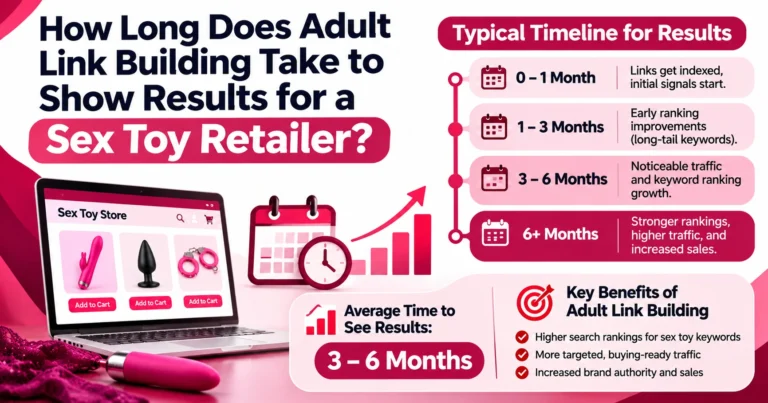
A sex toy retailer can earn a relevant link this week and still see no clear change in Google rankings next week. That does not automatically mean the placement failed. The publisher may have published the article, but search crawlers may not have revisited it. The link may already send qualified readers while rankings remain unchanged. Or the store may need better category pages, cleaner technical SEO, and stronger product information before any additional authority has much commercial value.
The practical answer is that adult link building results unfold in stages. Research, outreach, publication, discovery, referral traffic, search visibility, and sales are different events. Many campaigns can document activity during the first month. Some begin showing meaningful organic movement over the following months. A newer retailer competing against established brands may need a longer period of consistent work before results become obvious. None of those time ranges is a Google guarantee or a promise from an agency.
For a sex toy store, the more useful question is not simply, “How many backlinks can we buy this month?” It is, “Which credible references can we earn, what pages should they support, and how will we know whether the investment contributed to the business?” This guide explains what to expect, what delays progress, how to review links safely, and how to judge an adult backlink strategy without confusing activity with impact.
The short answer: when should a retailer expect results?
For planning purposes, use a three- to six-month observation window for broader SEO trends, while checking whether outreach and publication deliverables are completed much sooner. This is a working review period, not a forecast of rankings. An established store with strong content may observe earlier changes, while a new site, competitive category, or technically weak catalogue may take longer or never show a measurable gain from a particular link.
Google’s own SEO Starter Guide says that some search changes are reflected in hours while others may take several months. Its recrawling guidance notes that discovery can take days to weeks and that requesting a crawl does not guarantee indexing. Ahrefs’ general SEO timeline discussion cites a three- to six-month range from an informal audience poll; that is a broad SEO observation, not measured evidence that a backlink becomes effective at a precise age.
| Period after campaign start | What can reasonably be checked | What must not be assumed |
|---|---|---|
| Weeks 1-2 | Baseline, target pages, content assets, publisher qualification, outreach list | Links or ranking gains are already owed |
| Weeks 3-6 | Editorial responses, live placements, relevant mentions, referral visits | Every live link has been discovered by Google |
| Months 2-3 | Link verification, referral patterns, query/page impressions and ranking trends | A ranking change was caused by one link |
| Months 4-6 | Larger directional changes in non-brand visibility, sessions and transactions | Every keyword will reach page one |
| Months 6-12 | Sustainability, marginal return, category expansion and competitive positioning | Continued spending alone guarantees growth |
This timeline describes what a sensible reporting program might investigate. A campaign can be valuable even if ranking movement is slow: a specialist publication may send buyers, introduce the brand to stockists, or create a durable citation. Conversely, a link visible in a third-party tool may have no useful audience, no evident commercial contribution, and no reason to exist beyond manipulating search results.
What does “adult link building results” actually mean?
Use this measurement ladder to avoid treating published links, crawler discovery, rankings and sales as interchangeable results.
Results are not a single number. A retailer should report operational outputs separately from search and commercial outcomes. Without this separation, a monthly report can sound successful simply because it contains a long list of URLs. The genuine evaluation is whether relevant audiences discover useful pages and whether the store’s organic acquisition improves over an appropriate period.
Stage 1: an editorial relationship exists
The first success is a legitimate reason for another site to discuss or cite the retailer. A manufacturer may list an authorized stockist. A consumer publication may consult the store about product materials and care. A local media outlet may cover a verified retail event. A specialist blog may reference a well-sourced guide. The relationship has to make sense independently of link metrics. Cold outreach emails, accepted pitches and drafted articles are pipeline activities, not backlinks.
Stage 2: the reference is published and accessible
The source URL is live, the retailer is accurately named, the link points to the intended page, and the content is accessible to ordinary visitors. Record the publication date, source URL, destination URL, context, link treatment and any commercial arrangement. The publisher may change or remove content later, so publication is a milestone worth monitoring rather than a permanent entitlement.
Stage 3: crawlers discover the page and the link
Google and third-party platforms have different crawl schedules. A backlink missing from Ahrefs today is not proof that Google has never encountered it, and appearing in a commercial backlink database is not evidence that Google passes ranking value through it. Ahrefs’ help article on backlink discovery explains that its own crawler may take days to weeks to find new links. Google does not publish a per-link crediting clock.
Stage 4: the reference brings readers
Referral sessions are often the clearest early outcome. The question is whether readers from the source explore an appropriate guide, category or brand page, rather than whether a dashboard displays a high domain score. A small number of visitors with relevant interest can be more useful than a large number of untargeted clicks. Use privacy-conscious analytics and only the conversion tracking necessary to answer the business question.
Stage 5: organic search visibility changes
Monitor the landing pages and queries selected before the campaign, ideally against a comparable baseline. Search Console provides impressions, clicks, and average position, but these change with demand, seasonality, location, device and competing activity. A modest increase in relevant non-brand impressions may precede more clicks. It is not proof that a single external link caused the improvement.
Stage 6: qualified revenue or other business outcomes improve
For an ecommerce retailer, the eventual goal is not a backlink spreadsheet. It is profitable customer discovery, trustworthy product education and transactions. A referral from a product review might produce immediate sales even if SEO performance remains flat. A broader organic improvement might result from several factors working together: links, content, technical changes and merchandising. Report those factors rather than attributing every sale to backlinks.
Why link building is different for a sex toy retailer
Adult e-commerce sits between familiar online retail and a more restricted publishing environment. A store sells real products, handles inventory, offers delivery, and needs helpful buying information like any retailer. At the same time, publishers, affiliates, advertisers, and professional associations may have content policies affecting which brands and product categories they will feature. Some sites accept sexual wellness education but not explicit imagery; others decline any adult-category commercial promotion. Eligibility is determined by the publisher’s actual rules, not by assumptions about its audience.
This creates a smaller and more fragmented outreach market, but it does not mean respectable publications are categorically unavailable. Brand-appropriate angles can include materials and safety information, cleaning and storage, privacy-conscious ecommerce, manufacturing innovation, accessible product design, inclusive consumer education, and verified trends. These topics only work when the retailer can provide evidence or subject-matter input. A thin promotional article disguised as education is not improved by calling it digital PR.
Google’s guidelines for explicit content also matter. Search visibility may vary because of SafeSearch classification, query intent, and content presentation. Google specifically discusses adult products in ecommerce feeds and markup. A change in how an adult site appears to some searchers is not always a backlink problem. Marketers should investigate indexing, safe-search-related visibility and relevant search intent before treating every traffic decline as an authority shortage.
Retailers often face additional operational complications. A catalogue may contain many near-identical manufacturer descriptions, variant URLs, filtered category pages and discontinued items. A press link to an expired product that now returns an error is a missed customer experience. A campaign focused only on the homepage may fail to support the category pages buyers actually need. The link strategy must therefore be integrated with the store’s navigation and content roadmap, not sold as a separate monthly quantity.
Which type of page deserves a link first?
Choose a destination with clear purpose and lasting usefulness. A brand or About page may fit a corporate mention. A permanent material guide may suit an educational article. An authorized-stockist page may suit a manufacturer directory. A genuinely distinctive collection page may be referenced in a product roundup. A limited-edition SKU that will disappear next month usually needs a different strategy because the destination will be short-lived.
For adult link building for sex toy retailers, durable assets often outperform speculative link targets. Consider a product materials explainer that cites manufacturer documentation, a beginner-friendly product comparison framework with honest limitations, a shipping and privacy information hub, or a study based on the retailer’s own verified, aggregated inventory observations. Do not fabricate surveys or medical outcomes to make a page seem more linkable.
The variables that determine how long the campaign takes
Two stores can begin adult backlink building on the same day, earn links from seemingly similar publications, and experience very different outcomes. The pace depends on their starting point, the quality of the destination pages, actual audience relevance, editorial processes, and conditions outside the SEO team’s control. Understanding those variables helps avoid a false deadline.
1. The existing authority and reputation of the store
A long-established retailer with genuine press mentions, trusted suppliers, customer resources, and a coherent branded search presence has different conditions from a brand-new domain. An existing audience may discover new editorial coverage quickly. A new brand must build credibility with publishers and customers before expecting an external reference to carry much meaning. Age alone is not a substitute for usefulness, and domain-level third-party scores should never be mistaken for Google’s internal ranking system.
2. The competitiveness and specificity of the target query
A precise informational query about a material, product compatibility or care can have a different competitive landscape from a broad commercial term. Broad terms may attract large retailers, publishers, comparison sites, and established manufacturers with substantial resources. A sensible campaign connects targets to the pages that already satisfy search intent. No amount of anchor-text repetition will turn a weak category page into the best answer for a buyer.
3. Technical health and indexability
External references cannot reliably compensate for a destination that is blocked, redirects in a loop, duplicates dozens of URLs, or is difficult to navigate. Check canonical choices, pagination, important product availability, broken links and mobile rendering. Google’s canonicalization documentation explains how duplicate and very similar URLs can be consolidated. If publishers link to multiple variants, the site’s internal signals should make the preferred page clear rather than scatter attention across duplicate routes.
4. The editorial value offered to the publisher
A credible publisher has to find something worthwhile for its readers. Original product testing, a verified expert explanation, a timely launch, or accurate market data gives an editor a reason to consider a story. A generic request asking the publisher to “insert our link” offers almost nothing. Useful assets can accelerate genuine conversations, but editorial schedules and review standards remain outside the retailer’s control.
5. The type and destination of the link
Not every backlink is comparable. A manufacturer’s authorized retailer listing, an independent review, a sponsored feature, and a forum comment serve different purposes. A qualified sponsored link can be worthwhile for exposure but should not be counted as an unqualified ranking signal. Google says advertising and paid placements should be identified appropriately using rel="sponsored" or, where appropriate, nofollow. See Google’s outbound link guidance.
6. The site’s internal linking and content quality
When a valuable educational resource earns a reference, users should be able to navigate from it to relevant product categories and decision-support information. Contextual internal links help people understand the next step. Do not force commercial anchors into every paragraph. Google’s link best practices emphasize crawlable HTML links and descriptive anchor text. An internal linking review may be a better use of next week’s budget than another weak external placement.
7. Seasonality and product availability
Gift shopping periods, stock shortages, new collections and product recalls can change both search demand and conversion outcomes. A retailer whose most visible collection goes out of stock during a campaign may see limited sales despite receiving useful referral traffic. A seasonal PR campaign may earn press quickly, but its resulting demand may not continue. Reporting needs a calendar of major product, content and merchandising changes.
8. The quality of measurement
Without a reliable starting point, teams mistake normal variation for dramatic results. Define target pages, countries, branded and non-branded queries, existing referral sources, and revenue tracking before outreach. Missing consent settings, incorrect channel grouping and inconsistent product URLs can distort a trend. Good measurement does not make results happen faster, but it helps determine whether observed changes matter.
A realistic month-by-month adult backlink strategy
The purpose of a timeline is to set decision points, not to imply that every week produces the same number of links. A retailer entering a campaign should agree on what the supplier will do, what proof it will provide and what decisions follow if the results differ from expectations. In early months, the most dependable commitments are research and execution. Search-engine outcomes are observations rather than deliverables a supplier controls.
Month 1: establish the baseline and prepare worthwhile assets
The first month should begin with a review of existing links, target pages, current site health and likely publisher audiences. A retailer should know whether it is trying to raise awareness of a new brand, improve discovery of a useful category, earn mentions for a distinctive product, or repair lost references following a migration. Those objectives need different outreach angles.
Build a small inventory of assets that can honestly support a pitch. Check whether material claims have supplier evidence, whether guides contain clear explanations, whether images are licensed and non-graphic enough for the proposed publisher, and whether the destination page remains useful when a particular product goes out of stock. Review any previous relationship between the retailer and the publisher to avoid duplicate or inappropriate contact.
An actionable first-month handover might contain a prioritized target-page map, a reviewed backlink-risk profile, a publisher-prospect table, two editorial angles, approved destination pages and a measurement baseline. If outreach has already begun, record responses and next actions. An empty live-link count at this stage is not necessarily evidence of inactivity, but the team must be able to show what was completed.
Month 2: move qualified outreach into editorial decisions
During the second month, staff may refine pitches based on feedback and begin obtaining published mentions. Some publishers reply within days; others take several editorial cycles, and many will not accept the subject. Record declines and policy restrictions rather than quietly replacing rejected high-quality prospects with low-value networks.
For an online sex toy retailer, likely opportunities include relevant manufacturer directories, trade or retail publications, sexual wellness educators with actual editorial standards, product-design publications and consumer-interest features. Eligibility depends on each outlet. A brand with distinctive, verifiable manufacturing or sustainability information might have more than one editorial angle, while a general reseller with copied product descriptions may need to create a better resource before pursuing press.
At the end of month two, compare progress with what was promised: how many prospects passed review, how many relevant editors were contacted, how many requests resulted in a genuine dialogue and which pages went live. Assess source relevance, link context and referral activity. Do not publish an unattributed claim that a page has improved rankings because a new link exists.
Month 3: verify links, refine destinations and watch trends
By month three, a consistent campaign may have enough public references to review patterns. Check whether the links still exist, whether they point to correct canonical URLs, whether commercial placements are labeled, and whether readers from the source can find the intended product information. If a promising article receives traffic but the destination performs poorly, investigate page relevance, product availability and navigation.
Use Google Search Console to compare relevant query groups and landing pages with a pre-campaign period. Maintain a change log for major site events such as new category copy, site-speed improvements, promotions and discontinued collections. Where impressions rise but clicks do not, review search appearance and query relevance. Where clicks rise but purchases do not, inspect checkout and product suitability before ordering more links.
Month three is a useful review checkpoint, not a pass-or-fail deadline. A campaign that earned sound mentions but sees no organic lift may need more time, or it may need a different content strategy. One with no credible editorial progress should not be excused indefinitely by saying “SEO takes months.”
Months 4-6: assess whether the evidence supports expansion
A longer window provides more observations across search queries, landing pages, referral sources and ecommerce outcomes. This is where teams can start making better budget decisions, although the results still cannot be isolated perfectly from other changes. Some useful questions are whether non-brand impressions have improved in the prioritized topic groups, whether returning referral visitors engage with educational assets, and whether relevant commercial categories receive more qualified organic visits.
If evidence is promising, expand the program carefully into adjacent product education, supplier relationships or additional market-specific publishing. If evidence is weak, revisit the hypothesis: did the campaign pursue the wrong publications, pitch a poor asset, direct links to the homepage instead of a helpful resource, or ignore technical problems? Scale the method that has a plausible mechanism, not the one with the highest link count.
Months 6-12: evaluate resilience, not just the launch effect
A strong program should become less dependent on repeated cold pitching. A retailer can develop recurring expert relationships, update genuinely useful guides, build manufacturer and retail partnerships, and earn unprompted references when its information becomes a known resource. Continue reviewing link changes, deleted pages, changes in publisher policy and search trends.
Longer-term work also involves deciding what to stop. Some placements contribute no relevant readership and create ongoing maintenance burdens. Others sustain referral activity even when ranking position barely changes. The objective is to build a portfolio of defensible relationships, useful content and measurable channels, not an ever-growing total that looks impressive only in a presentation.
Which adult e-commerce link-building tactics deserve the budget?
A useful tactic has a logical audience, a real editorial or business reason for the reference, a suitable destination and a transparent commercial relationship. For link building for adult websites, that standard is especially important because low-quality placements are easy to buy and difficult to defend. The categories below are options to investigate, not promises that a particular publisher will accept adult retail content.
Earn manufacturer and authorized-stockist references
Many retailers sell products made by third-party manufacturers. If a brand maintains a legitimate stockist directory, ask how authorized retailers are listed. Provide accurate store details, approved product categories, shipping regions and a stable landing page. This benefits customers looking for an authentic seller and is not simply a request for ranking credit. Do not claim authorization you do not have, or create reciprocal-link requirements disguised as partnership terms.
This is often a sensible early opportunity because the business relationship already exists. The drawback is that many manufacturers do not offer public stockist pages, or use non-clickable listings. A missing link is not grounds to pressure a supplier. Preserve a useful relationship even when there is no search benefit.
Reclaim existing unlinked mentions
Search for genuine mentions of the retailer’s name, proprietary product lines and original resources. Some publications cite the brand in text but do not link to the relevant page. A short, respectful message asking whether readers would benefit from a specific source may be appropriate. Explain the information the link adds, not the SEO score you want to receive.
Reclamation is usually more defensible than creating mass guest posts because the publisher already chose to mention the business. It still requires editorial consent. Do not send repeated automated messages or demand that every mention be converted into a backlink.
Contribute expert knowledge to credible editorial coverage
A store may have useful expertise about materials, design constraints, customer product-care questions, discreet delivery operations, or retail safety checks. Journalists and editors occasionally need informed contributions to those subjects. Offer verifiable facts, identify the spokesperson accurately and separate an educational statement from a sales claim. The editor decides whether a brand mention or link is appropriate.
Avoid unsupported health promises, invented survey percentages or manufactured customer quotations. If a supplier provides technical documentation, use that source rather than presenting it as independent testing by the store. Editorial relationships built on accuracy are more valuable than one sensational headline.
Publish resources people can cite for a reason
A strong resource might compare material terminology with cited manufacturer references, explain how to evaluate compatibility claims, outline privacy considerations when choosing an online retailer, or document the lifecycle of recyclable packaging in the store’s supply chain. These assets need a clear reader benefit even when no backlinks arrive.
Original data can also attract interest if the retailer actually has reliable data. For example, a transparent aggregate analysis of product-return reasons could help a trade reporter understand packaging problems. Remove personal information, state the sample and period, and avoid drawing conclusions beyond what the data supports. Do not invent a research project merely to obtain press coverage.
Use selective guest contributions when they serve the host
A properly chosen guest contribution can be useful when the writer has genuine subject expertise and the host serves an overlapping audience. The article should stand on its own as editorial content, comply with the publisher’s requirements and include a reference only where it helps readers. Guest posting becomes problematic when the real product is a paid followed link or when the same thin article is distributed repeatedly with optimized anchors.
EMA’s adult link application page reflects this distinction between useful contributions and ranking-led placements. A retailer can use guest articles to explain a niche subject, but a publication is not evidence of ranking impact. Sponsored contributions need suitable disclosure and link treatment.
Consider relevant directories and industry associations carefully
Real organizations, credible retail groups and local business resources may help customers verify a business. A listing should have a reason to be there beyond its ability to generate backlinks. Check whether the directory has real moderation, accurate category data, up-to-date entries and an audience. Avoid directories that promise hundreds of links for a fee without showing how users benefit.
An international retailer should also distinguish a physical local store from an ecommerce brand operating across countries. Do not manufacture addresses, storefronts or local business eligibility for cities where no business presence exists. Accuracy is more durable than an aggressive location-link footprint.
Treat product gifting and paid editorials as promotion, not hidden SEO
Sending a sample to an independent reviewer can be a legitimate product-feedback or awareness activity, but not a bargain in which the reviewer must provide a followed backlink. Google’s spam policy includes exchanging products for links as an example of link spam when done primarily for ranking manipulation. If compensation or a free product materially affects an endorsement, the relationship should be disclosed under applicable standards. The US FTC Endorsement Guides provide examples of these expectations.
A paid feature may deliver referral traffic and brand exposure. Record it as a paid media or sponsorship activity with appropriately qualified links. Do not quietly report the placement as an organically earned editorial citation, or promise that payment buys a ranking improvement.
How to judge quality backlinks for adult websites
A high score in one SEO tool is not enough. A good backlink has understandable context, a relevant readership, credible editorial ownership and a destination that adds value. The exact mix will differ between a manufacturer citation, trade publication, educational resource and consumer-interest feature. Use a review checklist rather than a fixed threshold that treats every site with the same third-party score as interchangeable.
| Review question | Positive evidence | Warning sign |
|---|---|---|
| Who uses this publication? | Clear topic, relevant readers, accessible editorial pages | Random content across unrelated industries |
| Why is the retailer mentioned? | Genuine expertise, stockist relationship, useful source | Page created only to host anchors |
| Is the article original? | Specific facts, context and editor accountability | Recycled copy, fake byline or generic placement template |
| Does the destination help? | Stable, informative page connected to the claim | Dead product, unrelated homepage or misleading redirect |
| What is the commercial relationship? | Clear disclosure and correct link treatment | Seller guarantees a followed link for payment |
| Can performance be checked? | Live URL, date, referral data and changes logged | Only a claimed domain score or screenshot |
Relevance does not require every publisher to be an adult-specific website. A trustworthy design, retail, materials or ecommerce publication can sometimes be a natural fit for a well-supported story. Equally, a niche adult blog may be highly relevant to the reader yet unsuitable if it lacks standards or exists only to sell links. Inspect the specific article and audience, not just the domain name.
For a supplier carrying out an adult website backlink strategy, ask for pre-approval of publishers when appropriate, a clear distinction between earned and paid placements, and a log of source URLs and target pages. These records make future audits and handovers possible. They also reveal when a campaign is repeatedly linking to the same destination while neglecting useful sections of the store.
How should a sex toy retailer measure link-building ROI?
Measure the campaign in layers: quality of execution, useful editorial exposure, referral activity, organic visibility and business results. This prevents an agency from calling a campaign successful only because it delivered placements, while also preventing the retailer from declaring it a failure before enough comparable search data exists. Agree on the measurement window and baseline before the first outreach email is sent.
Start with a small set of target pages, not the entire website. For example, select one evergreen buyer guide, two important collections and a brand-trust resource. Record their existing search performance and organic landing-page engagement. Keep the same geographic market and search type when comparing periods. Note important content edits, campaigns and stock changes so the final review does not credit all movement to links.
A reporting dashboard that separates outputs from outcomes
| Measurement | Source or check | Review cadence | Interpretation |
|---|---|---|---|
| Qualified prospects and accepted pitches | Outreach records | Weekly | Execution progress, not SEO impact |
| Live source and destination URLs | Direct page inspection | At publication, then monthly | Proof of public references |
| Placement relevance and commercial disclosure | Editorial review | Before approval and at publication | Quality and policy risk |
| Referral sessions and useful actions | Privacy-aware web analytics | Monthly | Direct audience contribution |
| Non-brand impressions and clicks on selected pages | Search Console performance reports | Monthly and over longer periods | Search visibility trend |
| Organic purchases and revenue by landing page | Ecommerce analytics | Monthly or quarterly | Business outcomes, not single-link causation |
| Lost or changed references | Manual recheck and backlink tools | Monthly or quarterly | Campaign maintenance |
Google Search Console’s performance documentation recommends looking at trends in clicks and impressions, not position alone. Its Search Console setup guide explains how queries, pages and countries can be monitored. Filter a target category instead of averaging a whole store whose thousands of unrelated product pages change independently.
For external links, Google’s Links report is a useful reference but not a perfect ledger. Third-party crawlers also provide partial pictures. A supplier’s verified live-URL list, Search Console patterns and analytics should be evaluated together. If a publication link disappears from one tool, inspect the source page directly before assuming the publisher removed it.
Compare comparable periods, not convenient dates
Suppose outreach began just before a holiday shopping spike. Comparing November with October may show increased demand unrelated to link building. A better review considers year-over-year seasonality where sufficient data exists, the same page group, the same country, and significant promotions or stock events. If the site is too new for year-over-year comparisons, record that limitation and interpret short-period changes cautiously.
Keep branded and non-branded searches distinct. A viral product mention may raise brand queries but do little for category ranking. Both could matter commercially, yet their meaning is different. Also separate Search Console organic search data from referral visits: someone who clicks from an article to the store has not necessarily discovered the retailer through Google.
Use an attribution note instead of a made-up ROI claim
A reporting note might read: “Four relevant placements went live during the quarter. Two produced measurable referral visits. Non-brand impressions on the target collection rose in the same period. The store also changed category descriptions and product availability, so the contribution of backlinks cannot be isolated.” That statement is more useful than claiming a fixed percentage of growth “from link building” without a credible experiment.
Worked example: two hypothetical retailers, two different timelines
The following scenarios are illustrations for planning, not EMA client results or forecasts. They demonstrate how the same outreach activity can lead to different decisions because the starting conditions and destination-page quality differ. None of the figures represents a measured Google ranking effect.
Scenario A: a new store with a small catalogue
Store A launched recently with twenty products, sparse collection information, few brand mentions and no established press relationships. The team wants to compete immediately for broad commercial searches. During the first month it discovers that variants use inconsistent URLs, a category page contains only copied supplier descriptions, and several core policies are hard to find. These problems need attention before aggressive outreach.
The team chooses one credible topic, a buyer-friendly guide explaining how to assess material information, and prepares source documents. It contacts a modest list of relevant educators, manufacturers and retail publications. Some decline. One manufacturer confirms that authorized retailers can appear in a public stockist directory. A trade writer requests clarification. Those are meaningful early steps even if the domain has yet to improve in organic search.
In the second and third months, Store A fixes its catalogue structure and publishes the guide, then earns a few legitimate references. The correct next question is whether the linked pages are accessible, whether they help visitors and whether the outreach merits continuation. It would be premature to promise top positions for broad national keywords by a fixed date. If the store still lacks persuasive category content, additional links may be a poor investment.
Scenario B: an established retailer with useful resources
Store B has been trading for years. It maintains accurate product guides, a stable catalogue and relationships with suppliers. Its team notices that one high-value educational resource receives citations without links and that several manufacturer stockist pages omit its current web address. It also discovers that a page redesign left old press links redirecting through multiple hops.
The initial work focuses on correcting those destinations, asking publishers whether citing the guide URL would help their readers, and updating authorized stockist information. The store can start observing referral visits relatively early if a relevant publication updates its article. Whether rankings improve remains uncertain and must be reviewed separately. Because the baseline is stronger and the project addresses specific gaps, the team has clearer evidence about whether to continue this approach.
The contrast is important: Store A needs foundations and credible assets; Store B can concentrate on relationship and URL maintenance. Buying an identical backlink package for both would ignore the reason their growth prospects differ.
Why a campaign can earn links without lifting rankings
When rankings remain flat, use diagnosis rather than buying the next batch. Several explanations can coexist. The links may be mostly qualified sponsored placements, the target page may not match query intent, a stronger competitor may have improved its own content, or the links may simply be too few and too weak to change the broader picture. Search systems also evolve, so a static position does not reveal which signal was decisive.
A technical audit should check noindex directives, canonical selection, broken product pages and access to main category content. Ecommerce filters can generate duplicates that complicate reporting. Editorial review should ask whether the linked guide is genuinely the best source for the question. Business review should consider whether the store offers clear product information, trustworthy checkout policies and reliable stock availability.
Google’s people-first content guidance emphasizes original information, useful analysis and reader satisfaction. Strong content alone does not guarantee rankings, but weak content can make a link-only strategy an expensive distraction. When necessary, pause outreach and redirect effort toward the destination.
Five warning signs in an adult link-building proposal
- The supplier guarantees a particular keyword position or a fixed number of sales within weeks.
- Every package is sold by raw link quantity or a single third-party authority score, with no publisher review.
- The plan relies on private blog networks, automated posting or unrelated sites created mainly to sell links.
- The agency will not identify source URLs, link treatment, editorial costs, or where the links point.
- The report claims that sponsored placements pass organic ranking credit or that every ranking increase came from backlinks.
An honest supplier can commit to research, outreach, content production, recordkeeping and approved placements where publishers agree. It cannot promise how a search engine will evaluate those references. Review the terms governing cancellation, publisher refusal, paid placements and ownership of commissioned assets before signing.
What should the retailer budget for: links, content, or technical fixes?
There is no universally sensible “cost per backlink” for this niche. Fees may cover research time, editorial expertise, design, technical repairs, publisher prospecting, content production and verification. Costs may also differ because a campaign uses an existing useful asset rather than commissioning a new one. The right question is whether the proposal buys defensible work and a measurable hypothesis, not whether the headline link count appears cheap.
For a small store, a combined audit and one high-quality educational resource may provide a better basis for future earned coverage than many low-relevance directory listings. For an established retailer, relationship development and unlinked-mention reclamation may be appropriate. For a large catalogue, fixing canonical and category architecture may have higher priority than external outreach. This is why SEO for sex toy stores needs coordinated content, technical and authority decisions rather than a link-only subscription.
Before approving the budget, request a deliverables matrix: who writes or edits the asset, who checks claims and product eligibility, how publishers are screened, which expenses require approval, what happens after a publisher rejects the idea, and how source links will be reported. EMA describes its approach to adult authority building on the Adult Link Building service page; businesses should still confirm the current scope directly rather than assume that every deliverable is included in a base plan.
What published sex toy SEO case studies can and cannot tell us
Industry case studies show that adult retailers can pursue editorial coverage and SEO alongside broader site improvements. They do not provide a controlled measure of how long a single backlink takes to improve a ranking. For example, connective3’s Sinful case study describes digital PR and reported visibility outcomes. Coalition Technologies’ Tabu Toys example describes SEO content, site fixes and publicity activity together. These are agency-published descriptions, not independent causal experiments.
Use such examples to identify possible campaign ingredients and reporting questions, not to copy another brand’s results into your business case. If a case features product PR, redirects, new copy, paid advertising and seasonal sales at once, no reader should infer that backlinks alone produced the numbers. For a supplier comparison, ask how the figures were measured, over what period and what else changed.
Questions to ask an adult link-building agency before starting
A professional review begins with the business and its customers. Ask which queries and pages merit attention, why each publisher has audience fit, and how the agency will identify sources without risking private shopper information. Clarify the difference between publisher relationships, editorial articles, sponsored content and directories. Ask how rejected pitches affect the scope and how the agency decides when to stop pursuing a target.
Request a sample report showing the source URL, placement type, destination page, live date, link attributes, editorial rationale and relevant referral data. Agree that a third-party crawl or ranking tool is informative, not definitive. Ask who owns the articles and research briefs after the contract ends, and whether the agency will remove or update placements that become inaccurate or harmful.
For sex toy retailer SEO, also ask whether the team understands category filters, product variants, age-related presentation, material claims and the retailer’s shipping regions. An SEO proposal that cannot account for the store’s actual catalogue may produce attractive link reports without useful growth. EMA’s sex toy website development guidance explains how search-ready architecture and product-information clarity belong in the same planning conversation.
Frequently asked questions
Can adult link building show results within 30 days?
It can show operational results in thirty days, such as approved prospects, published links or referral visits. A demonstrable ranking or revenue lift is less predictable and depends on starting conditions. Do not treat the absence of a ranking change after one month as conclusive, and do not accept a supplier’s claim that every published link must move rankings immediately.
Is three months enough for a sex toy retailer to judge a campaign?
Three months can be enough to judge whether outreach quality, editorial execution and reporting are credible. It may not be enough to judge the full organic effect, especially for a new store or a highly competitive category. Use a staged review: assess deliverables first, then evidence across several comparable periods, and decide whether the strategy should continue or change.
Are five excellent links better than fifty weak ones?
There is no universal arithmetic. Five references from relevant, trusted pages may provide more useful exposure than fifty unrelated directory entries. But each link’s context, audience, destination and commercial relationship matter. Do not replace raw link-count targets with an equally simplistic “five strong links” promise. Evaluate the work page by page.
Do sponsored backlinks help adult e-commerce SEO?
Sponsored features can support awareness and qualified referral traffic. Paid links should be transparently identified and appropriately qualified, rather than sold as followed links that manipulate ranking signals. Their commercial value should be measured through reach, referral engagement and customer outcomes. They should not be presented as guaranteed organic ranking improvements.
Should a retailer target the homepage or category pages?
Choose based on the reason for the reference. Company news may naturally link to the homepage; a materials article may cite an educational guide; a manufacturer listing may link to a stable store or brand page. A relevant category may be appropriate when the publisher is helping users shop, but do not force a commercial destination into an unrelated article. Plan internal routes from helpful resources to suitable collections.
How often should the backlink report be updated?
A monthly review is practical for many retailers, supplemented by a live placement log and short updates when important articles publish. Track removal or change of valuable links and distinguish referral activity from organic search trends. Review quarterly for broader business decisions rather than treating day-to-day ranking fluctuations as a verdict on the campaign.
Can poor backlinks damage an adult retail website?
Manipulative link schemes can violate Google’s policies and may lead to ranking problems or other actions. A store should avoid deliberately creating such links and should monitor suspicious patterns. Not every unfamiliar link requires removal or disavowal, and broad automated disavowal can be inappropriate. Investigate the evidence and follow current Google guidance before taking disruptive action.
Does adult e-commerce link building require explicit content?
No. Product education, materials, manufacturing, ecommerce trust, consumer privacy and relevant retail news can be communicated professionally and without graphic content. The right approach depends on the publisher and the legitimate topic. Non-graphic language does not guarantee acceptance, but it can make a useful story accessible to a broader range of suitable editorial outlets.
What if the retailer’s backlink profile improves but revenue does not?
Check whether relevant pages receive better impressions, clicks and referral traffic, and whether shoppers can find appropriate products after landing. Stock availability, product pricing, shipping options, trust signals and checkout friction may limit sales even when discovery improves. A backlink tool score is not the objective. Adjust the broader store experience before paying for more of the same links.
Is a one-off guest post campaign enough for lasting results?
A single useful article can remain valuable, but it does not create a guaranteed lasting search effect. Publishing relationships, product information, category quality and technical maintenance require continued attention. The most sustainable approach treats each contribution as a genuine editorial asset with a useful destination, rather than a one-time transaction promising permanent ranking power.
The next decision: prove the mechanism before expanding the budget
For a sex toy retailer, the best adult backlink strategy is one that begins with the customer and can survive scrutiny. It identifies a legitimate reason to be referenced, sends readers to a helpful page, records the actual placement and evaluates outcomes over a realistic window. The work can create useful exposure quickly. Broader organic improvements may take months, may differ by product category, and are never guaranteed.
If you are evaluating a campaign now, map your target categories, inspect the store’s technical foundations, and request a transparent outreach and measurement plan. Escort Marketing Agency’s adult link building team can review the relevant pages, existing references and proposed publisher strategy before a scope is agreed. Start with evidence and a clear commercial goal, not a promise of instant backlinks or first-page rankings.
Emily Thompson
Content Writer
Writes EMA’s adult SEO and escort marketing coverage, working from the accounts the team runs. Commercial detail in every engagement stays under NDA.