Blog
What Questions Should I Ask Before Signing an Adult Marketing Contract?
By Emily Thompson, Content Writer Published Updated 35 min read

A contract for adult digital marketing should make the work, costs, approval process, account ownership, reporting and exit arrangements understandable before either side commits. Ask which channels are genuinely available to your business, what the agency will deliver each month, who can change your website or campaigns, what happens to your data, and how you leave with the assets you paid for. A persuasive sales presentation is not a substitute for those answers in writing.
The stakes are unusually practical for escort agencies, adult publishers, directories, creator businesses and adult ecommerce operators. Some mainstream advertising channels restrict or prohibit particular sexual-content categories. A poorly planned link campaign can introduce search risk. A public case study can expose an identity that a client wanted to keep private. A website redesign can leave a business dependent on an agency-controlled login. None of those problems is solved by a longer contract or a more impressive promise.
This guide is written for business owners assessing Adult SEO, Adult Digital Marketing, Escort Agency SEO, Adult Link Building and Adult Content Writing providers. It also explains the additional questions relevant to Enterprise SEO, Adult PPC, Adult Social Media Marketing, Escort Directory SEO and OnlyFans Marketing. Use it to compare proposals on equal terms, not to demand an unrealistic guarantee from a legitimate agency.

The short answer: what should be clear before you sign?
A good agreement connects five things: a defined business objective, a channel-by-channel statement of work, measurable evidence of completed activity, ownership and access rules, and a workable exit. The commercial schedule should also show every recurring or pass-through cost. If the sales team cannot explain these points in plain English, ask for a revised proposal before paying a deposit.
|
Contract area |
Question to put in writing |
Evidence to request |
|---|---|---|
|
Scope |
Which domains, markets, pages and channels are included? |
Signed scope and exclusions |
|
Deliverables |
What will be produced, implemented and reviewed each month? |
Quantities, acceptance criteria and timetable |
|
Advertising |
Which platforms permit the intended campaign? |
Platform and market eligibility assessment |
|
Fees |
What is the full cost beyond the retainer? |
Fee schedule and expense-approval limits |
|
Ownership |
Who controls the domain, CMS, analytics, ad accounts and final content? |
Account inventory and rights schedule |
|
Privacy |
Who sees sensitive information and what can be made public? |
Access matrix and confidentiality controls |
|
Reporting |
How will we know work happened and whether it helped? |
Sample report, source data and KPI definitions |
|
Exit |
What happens when the contract ends? |
Notice rules, asset export and handover checklist |
Google’s own guide to hiring an SEO recommends interviewing a provider about methods, communication, previous work, expected results and the changes it will make. It also warns that nobody can guarantee a number-one ranking. The same buyer discipline applies to every other adult marketing service, including paid media and creator campaigns.
1. Who is the contracting party, and who will actually perform the work?
Ask: “Which company is responsible for delivery, who is my day-to-day contact, and what work is subcontracted?” The name on an invoice should match an identifiable business entity. The contract should name the provider, the client, any project-specific service entity and the authorized representatives. If another company handles link outreach, paid media, website development or content production, ask how that arrangement is managed.
This is not a demand that every agency employ every specialist directly. Subcontracting can be entirely sensible. The issue is whether the agency can meet its commitments while controlling quality, access and confidentiality. A provider may have a senior strategist on the sales call but assign the project to a junior coordinator after signing. Request the roles, responsibilities, review path and escalation contact before this becomes a problem.
For a sensitive business, the scope of subcontractor access matters as much as the subcontractor’s name. A writer may only need an approved brief. A technical developer might need temporary access to staging. A media buyer may need delegated access to one advertising account, not a copy of the owner’s personal identification. Ask who approves subcontractors, whether they work under confidentiality terms, and whether access can be revoked promptly.
An effective answer describes an accountable delivery owner and a practical handoff plan if a specialist leaves. A red flag is “our network handles everything” with no explanation of who receives business data, who signs off on completed work, or who answers when something goes wrong.
2. Exactly which services are included, and which are excluded?
Ask: “Can we attach a statement of work that lists every service, deliverable, quantity, market and exclusion?” The label full-service marketing is not a useful purchasing unit. It may refer to strategy only, execution across a handful of channels, or broad access to agency expertise without a guaranteed production volume. The contract should make those differences visible.
For example, an adult business might need technical SEO, two city-page improvements, blog production, editorial outreach and reporting. It might not need advertising management or social scheduling at all. The opposite could be true for an established creator with a sound website but weak audience retention. Avoid paying for a bundle whose most expensive components do not solve your actual problem.
A useful scope has three levels: what is included, what is excluded and what triggers a separate approval. If the contract says “Adult Digital Marketing management,” ask whether that includes audience research, landing pages, creative assets, media buying, analytics configuration, conversion testing, reporting and monthly meetings. For each included component, specify who writes the brief, who approves it and who publishes the final work.
Do not assume that a quoted SEO retainer includes web development, hosting, a complete design refresh, paid media spend, premium tools, translation or a new content-management system. Those may be valuable services, but the commercial terms should state when they are additional. A clear change-order process protects both parties from awkward scope disputes.

3. What precisely counts as a delivered result each month?
Ask: “How will we verify that every item in the monthly plan has been completed?” A vague promise to “optimize the website” or “build authority” is difficult to assess. A useful deliverable includes a unit, a due date or cadence, an acceptance standard and a destination where the result can be inspected. Results of work and results in search engines are not the same thing.
Compare “eight hours of technical SEO” with “an audit of the specified templates, a prioritized issue register, agreed fixes to canonical tags and redirects, and a change log showing implementation and validation.” The first describes time. The second gives the client something to verify. A monthly contract can include time-based work, but it should explain what information will be provided to demonstrate progress.
The same principle applies to editorial work. “Four articles” may mean outlines, first drafts, edited articles or fully published posts. Ask who supplies interviews and source material, whether images and revisions are included, how long the pieces should be, and what happens when a draft needs factual corrections. A client who wants publication-ready content should not discover after signing that CMS formatting and internal linking cost extra.
For links, a prospecting list is not a live publication. For paid media, a proposed campaign is not an approved, running ad. For social content, a calendar is not the same as scheduled posts. A strong agreement distinguishes research, production, implementation and acceptance, rather than counting them as interchangeable accomplishments.
4. Which countries, cities, domains and business models does the scope cover?
Ask: “Are all target markets and properties listed, and how do we approve expansion?” Adult websites often operate across several cities, languages, brands and platform types. One site may include an agency service page, a directory of profiles, a creator landing page and a separate membership subdomain. These are not necessarily one optimization task.
An escort agency operating in three UK cities might need differentiated location information, accurate service coverage and consistent internal navigation. A directory with thousands of profile URLs has a different workload: crawl paths, filtering controls, canonicalization, duplicate content and publication rules. A subscription business may prioritize owned-site discovery and conversion tracking rather than local search. Put the actual properties and priorities into the statement of work.
Be especially careful with proposed expansion. If the client does not yet serve a city, the agency should not invent a local office, testimonials, availability or neighborhood detail to justify a location page. Ask what evidence of genuine service coverage supports each public claim. A city page should help a visitor make an informed choice, not merely replace a place name in identical copy.
The scope should also say whether multilingual work includes native editing, local search-intent research, translation, technical internationalization and regulatory review. It is reasonable for an agency to price those separately. It is not reasonable for a proposal to imply every country is covered when only one language and one market are funded.
5. How will you establish that each proposed marketing channel is actually usable?
Ask: “Show me the eligibility check for our exact business model, destination and target country.” A channel can be commercially attractive but unavailable for a particular adult category. Policy decisions may depend on the product or service, ad creative, website destination, user age, audience geography and platform rules. A proposal should not treat a restriction as a minor setup hurdle.
Google Ads has sexual-content restrictions and separate rules for content it disallows. TikTok’s adult-content advertising policy explicitly identifies sexual services such as escort services among prohibited examples. That does not mean every lawful adult retailer or educational brand has identical treatment across every platform. Eligibility must be checked for the actual campaign rather than assumed from the broad word adult.
Ask the agency to identify channels as eligible, restricted pending review, unsuitable, or not yet verified. Request a fallback plan if an account or creative is rejected. A fallback can include approved adult-friendly networks, search-led content, compliant partnerships, owned email where permitted, or improving the website conversion path. It should not include disguising the business, misleading an ad reviewer or opening replacement accounts to circumvent a suspension.
This is particularly important when a contract includes Adult PPC alongside SEO. Make the provider show which part of the fee covers eligibility and preparation, which part covers campaign operations, and which costs arise only if an approved campaign can actually run.
6. What methods will you use for Adult SEO and Escort Agency SEO?
Ask: “What will you audit first, which changes require approval, and what methods are off limits?” Responsible SEO starts with the state of the actual website. A useful proposal explains how the agency will check crawlability, indexing, site structure, page templates, internal links, content usefulness and measurement. The sequence should be tailored to the existing site rather than copied from a generic monthly checklist.
For Escort Agency SEO, the contract needs rules for city-level pages, profile accuracy, privacy, obsolete listings and redirects when content changes. The provider should explain whether it plans to edit existing pages, create new pages, consolidate duplicates or improve site templates. Each decision should have a reason tied to the reader’s task and current search data.
Google’s Search Essentials and spam policies provide useful boundaries. A seller should not promise rankings through doorway pages, automated low-value content, hidden text, cloaking or manipulative link schemes. Ask whether the agency checks for these risks before touching the site, and whether it will document the changes.
Request a staged implementation plan. Reading Search Console data can begin with a limited permission level; a domain migration or template change needs far more careful review. Ask who maintains the backup, who tests the staging version, what can be rolled back and how a technical issue is escalated after release. This is better protection than a vague promise that the site will be “Google-proof.”
7. Are technical SEO, CMS access and website development genuinely included?
Ask: “Who implements technical recommendations, and what happens when the CMS or developer blocks a fix?” A technical audit can identify broken canonical signals, inconsistent redirects, rendering problems, template duplication and indexing issues. It cannot fix every problem by itself. A contract that covers audit only should say so; one that includes implementation should identify the environment, access level and resource limits.
If the site uses WordPress, Drupal, a headless stack or specialist directory software, ask whether the agency has worked with that setup. A complex directory may require developer changes to filters, pagination, profile templates and internal-search URLs. A content team alone cannot safely rebuild that architecture. Similarly, a migration needs a redirect plan, pre-launch checks and post-launch validation.
Review EMA’s adult website design service when assessing technology choices, but do not select a platform merely because a marketer prefers it. Decide who owns the hosting account, source code, software licenses, data exports, integration keys and administrator credentials. Document whether the agency can install plugins, change tracking scripts or add third-party services without written approval.
The useful contract wording is operational: “The agency may recommend technical changes; implementation will be performed by the named developer after client approval, and test results will be recorded.” That is far clearer than “full technical support included,” especially for sites that process sensitive enquiries or profile information.
8. What standard will apply to Adult Content Writing?
Ask: “What makes a draft ready for publication, and who owns the fact-checking and approval steps?” An article’s word count is only one specification. Useful adult content writing needs a purpose, target reader, search intent, original contribution, reliable sources and a visible editorial standard. Ask for a brief before drafting and a defined process for factual corrections, tone changes, expert review and final publication.
An agreement should distinguish blog posts, city pages, landing-page copy, profile descriptions, FAQs and commercial service pages. These formats solve different problems. A directory description needs accurate, maintainable information. An educational guide may require citations and a clear answer to a complex question. A service page needs truthful differentiators and an enquiry path, not a collection of repeated keywords.
Ask how the provider will handle AI-assisted drafting. Automated tools can support research organization and editing, but a responsible workflow still checks names, URLs, claims, examples, policy statements and duplication. Google’s people-first content guidance emphasizes original information and value to visitors rather than content generated primarily to manipulate search rankings. The contract should not promise “100% plagiarism-free” or “human-written” without defining how those claims will be assessed.
If the business has confidentiality needs, add editorial approval for any public details, photographs, locations, testimonials and profile data. Ask whether the quoted fee includes image rights, source citations, author information, on-page formatting and internal links. A completed draft should arrive with an edit history or acceptance trail, not just a count of words.
9. How will Adult Link Building be planned and checked?
Ask: “Where will links come from, who approves placements, and what happens if a site is unsuitable?” Link-building activity is especially easy to describe in impressive numbers without explaining its value or risk. A contract promising dozens of links should specify whether these are earned editorial citations, paid placements, directory listings, partnerships or outreach attempts. Those are different services with different costs and disclosure requirements.
Google defines link spam as links created primarily to manipulate rankings, including links bought to pass ranking credit and large-scale guest posts with optimized anchors. Google also explains how to qualify paid outbound links using rel="sponsored" or other appropriate attributes. A marketing supplier should not sell a paid article as a guaranteed ranking boost while omitting the commercial relationship.
Request a prospecting standard based on real audience fit, editorial quality, suitability and destination relevance. Ask for the right to reject a publication before payment. A useful monthly record can include the host domain, article URL, publication date, destination, anchor context, sponsorship status and whether the page remains live. An outreach attempt should be reported separately from a completed editorial placement.
EMA’s adult link building approach is relevant background for assessing outreach quality. Read it as a framework for evaluating useful contributions, not as a reason to buy links solely for rankings. A serious provider can explain what value a publisher’s audience receives from the article.
10. Who chooses guest-post publishers, backlinks and anchor text?
Ask: “Can we approve the publisher shortlist, article topic, destination and commercial disclosure before outreach?” A link-building contract should not make the client responsible for placements that the provider selects without meaningful review. A shortlist can indicate relevant subject matter, real readership, recent editorial activity, topical fit and reasons a contribution would be useful. It should also identify sites that the agency will not approach.
Do not judge publisher quality from a single third-party authority score. A high metric does not prove that a page has useful readers, editorial standards or lasting value. Ask whether the publication sells unrelated articles at scale, accepts misleading author claims or mixes disconnected topics into one feed. A better prospect may be a smaller industry publication whose audience actually includes business owners looking for practical marketing information.
Anchor text is another risk area. The phrase linking to a client page should make sense to the reader. A contract that demands repeated exact-match phrases in every article can force awkward writing and create a pattern with little editorial justification. The publication may also have its own link and sponsored-content rules. Respecting those rules is part of delivery, not a problem to work around.
Ask who verifies that a placement is live, whether the agency can correct a broken destination, and how the team responds if a publisher removes the article. No provider controls another site’s decisions forever. The contract should describe reasonable follow-up efforts and reporting, not an impossible lifetime guarantee over a third-party URL.
11. What is different if the project includes Escort Directory SEO?
Ask: “Which directory templates, URL patterns, filters and profile-quality controls are inside the project?” An escort directory can produce more URLs than a conventional business website. Its risks may come from empty categories, near-duplicate listings, expired profiles, filter combinations and internal search results that search engines struggle to interpret. Adding more city pages without controlling these patterns can increase the maintenance burden.
The agency should identify the URL types it intends to inspect: city hubs, category pages, individual profiles, combinations of filters, pagination and search pages. Ask how it distinguishes a valuable landing page from a temporary filter state. A sensible engagement often needs a shared technical specification between SEO specialists and developers, particularly when the directory’s CMS cannot apply page-level changes consistently.
Profile moderation is part of content quality, even when it is not sold as SEO. Ask who is responsible for detecting inaccurate descriptions, duplicate photographs, inactive listings, unsafe user submissions and requests to remove a profile. The marketer may be responsible for recommending controls rather than operating the moderation team, but that boundary belongs in writing.
Reporting should distinguish indexable pages from raw database records. A directory with thousands of listings is not automatically healthy because all records have public URLs. Ask for coverage by page type, indexing diagnostics, priority categories and conversion paths. That gives the business a better basis for approving technical work than simply commissioning another hundred keyword pages.
12. When is Enterprise SEO genuinely necessary?
Ask: “Which additional complexity justifies an enterprise engagement, and which specialist resources are included?” Enterprise SEO should reflect a demanding operating environment, not merely a higher-priced label. Real reasons might include large inventories, international language versions, many city templates, several brands, complex JavaScript rendering, developer release cycles and multiple stakeholders who must approve changes.
An enterprise scope may require crawl sampling, log analysis, indexation rules, international URL strategy, structured-data validation, content governance and coordinated technical releases. Ask how the agency chooses representative templates for testing, handles exceptions, defines ownership of fixes and limits unintended changes at scale. If one site-wide template adjustment affects ten thousand pages, its approval process should be different from editing one headline.
You should also ask for a decision hierarchy. Who resolves a conflict between a marketing objective and a product-team requirement? Who can put a critical migration on hold? Which markets receive attention first when budget is constrained? Weekly status calls can help, but governance is more important than meeting frequency.
Compare enterprise proposals by technical access, leadership experience, implementation responsibility and the level of evidence delivered. A basic retainer may be entirely suitable for an established small website. Paying for enterprise services is sensible only when the scope addresses enterprise-level problems and the team has the authority and resources to act on its recommendations.
13. If Adult PPC is proposed, who carries the spend and policy risk?
Ask: “Where will paid campaigns run, who pays the media platforms, and what happens if approval fails?” PPC fees and media spend must be separate in the proposal. The management retainer pays for strategy, setup, optimization and reporting. The media budget funds clicks or impressions bought from a platform. Production costs for creatives, landing pages, tracking and network deposits may be separate again.
Ask whether the provider bills through a client-owned ad account or an agency-controlled billing arrangement. Either may have operational reasons, but the client needs visibility into gross spend, network invoices, fees, credits and refunds. If the provider works on a percentage of spend, ask whether there is a minimum charge and whether paused campaigns generate management fees.
Do not accept “we can get around ad restrictions” as a media plan. Demand a written review of the advertiser category, destination and geography against current platform policy. Some mainstream platforms restrict sexual-content advertising; others prohibit specific adult services. A campaign should not be launched on the assumption that approval for an unrelated wellness product also covers an escort agency or explicit subscription offering.
The agreement should explain what is measured after an approved launch, such as referral quality, verified enquiries or eligible conversions, and what can reasonably be measured without collecting sensitive user information. A successful ad review does not guarantee campaign profitability. A rejected campaign should trigger an agreed review and next step, not an automatic charge for months of media management that cannot be delivered.
14. What will Adult Social Media Marketing actually do?
Ask: “Which social platforms are in scope, what content is permitted there, and who approves posts?” Social management can mean strategy, community moderation, content writing, scheduling, creative production, analytics or paid campaigns. Make the provider list which it delivers. Do not assume that a monthly posting calendar includes graphic design, comments, direct messages or account recovery.
Platform suitability is central to adult businesses. A provider may suggest a professional brand voice on one platform, educational content on another, and no posting at all where the proposed account or content is unsuitable. That is often more responsible than treating every social network as a guaranteed distribution channel. The agreement should state what the team will do if platform rules change or an account is restricted.
Ask whether the agency will seek permission before using client photographs, staff names, public testimonials, profile details or recognizable location information. A photograph that is safe for the website may not be suitable for a social-media profile or paid campaign. There should be a named reviewer, a realistic approval window and a plan for urgent removal or correction.
A useful report distinguishes posts drafted, posts approved, posts published, reach, meaningful engagement and referral activity. Audience growth alone does not prove business value. If community replies are included, set escalation rules for harassment, privacy requests, impersonation and potentially harmful enquiries. The agency should not be given unrestricted authority to speak as a person without clear approval boundaries.
15. What should a contract for OnlyFans Marketing promise, and what should it avoid?
Ask: “Are you promoting a creator-owned brand, managing approved channels, or requesting direct access to a creator account?” These are different arrangements. A creator may want SEO for an independent website, public-facing social planning, content repurposing, compliant referral partnerships or analytics. None of those automatically requires access to private subscribers, messages, financial information or personal identity records.
The contract should distinguish public promotion from any account-level operation. If the agency requests direct access to a creator platform, review the platform’s current rules and define the exact permissions. It should never assume that logins can be shared, conversations can be delegated or private information can be copied just because a marketing contract is signed. The client should remain able to revoke access independently.
Ask what the provider can measure. A creator may receive visitors from a public website, social profile or affiliate link, but attribution can break when users move between platforms. The agency should state which figures come from first-party reports, which come from permitted referral tracking and which cannot be verified. Promises of a fixed subscriber count or revenue amount need skepticism unless clearly supported by a separate enforceable commercial arrangement.
For creator accounts, approval and identity controls deserve extra attention. Who can approve the use of a stage name, portrait, quote or personal story? Can the agency display work in its portfolio? Does it keep copies after termination? A professional answer protects the person as well as the marketing campaign.
16. Who will own the website, analytics, advertising accounts and finished files?
Ask: “Can we list every asset and specify who owns it, who administers it and who can export it?” Account ownership is a practical issue, not an abstract legal paragraph. A business that cannot access its domain registrar, CMS, hosting, Search Console, Analytics or advertising account can find itself unable to change suppliers, inspect performance or recover from a technical incident.
A sensible model is for the business to hold the primary ownership or administrator role and grant the agency an appropriate delegated role. Google’s Search Console permission guide describes different owner and user roles, while Google Analytics access management explains account- and property-level permission levels. Ask the provider to use the least access needed for each task and document when higher access is temporarily required.
Put a simple asset register alongside the contract. Include domain names, hosting, CMS, analytics, advertising accounts, tag managers, content repositories, source files, creative libraries and the SEO documentation produced during the engagement. Mark whether each item is client-owned, licensed to the client, agency-owned but exported at exit, or third-party licensed. The contract should explain any restrictions on usage after final payment.
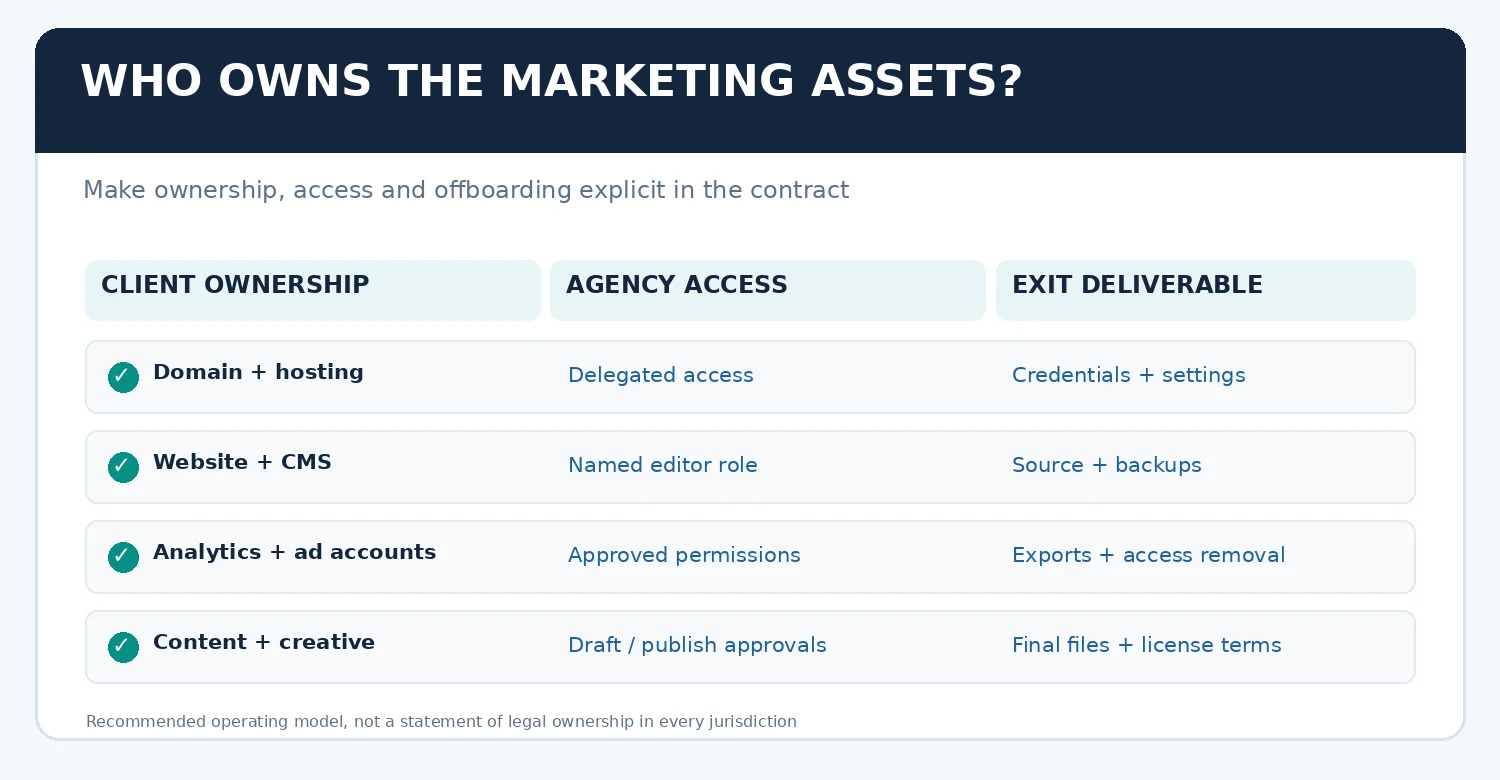
Do not overlook recovery details. Ownership is incomplete if the recovery email or two-factor authentication device belongs to a former employee or outside agency. Ask how credentials are stored and how departing users are removed. This prevents routine personnel changes from becoming expensive control problems.
17. How are confidentiality, personal information and approvals handled?
Ask: “Which information will you receive, who may see it, and how will it be deleted or returned?” A confidentiality promise is most useful when connected to real workflow controls. Adult businesses may have sensitive identity data, profile photographs, unpublished business plans, payment records, private enquiries or staff information. A marketing agency rarely needs every one of these materials to perform keyword research or improve a landing page.
Ask for an access matrix organized by role and purpose. A writer could receive approved public facts and a style brief. A strategist might need aggregated campaign figures. A developer may receive temporary staging credentials. Nobody should receive identity documents, private subscriber messages or customer lists by default. Limit exposure to the minimum necessary for the agreed task.
When an agency processes personal data on a client’s behalf, applicable data protection rules may require specific contractual terms. The UK’s Information Commissioner’s Office explains contracts between controllers and processors, including instructions, security, sub-processors and end-of-contract arrangements. The precise duties depend on the jurisdiction and the parties’ roles, so sensitive cross-border clauses should be reviewed by suitably qualified advisers.
Practical contract questions are still straightforward: Is data encrypted in transit? Are access rights reviewed? What is the breach escalation process? Can the agency use anonymized data in a case study? Will a testimonial or screenshot be published without explicit permission? How quickly can the client demand the removal of sensitive material? The answers should be operationally specific, not just a generic “we take privacy seriously.”
18. Who owns the content, images, code and campaign concepts produced?
Ask: “What rights will transfer after payment, and what remains licensed or proprietary?” Marketing output can include copy, diagrams, photography, design files, code, campaign creative, keyword research, dashboards, templates and third-party assets. They do not all have identical ownership rules. The agreement should say what the business can keep, edit, reuse, publish and transfer to another supplier.
A finished blog article may be assigned to the client, while a licensed stock image remains subject to a third-party license. A custom WordPress theme might include an open-source component. An analytics dashboard may use agency software that the client cannot keep. Those distinctions should be disclosed before delivery rather than revealed when the relationship ends.
Ask whether rights transfer upon creation, acceptance or final payment, and whether the agency can reuse its generic methodology. The United States Copyright Office explains that the concept of works made for hire has specific legal requirements. Do not assume that the phrase alone resolves every commissioned-work ownership issue in every jurisdiction.
For adult businesses, add a separate question about publication and portfolio rights. A client may want to own its content without permitting the agency to display the brand, photos, location, analytics or results publicly. Explicit, project-specific consent is more useful than a hidden blanket promotional license.
19. What is the complete price, including fees that do not appear in the headline retainer?
Ask: “Can you show the total budget by recurring fee, one-time fee, media spend, production and outside costs?” The cheapest advertised retainer is not necessarily the cheapest complete project. A proposal may exclude hosting, paid placements, content production, image licensing, design work, premium software, technical implementation and translation. These can be legitimate costs when they are explained and approved.
A transparent fee schedule lists invoice dates, currency, applicable taxes, minimum commitments, deposit requirements and the person authorized to approve new expenses. It should also clarify whether unused advertising budget stays available, whether a rejected placement is charged, and whether the agency earns a margin on third-party costs.
Consider a purely illustrative, fictional month: a $1,500 management fee, $2,500 in paid media, a $300 media-management surcharge and $400 in approved creative production produce a $4,700 total. That is not an EMA quote or a market benchmark. It demonstrates why comparing a $1,500 retainer with a $4,700 combined invoice is misleading when the scope and pass-through expenses differ.
Ask what happens if the budget is exhausted mid-month, a platform refunds spend, or a requested change requires new production. Written spending limits and prior approval are more reliable than “we will keep costs reasonable.”
20. How long does the agreement last, and how does renewal work?
Ask: “What is the initial commitment, the notice deadline and the exact cost of stopping?” SEO often requires sustained work, but the length of a contract should be a commercial decision informed by the plan, not an unexplained penalty for leaving. Review the start date, minimum term, renewal mechanism, notice window and the effect of early cancellation.
A proposal might offer a short discovery project, a multi-month retainer or a phased engagement that begins with an audit before expanding. Each can be suitable. A phased structure is useful when the site has unknown technical debt, because the client can review evidence before authorizing a larger program. The agreement should say whether the next phase begins automatically or requires a signed approval.
Ask whether a missed renewal deadline creates another long fixed term, whether unused prepaid work is refundable or credited, and whether disputed fees can be separated from undisputed amounts. Keep the cancellation method practical: a named email address and a clear effective date are easier to manage than an informal discussion with a salesperson who may no longer work there.
If the contract includes a performance review, define whether that review changes the scope, changes the price or merely informs the next plan. An annual strategy meeting is not a substitute for a workable exit clause.
21. Which KPIs will be reported, and which are outside the agency’s control?
Ask: “What baseline will we use, which data sources can I inspect, and what do the KPIs mean?” A ranking report is not a complete marketing report. It should be possible to see what changed in the website, what was published, what traffic arrived, which enquiries were measured appropriately, and what the team proposes to do next. Each metric needs a definition that allows fair comparison over time.
For SEO, a useful dashboard may include Search Console clicks and impressions by page type, indexed priority URLs, organic landing pages, work completed and changes awaiting implementation. For paid campaigns, distinguish spend, eligible impressions, clicks and attributable conversions. For social and creator work, separate published output from referral activity and revenue claims that cannot be verified.
Sensitive businesses need privacy-aware measurement. A marketing dashboard should not collect unnecessary personal details to make attribution look more precise. Agree on event definitions, access permissions, data retention and whether reporting can use aggregate counts instead of raw enquiry content.
Google’s SEO hiring guidance explicitly warns against guaranteed top rankings. Ask the provider to commit to controllable work and transparent measurement, while treating future traffic and revenue as projections subject to assumptions, competition and platform behavior.
22. What should the first 30, 60 and 90 days produce?
Ask: “Can I see the initial roadmap, decision points and deliverables before committing to the full term?” The first month should produce a baseline, access inventory, prioritized audit, verified channel plan and agreed content or campaign roadmap. It should also identify who is responsible for implementing urgent fixes. A kickoff call alone is not meaningful progress if nothing has been documented.
By the second month, the team should be implementing approved work, measuring early signals, resolving blocks and reporting what was delivered. By the third month, it should be possible to review the cost of each workstream, identify patterns in the data, refine priorities and decide whether the scope remains suitable. These are review milestones, not promises that rankings or revenue must reach a particular figure by day 90.
Require dependencies to be visible. If the client must supply images, confirm business coverage, review sensitive text or approve a website release, those responsibilities belong in the roadmap. If the provider cannot complete a task because a third-party developer has not deployed it, the report should distinguish recommended, approved, implemented and verified status.

23. What evidence supports the provider’s experience?
Ask: “Can you explain a comparable project, show an appropriate sample and describe what did not work?” A capable provider should be able to describe its approach without exposing a confidential client. Useful evidence might include a redacted audit, an anonymized before-and-after page structure, a sample report, a publishing checklist or an explanation of why one channel was rejected.
Do not require a firm to disclose sensitive adult-industry client identities just to win business. Equally, do not accept invented case studies, unverified rankings, screenshots without dates or testimonials presented without permission. Ask what the figures measure, the period covered and whether they are representative. A thoughtful account of limitations often says more about a provider’s judgment than a dramatic traffic graph.
For a specialized buyer, the most revealing question may be: “Describe a situation where you told a client not to run a campaign.” An agency that can explain its channel restrictions, data safeguards and editorial standards is demonstrating decision quality. An agency that claims every platform, link and keyword is available is not doing the same.
Request a sample report that shows work completed and not completed, not only rising metrics. Compare the sample with the reporting promise in the draft contract.
24. Which answers are warning signs, and which suggest a workable partnership?
Ask: “What would cause us to pause a campaign, and can you show the decision rule?” A useful contract should contain a process for identifying risk, not just general assurances that the provider is trustworthy. The strongest answers tend to acknowledge constraints and give the client visibility into decisions.
|
Warning sign |
Better answer to request |
|---|---|
|
“Guaranteed number-one rankings” |
Defined work, transparent reporting and realistic assumptions |
|
“Our backlinks are secret” |
Publisher criteria, placement records and policy-aware disclosures |
|
“All adult platforms are available” |
Eligibility review by category, geography and creative |
|
“We own all accounts until you leave” |
Client primary ownership and delegated access |
|
“Everything is included” |
Signed deliverables, exclusions and a change-order process |
|
“Your client details make a great case study” |
Explicit consent before any public disclosure |
|
“Cancellation terms are standard” |
Specific notice, cost and handover steps in writing |
Do not turn this table into a test of whether an agency agrees with every client request. A provider may reasonably refuse to guarantee results, share proprietary code, begin work without a deposit or accept unsafe marketing practices. The real question is whether both sides can describe a fair exchange of services, payment, decision rights and accountability.
25. If we leave, what exactly will the agency hand over?
Ask: “Can you attach the exit checklist now rather than invent it at cancellation?” A clean offboarding plan is one of the simplest signs of a mature agency. It should state who can terminate, how notice is delivered, what is owed, when accounts are reviewed and which files or reports are exported.
The practical handover may include approved content, source files where licensed, campaign records, analytics exports, keyword and issue registers, a list of technical changes, access and integration inventories, and outstanding work status. A provider should identify agency-owned tools that cannot be transferred while giving the client reasonable alternatives for maintaining visibility.
Sensitive information needs an end-of-contract plan too. Ask when agency credentials will be disabled, which stored files will be deleted or returned, how backups are treated and whether approved public content may remain live. If an advertising account is in the client’s name, confirm who pauses campaigns and removes payment methods or permissions.
A useful final question is simple: “Could another qualified provider continue this project without rebuilding everything from scratch?” If the answer is no because the first agency holds the only login, the content or the historical data, the contract deserves revision before it is signed.
Frequently asked questions before signing
Is a long-term adult SEO contract always a bad idea?
No. A longer term can make sense when the project requires sustained editorial, technical and reporting work. What matters is whether the term is understandable, the monthly scope is concrete, the reviews are meaningful and the cancellation terms are proportionate. A staged audit and implementation proposal can be a useful alternative when the existing website has substantial unknown problems.
Should I pay for Adult Link Building separately?
Sometimes. Separate pricing helps when publisher fees, outreach labor and content creation vary. It also makes the commercial nature of placements easier to inspect. Ask which costs are included, whether sponsored links are appropriately qualified, and whether each placement will provide genuine editorial or referral value. A purchased backlink should never be presented as a guaranteed ranking result.
Can an adult digital marketing agency promise specific leads or bookings?
It can explain forecast assumptions and set measurable review targets, but a guaranteed result should be treated cautiously. Conversion depends on factors beyond the agency’s control, including search demand, pricing, site usability, operational response and platform restrictions. Request clear definitions, the underlying data and a description of the work that will be completed regardless of outcomes.
Is Adult PPC automatically available for an escort website?
No. Platform eligibility depends on the business category, geography, destination and creative. Some platforms prohibit certain sexual services, while others restrict content or permit advertising only in narrow circumstances. Require a documented eligibility review before authorizing setup and ad spend. The agency should propose compliant alternatives rather than promising to bypass a platform’s checks.
Can I keep the articles and images if I end the contract?
That depends on the written ownership and licensing terms. Request an asset schedule that distinguishes assigned original work, third-party images, templates, software licenses and agency tools. Clarify when rights transfer and what happens to editable files. Protecting the business’s ability to use the content after offboarding should be settled before production begins.
What if the agency refuses to share client case studies?
Confidentiality can be a legitimate reason, especially in sensitive industries. Ask for redacted workflows, sample audits, anonymized outcomes with proper context or a demonstration using your own site. The provider should still be able to explain its decisions, methods and reporting standards without revealing someone else’s private information.
Final checklist: sign for a process you can inspect
A sound adult marketing contract does not need to promise a miracle. It needs to explain what the provider will do, who approves that work, how it will be measured, what it will cost, who controls the assets and what happens if the relationship ends. The right agreement protects a business’s ability to make informed decisions while giving the agency a workable scope and timely payment.
Before signing, ask the provider to walk through one proposed month line by line. Check the included channels against actual platform policies, verify the ownership schedule, examine a real reporting sample and request the exit checklist. If important points remain unclear, revise the scope before making the first payment.
For an assessment focused on lawful, privacy-aware marketing for adult businesses, contact Escort Marketing Agency and request a confidential review of your website, proposed channels and contract scope. The purpose of that discussion should be to find an approach that fits your business, not to sell services you do not need.
Emily Thompson
Content Writer
Writes EMA’s adult SEO and escort marketing coverage, working from the accounts the team runs. Commercial detail in every engagement stays under NDA.