Blog
What Does the First Month of SEO for a Multi-City Escort Agency Look Like, and What Does It Cost?
By Emily Thompson, Content Writer Published Updated 35 min read
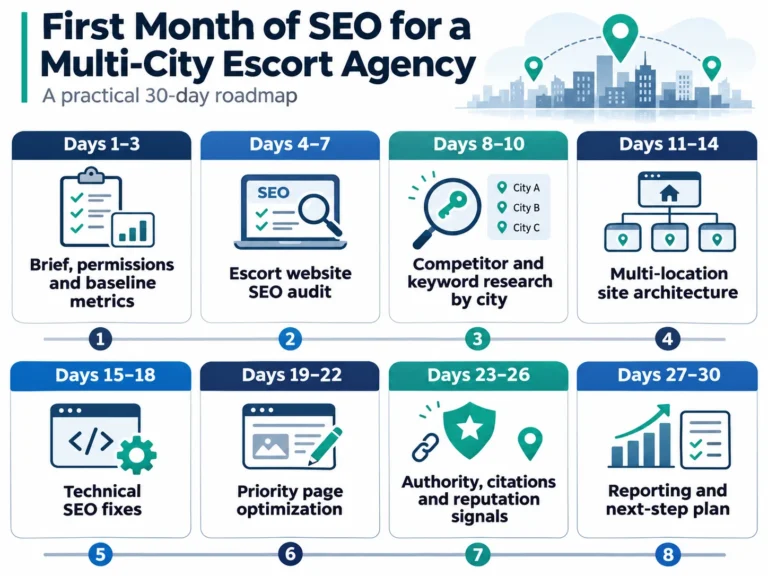
A multi-city escort agency does not need thirty versions of the same landing page or a promise of first-page rankings in four weeks. It needs a website that search engines can understand, city pages that deserve to exist, profiles that are accurately connected to real markets, and a clear way to measure progress without compromising anyone’s privacy. The first month is when those foundations are established.
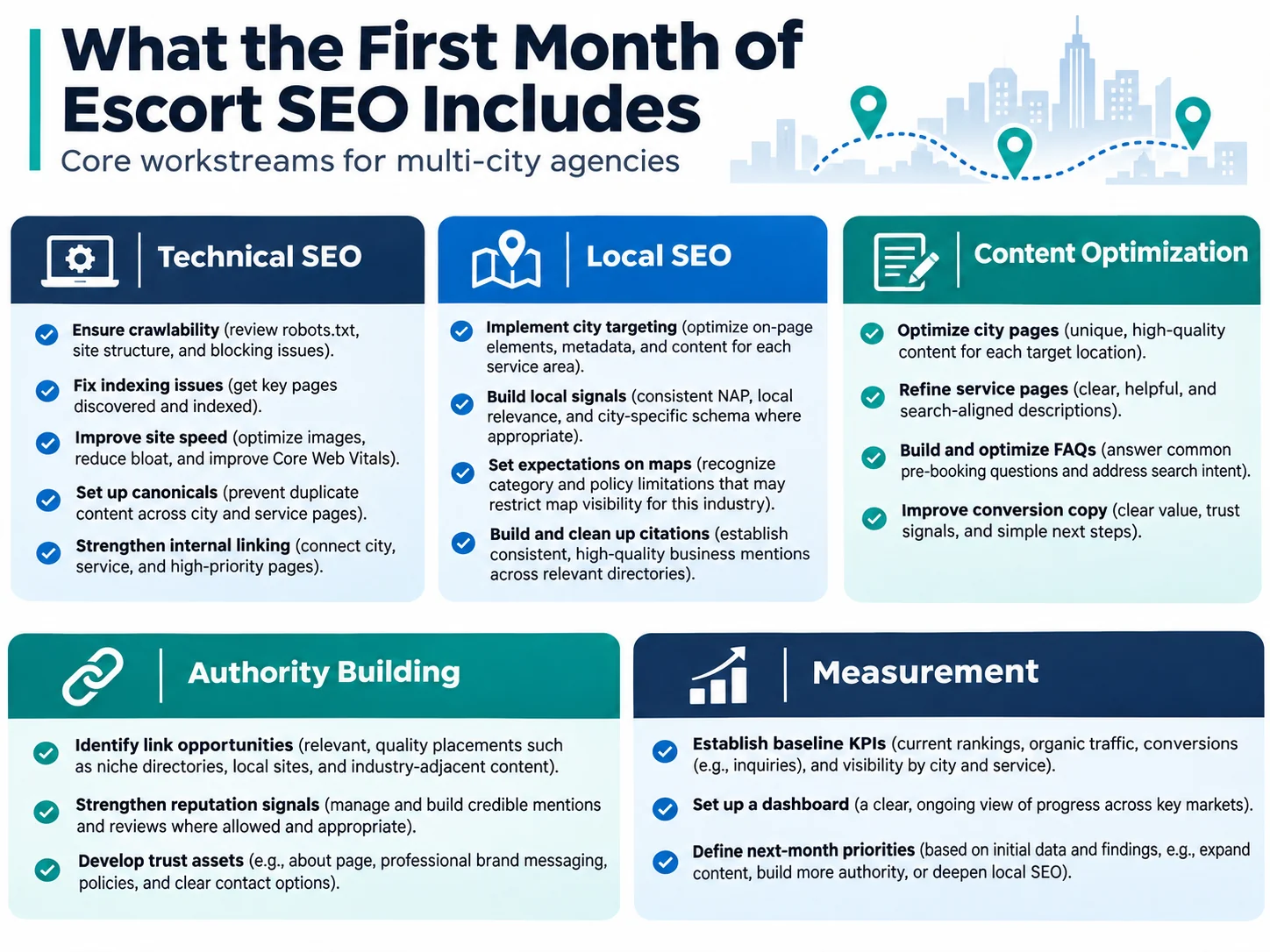
For an established agency serving several cities, the first 30 days of Escort SEO usually include a technical and content audit, competitor research, a city-by-city keyword map, fixes to high-impact indexing problems, improvements to priority location and profile pages, an ethical authority-building plan, and baseline reporting. Not every task is finished in month one. The campaign should end with documented improvements, an owner for remaining issues, and a practical plan for the next 60 to 90 days.
What does it cost? Escort Marketing Agency (EMA) currently publishes escort agency SEO plans starting at $599 per month for one to three cities, $799 for four to six, and $999 for seven or more markets, subject to the final scope and a three-month minimum. Its separate enterprise SEO tiers begin at $2,499, $3,999, and $4,999 per month for progressively larger and more complex operations, with longer minimum terms. These are published starting prices, not a quote for an unknown website. An agency with twelve markets, thousands of changing profiles, legacy technical problems, and several languages requires a different level of work from a five-city agency with a clean website. See EMA escort agency SEO services and enterprise SEO services for current plan details.
This guide explains what a responsible first month should produce, why multi-city work costs more, how to compare proposals, and what an agency owner can reasonably expect before rankings begin to move.
First-month SEO at a glance
A useful first-month campaign answers five questions. Can Google crawl the important pages? Which cities and page types have a genuine opportunity? What prevents visitors from trusting and using those pages? Which fixes can be implemented safely now? How will the owner judge whether the monthly fee bought meaningful work? Those questions are more valuable than a long list of unchecked SEO tasks.
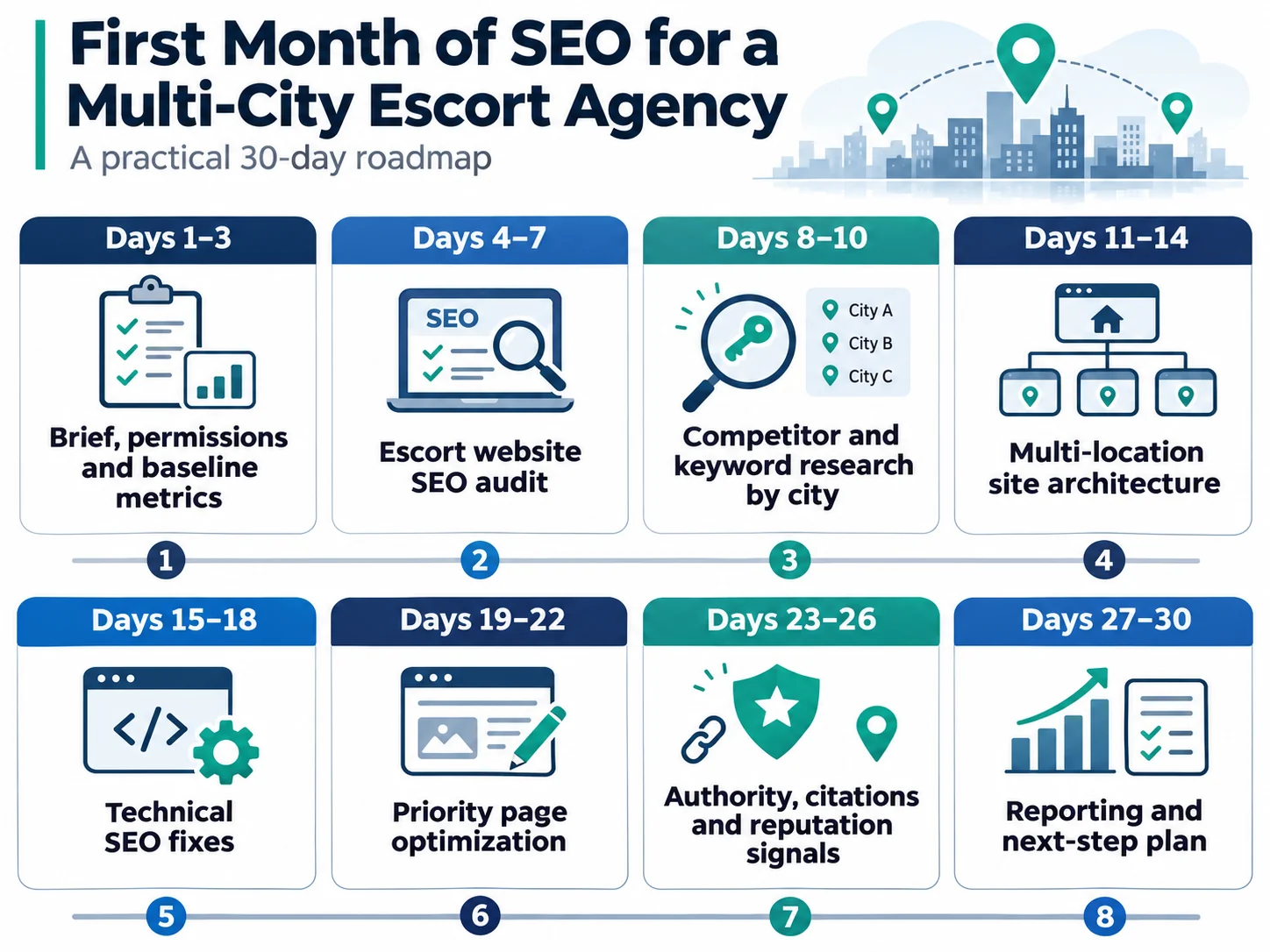
|
Period |
Main focus |
Tangible output |
|---|---|---|
|
Days 1-3 |
Confidential onboarding, access, goals and baseline |
Access register, measurement baseline, market list |
|
Days 4-7 |
Technical and content audit |
Prioritized issue register with owners and severity |
|
Days 8-10 |
Competitors and search intent by city |
Keyword-to-page map and opportunity scores |
|
Days 11-14 |
Architecture and city-page decisions |
URL map, canonical strategy and content briefs |
|
Days 15-18 |
High-impact technical fixes |
Tested changes, crawl checks and release notes |
|
Days 19-22 |
Priority city and profile improvements |
Improved templates and initial editorial pages |
|
Days 23-26 |
Authority, citations and trust review |
Link-risk review, outreach shortlist and trust fixes |
|
Days 27-30 |
Measurement and next-quarter planning |
Before-and-after report and 60-90 day roadmap |
The calendar is a working example rather than a guarantee of completion dates. A development backlog, slow approvals, sensitive profile information, or a major site migration can shift the order. Strong monthly SEO services for escort websites make those dependencies visible instead of quietly billing for work that could not be deployed.
Why the first month is different for a multi-city agency
A one-location business may need one strong service page, a few supporting explanations, and basic technical maintenance. A multi-location escort agency has an additional layer of complexity: each city competes against different websites, each market may have a different roster, and the same person or brand may legitimately appear in more than one location. Search engines must distinguish real differences from near-duplicate pages made only to capture traffic.
Consider an illustrative agency active in London, Manchester, Birmingham, Liverpool, Leeds and Bristol. London may have a large inventory of established competing sites. A smaller market might have fewer direct competitors but weaker evidence of local service coverage. The agency’s London page could already attract impressions while its Bristol page is barely discovered. Buying the same five articles for each city would ignore those differences.
Multi-city escort SEO therefore has two simultaneous jobs. First, it improves the shared website: navigation, crawlability, speed, profile templates, branding, and trust. Second, it improves the city-specific experience: actual coverage, useful local information, relevant profiles, accurate status, and measured organic visibility. The website should support both jobs without multiplying maintenance problems.
A second distinction is privacy. A normal local business might showcase staff names, office photographs, client reviews, and an exact public address. An adult-industry business often cannot or should not publish those details. Ethical SEO works with approved business facts, properly authorized images, clear policies, and truthful contact information. It never assumes that personal information should be made public merely because it might help a search result.
A third difference is how Google treats explicit content. Its guidelines for sites with explicit content explain that SafeSearch can filter sex-oriented dating and escort services, and that crawlers must be able to access relevant material for accurate classification. Optimization cannot override user filtering preferences or make an adult result eligible for every search feature. The plan must set expectations accordingly.
Days 1-3: Establish the brief, permissions and starting numbers
A credible SEO campaign begins with a business conversation, not a crawler report. The agency owner and SEO strategist agree on which cities are actually served, which markets are profitable enough to prioritize, who approves public copy, and what the website can safely disclose. If a new market is only being considered, it should not be represented as an operational location.
For the first three days, record the website’s current structure, languages, city coverage, typical profile turnover, publishing workflow, and known technical problems. Assign a single owner for approvals. Decide which information is confidential, which is suitable for public pages, and which data should be minimized or excluded from analytics. A professional escort SEO agency should not require access to client conversations, private identity documents, or booking records to carry out ordinary search optimization.
Next, request the minimum working access: read access to Google Search Console, suitably restricted analytics access, a list of important URLs, and a technical point of contact. CMS or hosting permissions should follow least-privilege principles. Changes to DNS, redirects, live templates, or tracking should require explicit approval and a rollback route. Establish how backups are made before any release.
Then take a baseline. Export recent Search Console data by query, landing page and country. Record impressions, clicks, average position, and whether important location pages are indexed. Add a small rank-tracking set for each priority city, but do not mistake third-party ranking snapshots for actual traffic. Review organic enquiries only where consent and privacy controls allow it. The first report should identify what is measurable today and what is not.
Deliverable: a one-page campaign charter, access register, prioritized city list, privacy rules, analytics checklist, and baseline export. If a provider cannot show the starting point, it will struggle to demonstrate the difference its work made.
Decide what success means before choosing keywords
The owner may say, "We want more Google traffic," but traffic alone is not a useful business objective. Some clicks arrive for people researching a general subject, while others arrive on a brand page or city landing page. The campaign should separate those audiences rather than count every visit as equal.
For the first quarter, sensible measures include a greater share of priority pages indexed, fewer canonical or redirect errors, improved visibility on the selected city pages, clearer organic enquiry attribution, and faster page publishing without duplicates. Later, qualified enquiries and contribution to business revenue may become important, but they require consistent tracking and appropriate privacy safeguards.
Set targets as planning ranges, not promises. For example, the team may aim to resolve every critical indexing error affecting its five priority cities in month one. That is a controllable delivery target. Promising a top-three ranking by day 30 is not. A good escort SEO campaign roadmap distinguishes controllable work from search-engine outcomes.
Days 4-7: Complete the escort website SEO audit
An escort website SEO audit should explain the website’s underlying problems and rank them by business impact. It is not enough to export hundreds of errors from a tool. On a multi-city website, the audit must connect each finding to the affected page type, market, likely severity, and proposed fix.
Start with crawl and indexation. Check important pages for successful HTTP responses, accidental noindex instructions, blocked resources, redirect loops, stale internal links, inconsistent canonical signals, and XML sitemap errors. Compare the agency’s intended indexable URLs with what Google has selected. Remember that a sitemap helps discovery but cannot force indexing. Google’s sitemap guidance makes that distinction explicit.
Then inspect the templates. City pages, profile pages, guides, contact pages, filtered results, and archived profiles behave differently. A problem in one shared template might affect hundreds of URLs. A unique flaw on one profitable city page might matter more than twenty small issues on low-priority pages. Identify both. Test mobile rendering, form journeys, navigation, speed, security, and the way search engines see important text.
The audit should also address content quality. Are city pages mostly identical? Do profiles use copied descriptions? Does a person have multiple URLs because they work in several cities? Do temporary travel pages remain indexable after the event? Are old profiles generating dead ends? Do a site’s visible statements match the actual coverage and contact process? These are operational questions disguised as SEO questions.
Finally, review backlinks, security warnings, manual actions, brand mentions, public citations, and any historical migrations. An unusual backlink pattern is a reason to investigate, not proof of an attack. Do not automatically disavow links or remove large page groups because an automated tool assigns a low score. Such actions need evidence and a defensible plan.
What a prioritized audit should look like
A useful audit contains four fields for each issue: evidence, affected URLs, recommended change, and owner. A fifth field identifies how the team will confirm that the fix worked. Severity should reflect business impact, not simply what software calls "critical."
|
Example finding |
Priority |
Proposed response |
Verification |
|---|---|---|---|
|
Five live city pages contain noindex |
Critical |
Correct templates after approval |
Re-crawl and inspect representative URLs |
|
Two profile URLs show the same person |
High |
Select one authoritative profile URL |
Check canonical, links and index status |
|
Mobile enquiry form fails on one city page |
High |
Fix form and test user journey |
Test successful submissions without exposing personal data |
|
Old tour pages still appear in navigation |
Medium |
Retire or update based on real status |
Check internal links and appropriate HTTP response |
|
Several images lack useful descriptions |
Lower |
Add accurate, non-graphic alt text where appropriate |
Manual editorial review |
This is how technical SEO for escort websites becomes understandable to an owner. The report should say, "Five operational city pages cannot be indexed because of a template rule," not merely "meta robots issue: 5 URLs." It should also make clear whether a fix is already implemented, pending approval, or awaiting a developer.
Days 8-10: Research competitors and map search intent city by city
Keyword research for a multi-city operation is not a list of every phrase containing the word "escort." It is a decision about which real searches match the agency’s actual offering and which landing page can answer each search. The first round should cover the agency brand, priority cities, approved service descriptions, profile names where authorized, and useful informational questions.
For each city, compare the pages currently visible for relevant searches. A directory, an independent website, and another agency may all appear, but their page types answer different questions. Record the recurring format, what information visitors receive, how clearly the page represents the market, and whether the competitor’s advantages are structural or editorial. A high-ranked page is not automatically a safe model to copy.
Create one keyword-to-URL map. If "agency in City A" and "City A agency profiles" express essentially the same intent and one page can serve both well, do not manufacture two weak pages solely to split exact-match phrases. If a second page solves a distinct task, such as employment enquiries or a genuinely separate service category, justify it on that basis. The keyword map should prevent multiple pages on the same website from competing for an indistinguishable purpose.
Use three planning tiers. Tier one consists of established cities where the site already has impressions or genuine demand. Tier two includes active cities with useful content gaps and manageable technical work. Tier three contains exploratory markets without enough evidence to justify separate landing pages yet. An agency does not have to launch pages for every possible city in the first month.
An illustrative six-city prioritization model
Imagine a business with six confirmed operating cities. Its first-month scorecard might combine current search visibility, business priority, page readiness, competitive difficulty, and the effort to improve each page. The numbers below are a fictional planning example, not traffic research or an EMA client result.
|
Market |
Existing condition |
First-month action |
Reason |
|---|---|---|---|
|
London |
Important page has impressions but weak internal links |
Improve navigation and content clarity |
Opportunity already exists |
|
Manchester |
Two similar city URLs compete |
Consolidate or differentiate correctly |
Remove internal confusion |
|
Birmingham |
Real coverage but incomplete page |
Develop verified local information |
Useful page can be improved |
|
Leeds |
Crawlable page with poor mobile experience |
Fix template and enquiry flow |
Technical and usability blocker |
|
Liverpool |
Genuine service, low existing visibility |
Create research-backed brief |
Build next-quarter pipeline |
|
Bristol |
Proposed expansion, not yet active |
Hold publication |
Do not invent local operations |
The key decision is not which city has the largest search volume. It is which city has an honest service proposition, a realistic search opportunity, and a page the team can make substantially better. Research should expose trade-offs, not create a false impression that every market can be conquered at once.
Days 11-14: Design the multi-location page architecture
Architecture is one of the most important parts of SEO for multi-location escort agencies because every new city and profile changes how the site is navigated. The goal is a predictable set of pages that people can reach without sorting through hundreds of irrelevant links. Search engines should see a meaningful hierarchy rather than dozens of disconnected keyword pages.
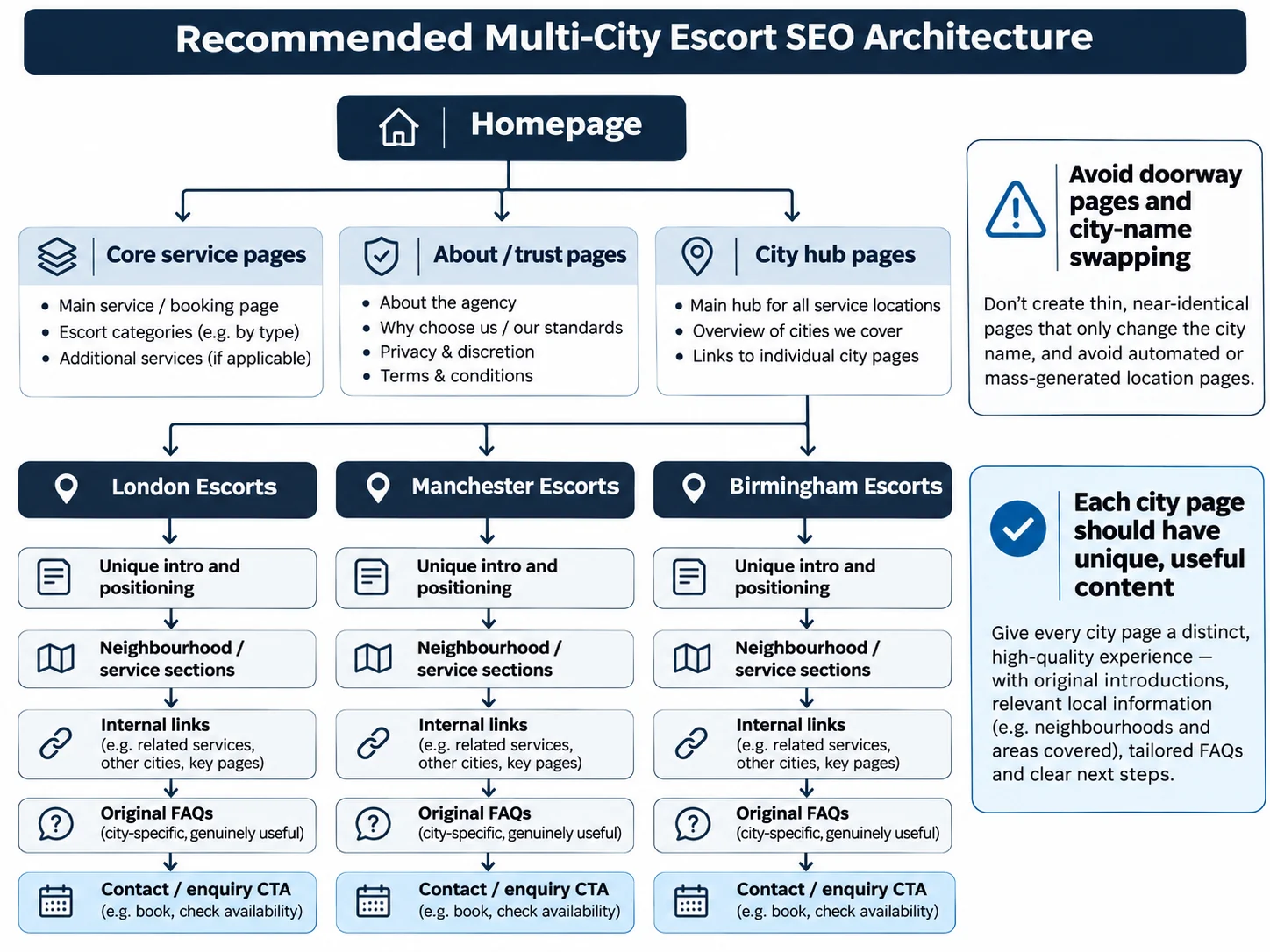
An agency operating under one brand may use a straightforward structure: the homepage introduces the company, a locations hub summarizes real coverage, each active city has a dedicated page when justified, and each approved profile has one primary URL. City pages can show relevant profiles without generating separate copies of those profiles for every location. A useful editorial article can link to the city page when it naturally extends the reader’s question.
Suppose one person is available in Manchester and Leeds on different dates. Creating two copies of the profile with slightly altered text can lead to duplication and maintenance errors. A single profile page, with accurate current coverage, can be linked from both cities. If separate pages truly represent different content, the site needs a distinct purpose for each rather than a cosmetic change to the URL.
Google treats redirects and rel="canonical" tags as strong canonical signals, and sitemap inclusion as a weaker signal. Its canonicalization guidance also explains that canonical hints are not absolute commands. For genuinely unique city pages, a blanket canonical to the homepage would be counterproductive. Decide based on actual duplicate relationships.
Avoid city-name swapping and doorway pages
The most tempting shortcut is to produce twenty pages that differ only in the city name. This can waste editorial budget, make maintenance difficult, and create a quality risk. Google’s spam policies describe doorway abuse, including similar regional pages that funnel users to one destination without providing distinct value. The issue is not having many city pages; it is having many pages whose only purpose is to intercept similar searches.
A useful test is simple. If the city name were removed, would the page still contain information unique to that market? Could a visitor understand which profiles or services are genuinely available there, any practical differences in coverage, and the correct way to contact the business? If the answer is no, the page may need a stronger brief or may not merit its own URL.
A second test is whether the page belongs in the site’s normal navigation. If it would be embarrassing or confusing to show an ordinary visitor, publishing it solely for search traffic is questionable. A third test is maintenance ownership: who will update the page when coverage changes? SEO content that becomes inaccurate quickly can undermine the very trust it was meant to build.
Days 15-18: Implement the highest-impact technical fixes
Technical SEO for escort websites should prioritize changes that remove real obstacles. On a large roster site, fixing a common template can help more pages than editing isolated meta tags. On a smaller site, restoring crawlability for two business-critical city pages might matter more than a comprehensive redesign. The audit should determine the order.
Typical first fixes include correcting accidental noindex directives, resolving broken canonical tags, restoring lost internal links, repairing mobile forms, fixing significant redirect problems, making key content accessible in rendered HTML, and updating the XML sitemap so it includes intended canonical URLs. Check the response codes and HTML after deployment, not only in the CMS preview.
Not every technical finding deserves immediate action. Google’s crawl budget documentation is aimed primarily at very large or rapidly changing sites, not every small business with a few hundred pages. Claiming that a ten-page agency website requires elaborate crawl-budget engineering is not a sign of sophistication. By contrast, a directory with thousands of filtered URLs may genuinely require careful URL discovery and indexation controls.
Age gates deserve special consideration. Google advises adult-content sites to allow verified Googlebot to crawl appropriate material despite an age gate; otherwise the crawler may not see the content accurately. This does not mean removing access safeguards for visitors or bypassing applicable obligations. The technical implementation must preserve the intended user experience while allowing legitimate search-engine processing in line with Google’s guidance.
Before deployment, stage sensitive changes where possible. Keep a list of URLs to test, obtain sign-off for template edits, create backups, and confirm that the new experience works on mobile. After deployment, record the exact change date. If rankings later fluctuate, that release history is part of the diagnosis.
Days 19-22: Improve the pages that matter most
Once the site is technically stable, on-page changes should focus on a small number of priority URLs. The team should not claim that every city has been fully optimized after editing a shared template. A template improvement is valuable, but it does not replace the research and fact-checking required for individual pages.
Choose two or three city pages with demonstrable business importance, and use them to establish an editorial standard. Review the title, main heading, opening explanation, real coverage information, approved profile links, enquiry guidance, trust information, and any useful questions that visitors repeatedly ask. Make the text easy to scan without repeating the main keyword in every heading. A helpful page should sound like it was written for a visitor evaluating that location, not for an algorithm matching a city name.
A parallel effort should improve the profile template. Check that names are used consistently with approval, images and descriptions are authorized, contact routes are current, and closed or unavailable listings are managed responsibly. A profile that disappears from service should not automatically redirect everyone to an unrelated homepage. Its appropriate treatment depends on whether there is a close substitute, a meaningful archived explanation, or no reason to keep it live.
At this stage, create an editorial backlog for additional city pages and supporting articles. Every brief should identify a real reader question, the facts needed to answer it, a suitable page owner, and the intended internal links. One well-researched page is more valuable than a dozen unsupported claims written around a keyword list. The first month may publish only a few pages because the infrastructure and fact-checking need to be established first.
What should a strong city page actually contain?
A strong city page has a purpose that survives the removal of its SEO title. It should give a person seeking the agency’s business information a clear picture of actual coverage, available approved profiles or categories, how to make an enquiry, and any limitations that affect the market. The content should be current, precise, and appropriately discreet.
For example, a Manchester page could explain which broad areas are supported, whether the business accepts enquiries from visitors outside the immediate city, what information is needed for a general enquiry, and which profiles or categories are relevant to that market. A London page might need a more detailed navigation structure because coverage is broader. Both pages can use the same design system, but their useful facts should not be interchangeable.
A suitable page framework has six components. The introduction establishes the business and actual market. A coverage section describes verified geographic relevance without manufacturing an address. A selection or profile section links to current, approved listings. A process section explains legitimate contact steps in a non-graphic manner. A trust section clarifies privacy expectations and content accuracy. Finally, a short FAQ answers questions specific to that page.
City landing pages should link to a locations hub and closely related resources, but avoid enormous footers containing every keyword and every neighborhood. Where a page needs frequent updates, use structured information in the CMS so that status changes can be applied reliably. Editorial teams should have a simple way to see which city page is due for review.
BrightLocal’s location-page guide makes a useful general point: every location URL must justify its existence with helpful, location-specific information. That principle is particularly relevant when several cities share one brand and the same profile database. The objective is not to make every paragraph artificially different. It is to represent real differences accurately.
Profile and roster SEO without duplicating people
For a multi-city agency, profile quality can be a larger long-term opportunity than adding generic blog posts. Each authorized public profile should have one clear identity, descriptive text that has been reviewed for accuracy, and meaningful links from the appropriate locations. Search engines and visitors should not have to guess which of several conflicting pages is current.
Separate stable information from changeable data. Approved biography text, general professional background and permitted images may remain stable. City association, availability status, temporary travel plans, and contact details can change. A content system that distinguishes those fields reduces the temptation to create a new URL every time a person travels or a schedule changes.
Do not import photographs or biographies from third-party directories without permission. Do not republish personal phone numbers, addresses or legal names in an attempt to gain authority. A consent and editorial review workflow is part of quality control, not a distraction from SEO. The same is true of moderation on any user-generated listing or comment feature.
The editorial team can still improve discoverability with accurate titles, descriptive internal links, clean image handling, and a logical relationship between city pages and profiles. Those are controllable improvements. They avoid the risks of fabricating reviews, attributes, or locations to fill out a template.
Days 23-26: Review authority, citations and reputation signals
This phase examines what trustworthy third parties say about the business and how people discover it outside the website. It should begin with an audit of existing links, citations and directory listings, not a target such as "buy 50 backlinks this month." The strongest opportunities are often correcting outdated information, reclaiming valid mentions, improving owned profiles on relevant directories, and contributing useful editorial information where it is genuinely welcome.
Adult industry link building is more restricted than many general SEO campaigns because numerous publishers decline adult-industry commercial content. That does not justify deceptive outreach, hidden sponsorships or automated networks. Google explicitly treats buying links for ranking purposes, excessive exchanges and low-quality directory links as link spam. Paid promotional placements should be properly qualified with rel="sponsored" or rel="nofollow" as appropriate. See Google’s link spam policy and its guidance on sponsored content.
A responsible first-month authority program may produce a shortlist of appropriate publishers, a record of current relevant links, outreach drafts that can be reviewed, and corrections to inaccurate directory citations. Actual editorial coverage depends on publisher choice and cannot be guaranteed. Judge opportunities on topical fit, real readership, editorial standards, transparency and risk, not only a third-party domain metric. Domain Authority and similar scores are useful comparative tools, not Google ranking factors or proof that a link will help.
Reputation work has boundaries too. Do not invent testimonials, buy ratings, or imply endorsement from organizations that have not given it. Verify branded listings and make sure names, business information and official site links are consistent. For adult businesses, authenticity and discretion matter more than making every directory profile as public as possible.
Is Google Business Profile part of local SEO for escort agencies?
Local SEO for escort agencies often means relevance to specific cities in organic search, not the assumption that every agency can obtain a Google Maps listing. Google’s Business Profile guidelines require eligible businesses to represent real-world operations accurately. Its restricted-content policies place limitations on promotion of adult services. Eligibility and acceptable content must be assessed for the particular business and current policy; it is unsafe to promise map placements as a routine deliverable.
Do not create fake offices in every target city, rent mailbox addresses solely to claim extra profiles, or place misleading pins where no genuine qualifying operation exists. A multi-city website can target genuine regional search intent organically without inventing multiple Business Profiles. If an eligible physical operation exists, its representation must still comply with the platform’s rules and avoid prohibited promotional content.
A practical alternative is to improve accurate city landing pages, maintain legitimately applicable directories, link profiles correctly, and monitor organic landing-page performance by market. That is a substantial local-search strategy even when a map-pack listing is unavailable. The campaign should distinguish location relevance from physical-location eligibility, because confusing the two can waste budget and create account risk.
Days 27-30: Report what changed, what did not, and what happens next
The last four days should not be a scramble to produce a flattering ranking screenshot. They are the point at which the SEO provider shows the owner a traceable record of work. A useful report separates completed changes, changes awaiting approval, early search observations, unresolved technical issues, and next-month priorities.
For every material technical release, include a change date and evidence of verification. For every updated city page, identify the URL and editorial changes. For each new content asset, state whether it is drafted, approved, published, or awaiting indexing. For off-site work, separate vetted opportunities, outreach actually sent, editorial responses, published coverage and links. These are different stages and should never be grouped as "links delivered."
Include city-level measurement. Compare the same time periods where possible, note seasonality and known tracking changes, and disclose when the data is too thin for a conclusion. Google Search Console offers page- and query-level performance and indexing information, as described in its getting-started guidance. First-month volatility does not establish that a campaign is succeeding or failing on its own.
The 30-day report should also recommend the next 60 to 90 days. Which cities receive editorial work next? Which template fixes are pending? Are any locations being removed because the business no longer serves them? Which approved profiles need rewriting? What evidence would justify expanding a larger enterprise campaign? Those decisions convert an audit and a few fixes into an ongoing operating plan.
A reporting dashboard that a business owner can understand
Avoid a dashboard filled only with technical metrics. Give each measure a purpose and connect it to a decision. A useful report may track six categories: discoverability, city visibility, content quality, site health, enquiry experience, and work delivery. Not all should be treated as direct SEO ranking signals.
|
Measure |
What it answers |
Appropriate first-month interpretation |
|---|---|---|
|
Important URLs indexed |
Can Google show the pages we need? |
Confirm status and investigate exceptions |
|
Organic clicks by city page |
Are visitors finding the right markets? |
Establish baseline; avoid premature attribution |
|
Search impressions by city |
Are pages becoming visible for relevant searches? |
Directional only over short windows |
|
Priority issues fixed |
Is the website becoming technically sound? |
Direct evidence of work completed |
|
Enquiry-form success rate |
Can visitors use the website? |
Verify usability and tracking, with consent |
|
Approved pages published |
Is editorial execution on schedule? |
Separate draft, live, and indexed states |
Strong reporting is honest about what it cannot measure. An agency may avoid storing sensitive enquiry contents in analytics, while still measuring whether a properly configured contact button or form was used. That is better than collecting more private information than the marketing team needs.
Escort SEO pricing: what does the first month actually cost?
Escort SEO pricing depends on the business model, the number of markets, technical condition, current content, competition, and the quantity of work that the supplier agrees to complete. The first month can cost the same as the normal retainer when the audit is included, or it can be higher when a large migration, redevelopment or deep data cleanup is quoted separately. The written proposal should make the distinction explicit.
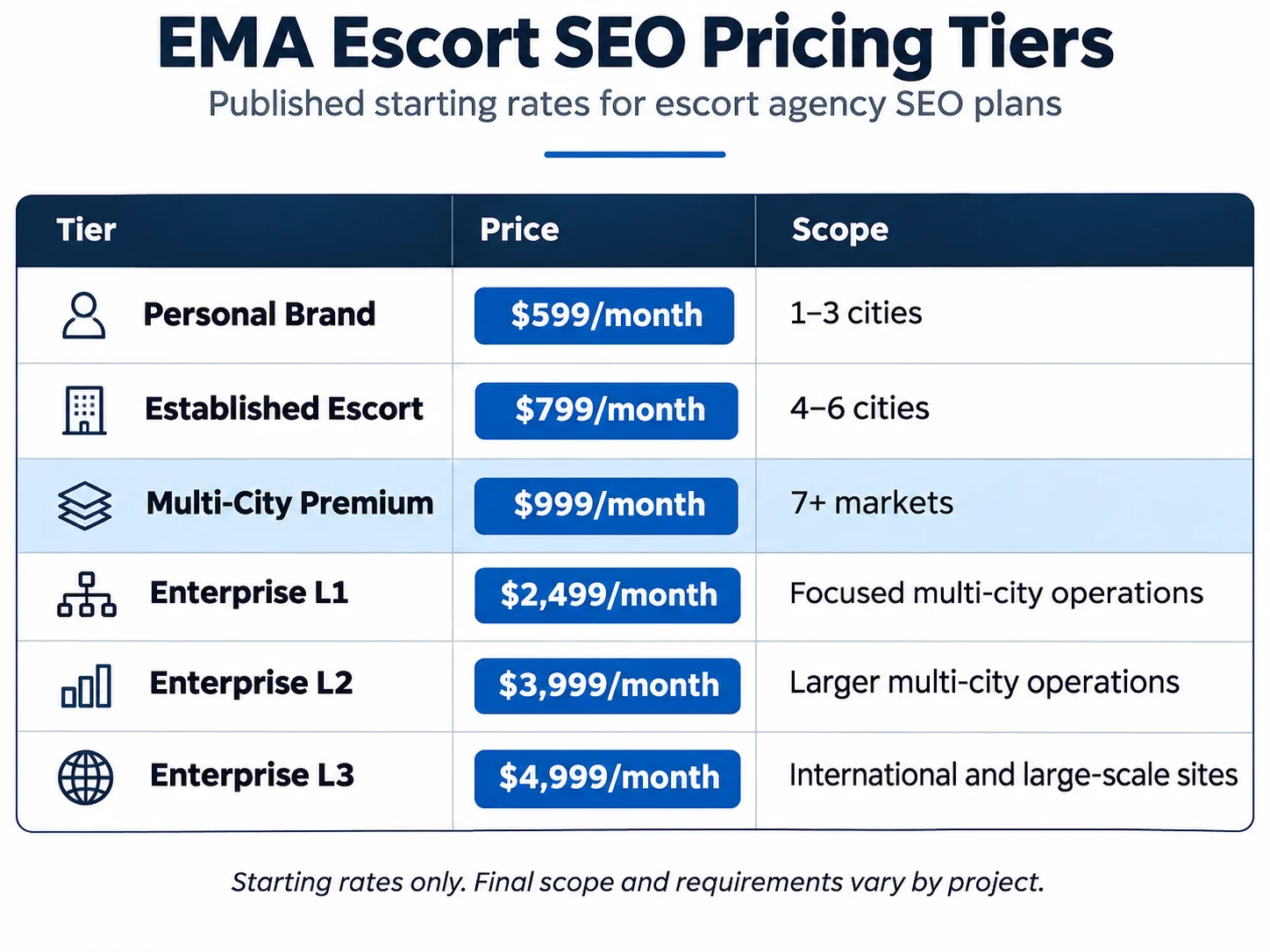
EMA publishes dedicated escort agency SEO services with the following entry points, reviewed in November 2026. The $599 plan targets agencies in one to three cities, the $799 plan is positioned for four to six, and the $999 plan targets seven or more markets. Each is listed per month with a three-month minimum and a final scope confirmed after review. They are not interchangeable with unlimited custom development work. See the current escort agency SEO package page.
Larger operations can be better suited to Enterprise escort SEO. EMA’s separate enterprise SEO services page lists L1 from $2,499 per month with a six-month minimum, L2 from $3,999 per month with an eight-month minimum, and L3 from $4,999 per month with an eight-month minimum. Those tiers are intended for increasingly complex, multi-city, international or platform-scale websites. The final price and scope still require an audit.
|
EMA published plan |
Monthly starting price, USD |
Typical scope positioning |
Listed minimum term |
|---|---|---|---|
|
Agency Personal Brand |
$599 |
1-3 cities; foundational technical, page and reporting work |
3 months |
|
Agency Established Escort |
$799 |
4-6 cities; broader content and city coverage |
3 months |
|
Agency Multi-City Premium |
$999 |
7+ markets; larger roster and international needs |
3 months |
|
Enterprise L1 |
$2,499 |
Focused group of cities in one country |
6 months |
|
Enterprise L2 |
$3,999 |
Multiple cities or additional-country complexity |
8 months |
|
Enterprise L3 |
$4,999 |
Large international or database-driven operations |
8 months |
These published rates answer the headline question more honestly than a generic "SEO costs $500 to $10,000" range. However, they still do not price a specific website until the agency determines what is included, what is excluded, whether development resources are available, and what approval process is required. Published pricing and a signed scope of work are not the same thing.
How do those prices compare with wider SEO markets?
The general SEO industry is an imperfect comparison because an ordinary local business and an adult-industry platform have different publishing, compliance and distribution constraints. Still, broader prices establish context. In an Ahrefs survey of 439 providers, reported agency retainers averaged about $3,209 per month, although the distribution covered substantially cheaper and more expensive work. The survey is not a study of escort SEO, and its averages should not be used as a forecast for this niche.
Public adult-industry providers also use different packages. Wave69 lists escort agency SEO tiers from roughly GBP 500 to GBP 1,200 per month, while some providers prefer bespoke quotes rather than a public fixed-price menu. Different currencies, jurisdictions, minimum commitments, content volumes and link arrangements prevent a direct apples-to-apples comparison. A cheaper plan that excludes technical implementation may ultimately cost more than a higher retainer that includes approved development work.
The most useful comparison is the deliverable, not the headline price. Ask how many pages will be evaluated and updated, who creates approved local facts, what development capacity is included, what happens to old profiles, whether link outreach is editorial and compliant, and how success will be measured. The scope explains the cost.
What determines the monthly Escort SEO cost?
Two agencies serving eight cities can face radically different workloads. One may have a relatively small website with a stable roster and clean templates. The other may have a large database of changing listings, copied historical content, duplicate regional URLs, and unresolved migrations. Counting city names alone will not reveal the difference.
The Escort SEO cost is driven by six practical factors. The first is site size and architecture: more indexable templates and dynamic pages mean more auditing and quality control. The second is market competition: an established major city may demand deeper content and authority work. The third is technical debt: serious crawl, canonical, rendering or hosting problems can consume the opening sprint. The fourth is editorial complexity: verifying city facts, obtaining approvals and protecting profile privacy takes real time. The fifth is international scope: languages, country-specific content and alternate-language implementation create additional work. The sixth is resources included: strategy alone is different from strategy plus a developer, editor, analyst and outreach support.
A quotation should also disclose whether website hosting, paid tools, website redevelopment, translation, copywriting, photography, content moderation and any sponsored publishing are included. Do not assume an SEO retainer pays for everything involved in running or developing the website. If the provider proposes a separate setup fee, request a clear list of deliverables and how those tasks differ from the first retainer month.
Three illustrative first-month budgets
The following scenarios are planning examples created for this guide, not actual client quotations, market averages or promises of results. They demonstrate how an owner could think about scope before a formal audit.
Scenario A: A growing five-city agency. The website has one main location hub, five active city pages, around thirty approved profiles, and no known major migration. An entry discussion might begin with EMA’s publicly listed $799/month agency tier for four to six cities. The first month could concentrate on an audit, core technical fixes, the first two city pages, a template review and reporting setup. Anything beyond the agreed content or development limits must be documented rather than implied.
Scenario B: A ten-city agency with inconsistent pages. The website has multiple duplicate profiles, several years of outdated tour pages, and unclear canonical behavior. EMA’s published $999/month Multi-City Premium tier is a reference point, but an effective scope may require separate cleanup or a higher enterprise engagement if database and development work are substantial. The owner should ask for a phased quote: immediate indexation blockers first, content architecture second, wider editorial rollout third.
Scenario C: A multi-country directory-style platform. The business manages thousands of URLs, dynamic location filters, regional languages, and frequent listing changes. This is closer to enterprise SEO than a fixed small-agency plan. EMA lists enterprise tiers beginning at $2,499/month, with $3,999 and $4,999 entry points for larger complexities. A first-month work plan might prioritize template auditing, crawling controls, data governance, international mapping and release management before commissioning a large batch of new pages.
These examples show why the most expensive mistake is not always buying an expensive retainer. It can be buying a plan too small to fix the core problem, or paying for many pages before the website has a sound structure. A credible proposal should say what can realistically be done within the available budget and what needs another phase.
What should happen after the first month?
Month one should not end with the entire website declared "optimized." The team has identified the strongest opportunities, repaired urgent problems, and tested a method that can be repeated. In months two and three, that method should expand to additional genuine markets: improve city pages, refine approved profiles, resolve remaining template issues, publish useful supporting explanations, and continue appropriate digital PR and editorial outreach. Reports should show what changed and whether the intended pages are being discovered.
By months four to six, the focus may shift toward deeper page quality, remaining competitive gaps, international improvements, and better visitor journeys. That is when historical reporting becomes more meaningful, although rankings and traffic still cannot be guaranteed. Some markets may respond faster than others. A sensible plan allows budgets and priorities to change as evidence emerges rather than repeating a fixed checklist indefinitely.
For very large sites, the longer-term value of enterprise SEO services often lies in better systems: consistent templates, effective editorial approvals, reliable location data, controlled indexation, and safer releases. Those improvements support the whole site. They also make future city launches less expensive to manage than a workflow that requires reconstructing every page by hand.
How to choose a professional escort SEO agency
A professional escort SEO agency should be able to explain its planned work in terms of your site, not just repeat promises about rankings or the number of backlinks it can supply. Ask for a sample audit structure, a realistic first-month schedule, an editorial approval process, and a reporting example with confidential information removed. Confirm who will perform technical changes and whether the provider has experience managing multi-city content without doorway pages.
Look for transparent deliverables, safe access practices, a defined scope for content and development, and a clear account of exclusions. Ask what would happen if the audit reveals a major migration problem halfway through the month. The best answer is a written re-prioritization and a decision on extra scope, not a silent reduction in work or an unapproved invoice.
Be skeptical of guaranteed top positions, fixed quantities of allegedly powerful links, copied city-page packages, or assurances that Google Maps listings can be created for every market. Equally, do not reject a provider merely because the first month emphasizes foundational work over a large volume of articles. The appropriate first deliverable depends on the condition of the site.
If the business needs broader adult SEO services such as technical support for a directory or content operations across several brands, confirm whether the supplier is quoting an ordinary escort agency campaign or a separate enterprise program. EMA describes those scopes on its adult SEO and enterprise services pages. A properly scoped service should make the difference understandable before the contract begins.
Frequently asked questions
Can an escort agency rank on Google in the first 30 days?
It is possible for individual pages or queries to change visibility during the first month, especially when an important technical problem is fixed. It is not reasonable to promise first-page rankings across several competitive cities in that period. Google’s crawling, indexing and ranking systems are outside an agency’s control. Judge the initial campaign primarily on verified fixes, page quality, measurement and the quality of its next-step plan.
Should every city receive a new landing page in month one?
No. Publish a dedicated page when the agency genuinely operates there and has enough useful, verified information to distinguish it from other markets. Begin with important cities where the site can provide a strong visitor experience. Hold proposed markets until the business can describe actual coverage. This approach protects both editorial quality and the maintainability of the website.
Does monthly SEO include the same work every month?
No. Good monthly SEO services for escort websites shift as the site improves. One month may concentrate on crawl and canonical problems; another on location pages, profile accuracy, editorial content or technical maintenance. The recurring agreement should specify a predictable level of service while allowing priorities to respond to Search Console evidence, business changes, and approved development needs.
Is link building necessary from the first month?
A backlink review is sensible early, but paid or large-volume link acquisition is not a prerequisite for beginning. First confirm that the site is useful, indexable and internally coherent. Then pursue appropriate mentions, genuine directories and editorial opportunities. Distinguish authentic promotion from link schemes created primarily to influence ranking, and disclose sponsorship when required.
How can an agency compare two SEO quotes fairly?
Request the same information from both suppliers: markets included, audit depth, number and type of pages addressed, development capacity, writing and approval process, reporting frequency, contract term, exclusions and the treatment of paid publishing. Compare the work needed to solve your specific problems rather than the cheapest monthly headline. Ask what each supplier will deliver by day 30 and how that delivery will be verified.
Build the first month around evidence, not promises
For a multi-city escort agency, the most valuable first month of SEO creates clarity. It identifies where genuine market opportunities exist, removes barriers that stop useful pages from being found, improves the most important locations and profiles, and establishes a measured path for continued work. The owner should understand exactly what was bought and why it matters.
EMA’s published Escort SEO and multi-city plans provide a starting point for budget discussions, while enterprise operations require deeper scoping. To understand which approach fits your website, request a confidential escort agency SEO review. The right proposal should show the first 30 days in concrete deliverables, explain the monthly fee, and make no promises that a search engine alone can decide.
Emily Thompson
Content Writer
Writes EMA’s adult SEO and escort marketing coverage, working from the accounts the team runs. Commercial detail in every engagement stays under NDA.