Blog
How Do I Compare Adult Product SEO Proposals from Three Agencies for a Shopify Adult Store?
By Emily Thompson, Content Writer Published Updated 52 min read
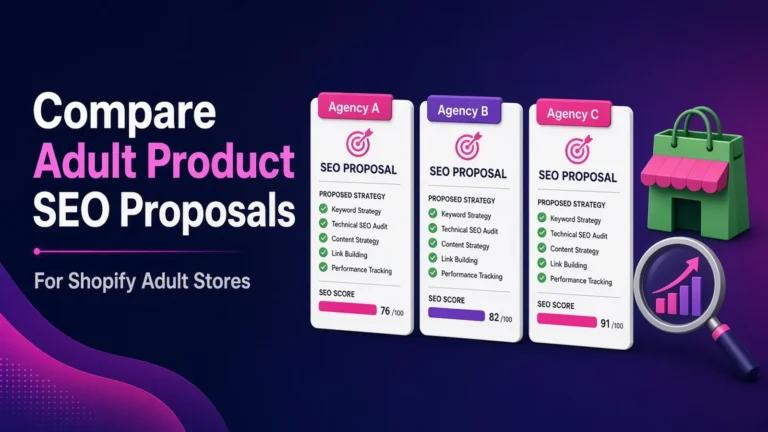
Compare adult product SEO proposals by putting the same scope, evidence, implementation responsibilities and total costs beside each other. Then score all three agencies against fixed criteria. Prioritise relevant adult retail experience, Shopify delivery capability and commercially useful work. Treat missing information as a clarification request, and reject unacceptable practices before considering the final score.
Three persuasive proposals can describe three very different purchases. One agency may offer a technical audit and leave every fix to your developer. Another may include product copy but exclude uploading it. A third may bundle outreach, reporting and development into a retainer without explaining how much capacity your store receives.
The lowest fee is meaningful only after you understand those differences. The longest proposal is useful only if its promises can be checked. Your task is to identify which agency can deliver the work your particular Shopify store needs, within a budget and working arrangement you can sustain.
This guide provides a practical comparison table, a weighted evaluation scorecard and a method for checking the evidence behind each proposal. It covers technical SEO, research, product and collection pages, content, links, reporting, pricing and contract terms. The examples are hypothetical decision exercises, not agency case studies or claims about market performance.
Start with the buying decision your store actually faces
Before reading the proposals again, write down the problem you are hiring someone to solve. An established store with weak collection pages needs a different plan from a new store with incomplete product data. A store approaching a theme migration needs different technical support from one whose immediate problem is an unclear content strategy.
Be specific enough to expose irrelevant recommendations. “Improve SEO†leaves almost any package looking suitable. “Improve discovery of our stocked priority collections, resolve documented indexing issues and build a repeatable product publishing process†creates a clearer test of relevance.
State the commercial constraints as well. An agency might identify promising searches for products you cannot reliably supply. It might propose international expansion before you have workable shipping, customer support or product availability for those markets. Attractive demand is not automatically an actionable opportunity.
Give all three agencies the same starting information
Prepare a short factual brief covering your catalogue, markets, theme, important apps, current team and recent changes. Include the number of products and collections, but explain their variety. Hundreds of near-identical variants can require a different approach from a smaller catalogue containing unrelated product families.
Share your priority categories, stock constraints and the pages that matter commercially. If exact margins are confidential, provide bands or a relative priority ranking. The agency needs enough information to avoid treating a frequently unavailable, low-contribution product as the centre of your growth plan.
Include known measurement limitations. If purchase tracking has been unreliable, say so. If a previous agency changed URLs without a useful record, disclose that too. An honest starting point helps distinguish a realistic proposal from one that depends on data your store does not have.
Do not give one bidder a detailed briefing and another only your homepage. That creates a difference in evidence which can be mistaken for a difference in competence. Send material clarifications to all three, while keeping each agency’s confidential recommendations separate.
Establish your non-negotiables before scoring
Use a small set of eligibility requirements before the weighted assessment. These should reflect actual business needs: willingness to support your product category, acceptable access arrangements, transparent methods, an affordable minimum commitment and a workable implementation model.
An agency that refuses to explain its link acquisition methods should not recover through attractive scores for content and price. Likewise, a technically strong provider that will not work with your catalogue is not a viable choice. The scorecard compares acceptable candidates; it does not excuse fundamental problems.
Record the reason for each exclusion. “Outside our available budget†is different from “unable to provide implementation†or “proposed undisclosed paid ranking links.†Specific reasons let you reconsider a candidate if the constraint changes without rewriting the entire evaluation.
What should an adult product SEO proposal include?
An adult product SEO proposal should define the store’s starting problems, priority opportunities, planned work, delivery owners, evidence of completion and full commercial terms. It should distinguish advice from implementation and connect each major activity to a relevant product, collection or customer need. Important assumptions and exclusions should be visible before you sign.
Request a comparable response under the same headings from each bidder. You are not asking agencies to use identical strategies. You are asking them to explain their different strategies in a format that lets you evaluate the trade-offs.
|
Proposal component |
What you should be able to verify |
|---|---|
|
Initial diagnosis |
Specific observations, example URLs and limits of the review |
|
Strategy |
Priority categories, target markets, sequencing and reasons |
|
Technical work |
Issues investigated, implementation ownership and validation |
|
Keyword research |
Intent groups, page mapping and commercial prioritisation |
|
Product and collection work |
Named fields, page types, scope and review process |
|
Content |
Topics, expertise, editorial responsibility and publishing |
|
Link acquisition |
Prospect criteria, methods, reporting and paid relationships |
|
Measurement |
Baseline, agreed metrics, access and interpretation |
|
Delivery team |
Named roles, available capacity and escalation route |
|
Commercial terms |
Fees, extras, minimum term, changes and exit arrangements |
A useful diagnosis can be modest. Before receiving access, an agency may identify a small number of visible issues and explain what requires verification. That is more credible than claiming to have fully diagnosed your revenue problem from a homepage scan.
Ask for the first delivery cycle in concrete terms. Which pages will be examined? What will you receive? Who approves it? What gets implemented? What evidence shows that the change works as intended? These questions turn broad adult product SEO services into a purchase you can assess.
Separate recommendations, production and implementation
A recommendation is a proposed action. Production creates the asset or specification needed for that action. Implementation makes the approved change in your store. Validation checks the result. Proposals sometimes group all four under a single phrase such as “on-page optimisation.â€
For example, an agency might recommend clearer collection introductions, write the introductions, ask your team to upload them and then check the published pages. Another might stop after suggesting topics. Both can be legitimate arrangements, but their prices and your internal workload are not directly comparable.
Use a responsibility line for every substantial deliverable: agency, merchant, developer or third party. Where two parties are involved, specify the handover. A technical ticket sent to an unassigned inbox is not a functioning implementation process.
Make acceptance practical. “Collection page improved†is difficult to inspect. “Approved introduction, useful selection guidance, accurate title and description, relevant internal links, mobile review and published URL recorded†gives both sides a shared definition of completion.
Use a three-agency comparison table before choosing a winner
Build the comparison from written proposals and clarification responses. Record what each agency commits to, where evidence is missing and what your team must supply. Keep impressions from sales calls in a separate note until the agency confirms any material promise in writing.
The following fictional example illustrates how three otherwise plausible options can differ. It does not represent real providers, actual offers or recommended service quantities. Replace each entry with the wording and evidence from your own proposals.
|
Area |
Agency A: audit-led |
Agency B: implementation-led |
Agency C: content-led |
|---|---|---|---|
|
Adult retail evidence |
Relevant example; role unclear |
Relevant example with delivery explanation |
Adjacent wellness work; adult retail evidence pending |
|
Shopify technical work |
Audit and developer tickets |
Audit, scoped fixes and release checks |
Basic review; specialist support excluded |
|
Keyword strategy |
Keyword list; mapping needs clarification |
Intent groups mapped to priority pages |
Editorial topics; collection mapping incomplete |
|
Product and collection work |
Recommendations; merchant uploads |
Defined page batches, editing and publishing |
Copy production; theme changes excluded |
|
Link acquisition |
Method and prospect examples requested |
Prospect criteria and reporting documented |
Outreach hours offered; selection criteria unclear |
|
Content |
Briefs; writing quoted separately |
Research, writing and review included within scope |
Larger editorial allocation; commercial links need review |
|
Reporting |
Rankings and traffic |
Page groups, commercial context and change log |
Content reach; purchase reporting needs clarification |
|
Cost comparison |
Add developer and writing costs |
Check capacity limits and app charges |
Add implementation and analytics costs |
|
Contract |
Exit and ownership wording pending |
Scope and exit documented |
Renewal and revision limits need clarification |
Do not award Agency B the contract just because this fictional table appears more complete. Your own store may already have an excellent developer and writer. In that situation, Agency A’s specialist advisory model could fit better, provided its missing information is resolved.
Equally, Agency C’s content emphasis may suit a store with strong technical foundations and a capable merchandising team. The question is whether the proposed model covers your actual constraints. A mismatch can be expensive even when the agency is good at its chosen work.
Mark uncertainty instead of filling gaps with optimism
Use four labels in your working notes: confirmed, excluded, dependent and unanswered. “Confirmed†means the proposal or written clarification describes the commitment. “Excluded†means you must source it elsewhere. “Dependent†means delivery requires an approval, dataset or resource. “Unanswered†means you still lack a usable response.
This prevents a common comparison error: treating a vague phrase as a generous inclusion. “Technical support†might mean advice during a monthly call rather than development time. “Content optimisation†might include titles only. Ask before assigning value.
Keep a document reference beside important entries. A page number, proposal section or clarification date is enough. When the final contract arrives, check that it preserves the commitments which justified your preferred agency’s score.
Evaluate adult industry experience beyond a niche label
Relevant experience means understanding the operational realities of adult retail and showing how that understanding affected previous work. Look for evidence involving product catalogues, customer discretion, platform restrictions and commercial page strategy. A broad claim about adult industry SEO services does not establish expertise in your particular Shopify store.
Adult businesses are not interchangeable. A directory, subscription publisher and product retailer have different page types, customer journeys and operational priorities. Experience in one can be useful, but the agency should explain what transfers and what requires a different approach.
Ask for a relevant project discussion rather than a logo collection. What was the starting problem? Which pages were involved? What did the agency personally deliver? Who implemented changes? Which constraints affected the plan? What would the team do differently now?
Respect confidentiality. A provider may reasonably avoid identifying a client or sharing private revenue data. It can still describe its method, show a redacted deliverable or arrange a reference with the client’s permission. Refusing every form of verification is different from protecting a client’s identity.
Test whether experience changes the proposed work
Give each agency one practical scenario. For instance, your catalogue mixes general wellness accessories with adult products, and you want the strategy to reflect those differences accurately. Ask how it would investigate page presentation, search intent and channel eligibility before recommending changes.
Listen for distinctions, not sweeping claims. Google’s guidance for sites with explicit content discusses SafeSearch, age-gated access and identification of adult-oriented products. An agency should assess the actual content and implementation rather than assume every adult retailer has identical visibility conditions.
Search access and legal age controls require careful coordination. Ask how the agency would investigate crawler access and involve your developer and relevant adviser. A proposal should not promise to bypass classification or suggest removing legally required protections to make an SEO report look better.
The strongest answer names what needs checking, who can check it and how recommendations will be reviewed. You are assessing judgement as much as terminology. Someone who recognises the limits of an initial review may be more reliable than someone who confidently diagnoses everything without access.
Verify the people who will actually work on the account
Ask whether the case study team is the delivery team. A senior specialist may lead sales while another person handles your store. That is not inherently a problem, but you should know the proposed account structure, oversight and escalation route.
Check who owns technical decisions, product research, editorial approval and outreach. If subcontractors are involved, ask how they are briefed on your product category and confidentiality expectations. Avoid assuming that one experienced founder personally reviews every output.
For broader context, EMA’s adult SEO services page explains its adult-sector focus. Use any provider’s service description as a starting point for questions, then ask for evidence relevant to Shopify product retail. A published positioning statement is not a substitute for store-specific due diligence.
How do you evaluate Shopify technical SEO expertise?
Evaluate Shopify technical SEO expertise through a small, store-specific diagnosis and a credible implementation plan. Ask the agency to explain what it observed, what remains uncertain, where changes would be made and how they would be tested. Strong proposals distinguish Shopify’s built-in features from problems introduced by configuration, themes, apps or custom development.
A generic adult store technical SEO checklist can make almost any agency appear technically capable. Your evaluation should reveal whether the team understands your storefront and can work within it. Ask for an explanation of one collection template, one product template and one relevant navigation or filtering issue.
The agency does not need to perform an unpaid full audit. It should demonstrate enough reasoning for you to understand its approach. If deeper diagnosis is necessary, a clearly scoped paid discovery project can be more useful than three superficial free audits.
Check crawling, indexing and canonical decisions
Ask how the agency will distinguish URLs that should attract search visits from alternative URLs that exist mainly for navigation, sorting or product selection. The proposal should include a way to document those decisions and check the resulting signals.
Shopify automatically generates sitemap files. A proposal charging for sitemap work should therefore explain whether the task is verification, submission, troubleshooting or something genuinely custom. “Create a sitemap†alone tells you little about the value being delivered.
Similarly, request a diagnosis before approving canonical changes. Ask for example URLs, their current canonical signals and the intended page to represent the content. A recommendation to rewrite every canonical without checking current behaviour deserves scrutiny.
Google’s ecommerce URL guidance explains how multiple URL forms can create discovery and crawling problems. Your agency should translate that general issue into specific findings, rather than treating every alternate Shopify URL as an emergency.
A good technical deliverable records the current state, recommended state, affected templates, implementation owner and validation steps. This makes it possible to distinguish a justified change from a preference presented as a critical fault.
Ask about collection filters and navigation
Filtering can help customers narrow a catalogue while producing many URL combinations. Google’s faceted navigation guidance describes the crawling problems such combinations can create. The buying question is whether the agency can identify meaningful landing pages without treating every filter combination as a search opportunity.
Ask the bidder to separate useful customer filters from pages that deserve a deliberate search strategy. A popular product characteristic might justify a curated collection when there is sufficient demand and a useful assortment. An arbitrary combination of several filters may not.
Do not reward a proposal simply for generating more pages. Ask what each proposed collection adds: a distinctive selection, a clear customer purpose, maintainable stock and meaningful guidance. The agency should also explain how navigation and internal links will help customers find those pages.
For a practical test, provide one important collection with several filters. Ask the agency to describe its investigation, not prescribe rules from memory. Does it inspect the actual URLs and rendered pages? Does it consider what happens when filtered results are empty? Does it understand who owns the filtering app?
Require caution around robots controls
Shopify provides a default robots.txt file and warns that customisation requires care. Its robots.txt.liquid documentation distinguishes crawling from indexing: blocking crawling does not automatically remove a URL from search results.
Ask for the exact problem a proposed robots change solves, the affected URL patterns and a test plan. An agency should be able to explain which pages remain accessible and how it will check for unintended effects.
Avoid accepting a blanket instruction to block anything that looks duplicated. Your store’s current settings, page relationships and search visibility matter. The contract should identify who approves changes to these controls, because a broad pattern can affect more pages than the initial example suggests.
Assess theme, app and performance work
Ask which parts of the storefront the agency can change directly and which require your theme developer or an app vendor. A provider should not promise unrestricted control over every performance issue simply because it knows Shopify.
Request an example of a technical ticket. It should identify the observed problem, affected page type, proposed change, dependencies and acceptance checks. “Improve mobile speed†is a goal; a documented investigation and scoped implementation are deliverables.
For performance work, ask what will be measured before and after a release. The measurement should use comparable conditions and distinguish a controlled test from actual customer experience where suitable data exists. A single attractive screenshot is not enough to establish a durable improvement.
Include customer functions in testing. An apparently faster page is not an improvement if its variant selector, reviews, navigation or purchase controls stop working. The proposal should state who performs these checks and how the team restores the previous version if something breaks.
Treat structured data as product information, not a promise
Ask the agency to inspect existing theme and app output before adding another source of structured data. Multiple components can produce overlapping or inconsistent information. You need an explanation of what is currently present, what is accurate and what requires correction.
Google’s product structured data documentation covers product information and variants. Its general structured data guidelines make clear that valid implementation does not guarantee a rich result. Eligibility also depends on the relevant feature and content requirements.
The proposal should therefore promise an accurate implementation and documented checks, not guaranteed stars, enhanced listings or increased click-through rates. Ask how price, availability and product identity will remain consistent as your catalogue changes.
For adult products, request a separate eligibility review before accepting forecasts based on Shopping features. Google’s sexual content policy for listings includes restrictions that depend on circumstances including market and audience. Ordinary web search, product features and advertising should not be bundled into one assumed opportunity.
Review international scope explicitly
If your Shopify store serves several markets, ask which domains, languages and catalogues the proposal covers. A plan for one English-language storefront is not automatically a plan for every regional version.
Shopify’s international SEO documentation describes built-in handling of signals such as hreflang, canonicals and sitemaps when markets are configured appropriately. Ask the agency what it will verify in your implementation and what custom work is necessary, rather than paying twice for a feature already provided.
The commercial research must match the technical scope. Translated keywords alone do not establish local demand, suitable product availability or an appropriate customer experience. Require a clear boundary between translation, localisation, technical validation and market advice.
How do you evaluate adult product keyword research and strategy?
Evaluate adult product keyword research by checking whether it maps relevant customer intent to suitable pages and commercial priorities. Search volume alone is insufficient. A useful strategy explains which collections, products and guides deserve attention, why they fit your stock and markets, and how the agency will test its assumptions after implementation.
Ask for a small sample of the proposed research format. It should show the topic or query group, intended audience, target market, likely intent, current or proposed page, evidence and recommended action. The sample should make the agency’s reasoning visible without requiring it to reveal an entire unpaid strategy.
A large spreadsheet is not automatically an adult product SEO strategy. Hundreds of terms can still leave you unsure which page to improve first. The value lies in the decisions made from the research and whether those decisions survive contact with your catalogue.
Distinguish product, collection and informational intent
Consider three hypothetical searches: a specific product model, a broader category with a particular feature and a question about caring for a material. They may require a product page, a collection page and an informational resource respectively.
Ask the agency to explain what it would inspect in current search results before deciding. Would it look at the types of pages appearing, the language used by shoppers and the products you can actually offer? Would it change its recommendation if the results indicate a different intent?
A weak plan assigns every attractive term to a new blog article. Another weak plan sends every query to a product page. A stronger Shopify SEO strategy for adult stores allows different page types to perform different jobs and connects them where that helps the visitor.
Use a sample mapping exercise as an interview prompt. Choose a priority collection and ask each agency to identify the questions it needs answered before finalising the target. You will learn more from its investigation than from a list of confident keyword suggestions.
Include stock, margin and operational fit
Ask how the agency will prioritise a promising collection when its best products are often unavailable. Possible actions might include coordinating with merchandising, selecting a different starting collection or improving the page without making it the immediate growth focus.
Your commercial team should influence this decision. SEO specialists can analyse discoverability, but they do not automatically know supplier reliability, return patterns or your actual contribution margins. A proposal should include a way to incorporate that knowledge.
Request a reason for deprioritising opportunities too. Strategic work involves deciding what not to pursue yet. An agency that recommends everything at once may be avoiding the difficult judgement you are hiring it to provide.
Do not treat tool estimates as precise counts of future customers. Ask where estimates come from, what geography they represent and whether the agency has corroborating evidence from your own search data. Uncertainty should inform prioritisation rather than disappear inside a polished forecast.
Look for page mapping and overlap management
Ask how the agency will prevent several pages from competing for the same purpose without offering a meaningful difference to visitors. The answer should involve page-level review, not merely assigning a different exact-match phrase to every URL.
A collection and a guide can discuss the same subject while meeting different needs. Conversely, two almost identical collections may divide effort without creating a useful distinction. Ask how the proposal identifies those situations and decides whether to improve, combine or retain pages.
Require approval before important consolidation or URL changes. Existing pages may support campaigns, customer bookmarks or merchandising plans beyond the information visible in an SEO tool. The agency should consult the store team and document the reasons for the decision.
How do you evaluate Shopify product page optimisation services?
Evaluate Shopify product page optimisation services by inspecting the proposed changes to real page fields, customer information and publishing workflows. Look for accurate product facts, useful differentiation, sensible search targeting and a clear review process. A page count is meaningful only when the agency defines what happens to each page and who verifies it.
Start with a representative product rather than your easiest bestseller. Choose something with variants, incomplete supplier information or a meaningful selection question. Ask what the agency would need to improve the page responsibly.
An effective answer may request manufacturer specifications, approved images, warranty details, care instructions and your own product knowledge. This shows that the agency sees product copy as factual merchandising work, not a place to insert keywords around generic claims.
Define the unit of product work
Ask whether one “optimised product†includes its title, description, search preview fields, images, variant information, internal links and publication checks. Some proposals include only selected fields; others include a fuller review. Neither should be left ambiguous.
Clarify how variants count. Does a colour change count as another optimised product? Are different product models treated separately? Are translated versions separate deliverables? The answer affects both workload and the apparent value of a monthly page allowance.
Request a before-and-after sample with an explanation of the changes. The agency should be able to say which customer uncertainty it addressed, which facts it verified and which fields it deliberately left unchanged.
Treat unsupported product claims as a quality failure. Writers should not invent certifications, material properties, medical benefits or performance claims. Where evidence is missing, the correct action is to ask the merchant or manufacturer, not create plausible marketing language.
Compare collection optimisation separately
Collections help customers choose among products. Their optimisation should therefore include the assortment and navigation context, not only a paragraph of copy above the grid.
Ask how the agency will review the collection’s purpose, product selection, introductory information, useful filters, related collections and links from supporting content. The plan should preserve an easy shopping experience while answering important selection questions.
A fixed word count for every collection is a weak specification. Some collections need a concise introduction and clear attributes; others benefit from more guidance. Request a rationale based on customer needs and the page layout.
The deliverable should identify where content will appear and who will approve it on mobile. Long passages can interfere with browsing if placed without design judgement. Product and collection optimisation earns its weight in the scorecard through useful decisions and careful execution, not text volume alone.
Check how quality will scale across the catalogue
Ask how the first approved examples become a repeatable process. A useful approach might include a product information checklist, a writing brief, rules for unavailable information and a review sample for later batches.
Clarify whether automated or AI-assisted tools will be used and who remains accountable for accuracy. The important question is whether every published claim has an appropriate basis and whether the workflow catches mistakes before they spread across many pages.
Require a clear distinction between bulk template improvements and individual editorial work. A template change may benefit many pages but should not be presented as hundreds of individually researched descriptions. Both forms of work can have value when described honestly.
Finally, ask what happens after launch. New products, discontinued items and supplier changes can quickly make a one-time clean-up incomplete. A reliable adult store SEO agency should explain whether ongoing catalogue maintenance is included, transferred to your team or quoted separately.
Assess content strategy by its role in the buying journey
A useful content strategy for Shopify adult store SEO should explain which customer questions your store needs to answer and how those answers support appropriate commercial pages. Ask why each proposed topic deserves publication, what knowledge it requires and how the agency will measure its contribution. An editorial calendar with many titles can still lack a coherent purpose.
For adult ecommerce SEO, discretion and factual accuracy matter throughout that journey. Customers may want clear information about materials, maintenance, packaging, delivery or product differences. The content plan should draw on questions your business can answer reliably without becoming graphic or making unsupported health claims.
Ask your support and merchandising teams to review proposed topics. They may identify recurring questions that a keyword tool misses or explain why a superficially attractive topic is unsuitable for your catalogue. A good agency incorporates that feedback rather than treating research tools as the only authority.
Require a content brief that a writer can execute
A useful brief identifies the reader, question, intended page role, relevant product knowledge, source requirements and natural next step. It should also say which claims require merchant approval and which related pages already exist.
Ask for a sample brief and a finished sample. Compare them. Did the writer answer the central question? Did the final page contain factual support where needed? Did the content remain useful when the sales language was removed?
The proposed workflow should name the editor. “Expert-reviewed†has little meaning without a suitable reviewer and an actual review step. If a topic needs specialist knowledge that neither party has, the agency should narrow the content or arrange appropriate review rather than invent expertise.
Assess updating as well as creation. A useful guide can become inaccurate when a product line changes or a store policy is revised. Ask who maintains the content, what triggers a review and whether updating existing resources counts against the monthly allocation.
Distinguish useful support content from traffic expansion
Ask what happens if an article attracts visitors but does not support the store’s commercial priorities. The answer should involve examining relevance, page role and customer behaviour, not automatically publishing more of the same.
Some informational content has a legitimate supporting purpose even without immediate purchases. It may help existing customers, clarify product selection or support a more useful collection page. Agree on that purpose before judging the work solely by direct revenue.
At the same time, broad traffic growth should not hide weak progress on product and collection pages. Require reporting that separates editorial reach from commercial page performance. This helps you understand whether the content strategy is complementing the core store or becoming an unrelated publishing project.
Be cautious about proposals that promise large volumes of interchangeable articles. Google’s spam policies address scaled content abuse and manipulative practices; the practical buying test is whether the proposed material adds specific value for your audience. Ask for editorial standards and examples, not assurances based only on the production method.
How do you compare adult industry link building proposals?
Compare adult industry link building proposals through the relevance of prospective publishers, the acquisition method, editorial quality and transparent reporting. Separate earned coverage from paid promotion. Ask what the agency controls, what depends on a publisher and how links will be qualified. A backlink count or third-party authority score cannot establish quality by itself.
Start with the objective. Is the agency proposing editorial outreach around a useful resource, relationships with relevant trade publications, supplier mentions or paid sponsorship? These activities have different costs, dependencies and measures of success.
Request representative prospects and explain your audience boundaries. A site can be broadly “adult†while being entirely unsuitable for your retail brand. Your decision should consider its actual readers, content, location, reputation and fit with the destination page.
Ask why a publisher would want to cover your store. If the answer depends entirely on a payment and a promised ranking benefit, investigate further. If it depends on useful expertise, a relevant resource or a legitimate commercial relationship, ask how that value will be demonstrated.
Evaluate the method before the metrics
Google identifies buying links for ranking purposes, automated link creation and other manipulative practices as link spam. Its outbound link guidance recommends identifying paid placements with sponsored attributes; nofollow is also acceptable for those links.
An agency should explain paid relationships openly and distinguish their promotional value from any claimed ranking effect. It should not sell unqualified paid links as a risk-free shortcut because your business operates in the adult industry.
Third-party metrics can help organise research, but ask what the agency inspects beyond the number. A high metric does not prove editorial relevance, audience quality or a good context for your brand. Request the actual page and placement rationale where possible.
Also ask about ownership or commercial connections between the agency and proposed publishers. Such relationships may affect the nature of the placement. You need enough transparency to judge what you are purchasing and whether the agency’s description is accurate.
Define the outreach deliverables honestly
Distinguish research, pitching, responses, agreed coverage and published links. Those are different stages, and a report should not combine them into one inflated activity total.
Ask what a monthly outreach commitment includes: prospect research, approved angles, asset preparation, personalised contact, follow-up and reporting. If a publisher declines, does the agency explain what it learned and revise the approach?
For any placement commitment, clarify the terms. Does it refer to a paid placement under an agreed arrangement or an aspiration for earned coverage? What happens if a publisher changes a page, removes a link or does not publish? Avoid assumptions about permanence.
Require a report with the source URL, destination URL, context, relationship type, publication date and relevant link attributes. The purpose is to understand the work and its fit, not to demand publication of private correspondence or sensitive contact data.
EMA’s overview of adult industry link building can help frame questions about specialist outreach. Apply the same evaluation to every bidder: inspect the method, the proposed context and the evidence. A familiar niche label does not remove the need for scrutiny.
Compare reporting and analytics before the first report arrives
Ask each agency to show a redacted sample report and explain the decisions it would help you make. Good reporting connects completed work, observed changes, commercial context and next actions. It should also identify uncertainty. A dashboard full of upward arrows is less useful if you cannot tell what changed or what the team will do next.
Agree on a baseline before implementation. Record the selected period, important page groups, target markets and known measurement problems. If the baseline changes later, retain the original and explain the reason so that comparisons remain understandable.
The proposal should identify the reporting sources and who controls access. You should be able to inspect your own store and analytics accounts directly. An agency’s dashboard can be convenient, but it should not become the only place where your business can see its performance history.
Separate four kinds of evidence
First, track delivery: approved pages, implemented technical work, published content and documented outreach. Second, track discovery: whether intended pages are accessible and appearing for relevant searches. Third, track engagement and purchasing where measurement supports it. Fourth, track context such as stock availability, promotions and major site changes.
These categories answer different questions. Completed work establishes that the agency delivered. Search visibility suggests how discovery may be changing. Orders and revenue provide commercial information. Context helps explain why those numbers may have moved.
Do not assume a change in one category proves causation in another. A seasonal increase in sales is not automatically an SEO result. An improved ranking for a low-relevance query is not automatically useful growth. Ask the agency how it will distinguish plausible contribution from unsupported attribution.
For a practical report test, ask the bidder to explain a month in which traffic increased while organic revenue declined. A thoughtful response might examine landing-page mix, stock, promotions, tracking, conversion behaviour and comparison periods before claiming success or failure.
Keep branded and non-branded demand understandable
Your own brand searches can change because of email, publicity, offline activity or customer retention. Ask the agency how it will interpret those changes alongside searches for product categories and specific items.
Any brand classification will have limits. Agree on a sensible definition and note ambiguous queries rather than pretending the split is perfect. Consistent interpretation is more useful than a precise-looking chart built on changing rules.
Request separate views for priority collections, products and editorial content where the data allows. This prevents a growing blog from masking weak commercial pages and helps the agency decide where to allocate the next cycle of work.
For global stores, request market-level interpretation when it is material to the scope. Increased visibility in a country you cannot serve should not receive the same commercial weight as progress in a supported market with available stock.
Ask who fixes measurement problems
Analytics review and analytics repair are different services. A proposal may identify missing events but exclude implementing changes. Clarify whether the agency can investigate the setup, whether specialist help is needed and how that work is priced.
Require a clear method for documenting tracking changes. Otherwise, a sudden improvement in reported revenue could reflect corrected measurement rather than increased sales. Reports should make that distinction visible.
Agree on how refunds, cancellations, currency and reporting periods will be handled in your commercial review. Different systems may count or attribute transactions differently. The goal is an understood reporting method, not a promise that every dashboard will always match exactly.
Apply the weighted SEO agency evaluation scorecard
Use the scorecard after clarifying scope and checking eligibility. Score all three agencies against the same evidence standard, then multiply each rating by its category weight. Keep a short explanation and source for every rating. The total supports a decision; it does not turn uncertain judgements into objective facts.
The weights below provide a practical balance for a Shopify adult store. Together they total 100%. Adult experience, technical expertise and product or collection execution receive substantial weight because they directly affect whether the proposed strategy can fit and improve the store.
|
Evaluation category |
Weight |
Evidence to inspect |
|---|---|---|
|
Adult industry experience |
15% |
Relevant retail work, policy judgement, delivery team |
|
Shopify technical SEO expertise |
15% |
Diagnosis, implementation plan, testing and dependencies |
|
Keyword research and strategy |
10% |
Intent mapping, commercial priorities and rationale |
|
Product and collection optimisation |
15% |
Samples, field coverage, accuracy and publishing process |
|
Adult industry link building |
10% |
Prospect fit, transparent methods and reporting |
|
Content strategy |
10% |
Useful topics, expertise, editing and maintenance |
|
Reporting and analytics |
10% |
Baseline, page groups, commercial context and ownership |
|
Pricing and value |
10% |
Complete costs, usable capacity and internal workload |
|
Contract transparency |
5% |
Clear scope, renewal, ownership, changes and exit |
|
Total |
100% |
Apply only after eligibility checks |
Use a consistent rating scale
Rate each category from zero to five. Zero means no usable evidence after clarification, or no relevant provision. One means weak evidence with major unresolved gaps. Two means partial coverage with significant limitations. Three means adequate, supported coverage for the agreed scope. Four means strong evidence and a well-defined delivery approach. Five means exceptionally convincing fit supported by specific, verifiable evidence.
Reserve high scores for evidence, not confident language. A polished presentation can explain the offer well, but it does not prove implementation capability. A modest presentation with excellent samples and clear responsibilities may deserve the higher rating.
Use “pending†while you are still waiting for an answer. Do not silently turn pending into an average score. Before making the final decision, either resolve it or record that the agency has not demonstrated the capability.
For categories with several subtopics, write a short rationale rather than multiplying the spreadsheet into dozens of arbitrary sub-scores. Explain the most important strength, limitation and dependency. This preserves judgement without making the exercise unmanageably complicated.
Calculate the weighted score correctly
For each category, calculate weighted points as: rating divided by five, multiplied by the percentage weight expressed as whole points. A rating of four in a category worth fifteen points earns twelve points. Add the category points to get a total out of one hundred.
In a spreadsheet, if the rating is in B2 and the weight is stored as the number 15 in C2, the calculation is =B2/5*C2. If the weight is stored as the percentage 15%, multiply the final sum by 100 to display a score out of one hundred. Do not mix the two conventions.
The following ratings are invented solely to demonstrate the arithmetic. They are not evaluations of real agencies and are not automatically inferred from the earlier comparison table. Assume, for this exercise, that clarification has been completed and all three candidates pass the eligibility requirements.
|
Category |
Weight |
A rating |
B rating |
C rating |
|---|---|---|---|---|
|
Adult experience |
15 |
4 |
4 |
2 |
|
Shopify technical expertise |
15 |
4 |
5 |
2 |
|
Keyword strategy |
10 |
3 |
4 |
3 |
|
Product and collection work |
15 |
3 |
5 |
3 |
|
Link building |
10 |
3 |
4 |
2 |
|
Content strategy |
10 |
3 |
4 |
5 |
|
Reporting and analytics |
10 |
3 |
4 |
3 |
|
Pricing and value |
10 |
4 |
3 |
4 |
|
Contract transparency |
5 |
3 |
4 |
3 |
|
Weighted total out of 100 |
100 |
68 |
84 |
58 |
Agency B leads this fictional exercise because its stronger technical and commercial-page scores outweigh its lower value rating. That does not establish that implementation-led agencies always win. Different evidence from your real proposals will produce a different assessment.
Make uncertainty visible beside the total
Add a confidence note to each category: strong, moderate or limited evidence. This note does not alter the arithmetic, but it helps you decide what to verify before signing.
For example, a four for technical expertise based on a relevant sample and a discussion with the delivery lead is more convincing than a four based only on a salesperson’s description. If both currently have the same rating, the evidence note reveals that the evaluation needs further work.
Review the biggest differences first. If one candidate leads by a single point, a minor judgement change could reverse the order. If it leads substantially because two others exclude work your store needs, the decision may be more stable.
Keep these weights fixed for the main comparison. If you explore a different business scenario, label it separately and explain the changed assumption. Do not adjust weights after seeing the result merely to make a favourite agency win.
Prevent the total from hiding a serious weakness
A five-percent contract weighting does not mean ownership or exit problems are unimportant. Basic acceptability belongs in the eligibility check. The five percent measures the clarity and quality of acceptable arrangements.
Likewise, excellent content cannot compensate for a refusal to work transparently. If a candidate fails a non-negotiable requirement, mark it ineligible even if its numerical total is attractive. Reconsider it only if the underlying issue is resolved in writing.
Use the scorecard as a record of reasoning. When an owner, marketing manager and developer disagree, the category notes reveal the real issue. They may be judging different scopes, assuming different internal resources or placing confidence in different evidence.
How much does adult ecommerce SEO cost?
Adult ecommerce SEO cost depends on scope, catalogue complexity, markets, content needs and who implements the work. There is no defensible single price for the three proposals without seeing their inclusions. Compare written quotes over the same period, adding required development, content, apps and other charges. Keep optional spending separate from mandatory costs.
A proposal can be inexpensive because it is efficient, because it covers less work or because costs sit outside the stated fee. Your evaluation should determine which explanation applies. Avoid assuming that a premium price proves specialist quality or that a low price necessarily indicates poor work.
The most useful adult ecommerce SEO pricing discussion begins with a defined problem and delivery model. Ask each agency to explain what your budget buys, what it excludes and which constraint would limit progress first.
Compare the main commercial models
A fixed project can suit a defined audit, migration review or collection improvement programme. Its usefulness depends on a clear boundary, deliverables and completion conditions. Ask what happens if the investigation reveals a larger problem than expected.
A monthly retainer can support ongoing prioritisation and repeated delivery. Ask what capacity is reserved, how priorities change and how unused or blocked work is handled. “Ongoing SEO†should not remove accountability for what the team actually does.
An hourly arrangement can provide specialist flexibility when your own team manages execution. Ask for estimates, spending limits, time reporting and approval before overages. Hours are a resource measure; you still need a useful outcome from the work purchased.
A mixed model might combine initial discovery with ongoing implementation. Check whether the discovery fee is separate, whether its outputs are reusable and whether you are free to choose another implementation provider. An initial project should not create an undisclosed commitment to a later retainer.
Calculate the full comparable cost
Use the same evaluation period for all three proposals, while separately recording the contractual minimum commitment. The comparison period is your analytical choice; it does not change what the agreement obliges you to pay.
For each agency, calculate: setup fees plus recurring agency fees over the selected period, plus required implementation, content, software and approved third-party costs. Add applicable taxes consistently when comparing cash requirements. Record internal staff time separately if it is material.
Do not insert assumed prices for missing items. Mark them “quote required†and request a written amount or an agreed cap. A total containing unresolved mandatory costs is incomplete, not cheaper.
|
Cost item |
Question for all three agencies |
|---|---|
|
Setup or discovery |
Is it mandatory, and what usable output do we receive? |
|
Recurring service fee |
Which work and capacity does it include? |
|
Development |
Included, capped or separately estimated? |
|
Product and collection writing |
Research, editing, uploading and revisions included? |
|
Editorial content |
Are specialist review and updates covered? |
|
Apps and tools |
Who pays, owns the account and approves renewals? |
|
Outreach and promotion |
Are publisher charges or sponsored activity separate? |
|
Localisation |
Which languages and markets are included? |
|
Reporting setup |
Are tracking investigation and repair additional? |
|
Exit or handover |
Are exports, documentation or transition work charged? |
Distinguish an agency’s own operating tools from subscriptions your business must maintain. You should understand which costs disappear when the engagement ends and which remain necessary for the store to function.
Ask about currency, invoicing dates and fee review provisions. For a global store, exchange movements and cross-border billing can affect the cash cost even when the service scope stays the same. Obtain accounting advice where needed rather than assuming identical tax treatment across jurisdictions.
Compare value through usable work
Ask what important work will be finished during the first delivery cycle and what will remain blocked. A lower retainer can be poor value if your team cannot implement the recommendations. A higher retainer can also be poor value if it includes capacity your store does not need.
Evaluate duplication. If your existing developer already handles theme releases, you may need SEO specifications and validation rather than another development team. If your staff already produces excellent product copy, specialist research and editing may be more useful than wholesale rewriting.
Avoid comparing price per page unless the page definitions match. Editing a search title is different from researching a product, rewriting its description, reviewing images and publishing the result. Similarly, a short collection update and a complex international template change are not interchangeable units.
Use a simple value question: “Which necessary decisions and changes become possible because we buy this proposal?†If the answer is unclear, return to the scope before negotiating a discount.
Treat forecasts as assumptions to examine
A forecast can be useful if it explains its starting data, assumptions and range of possible outcomes. It becomes misleading when it presents speculative rankings or revenue as a contractual certainty.
Ask which parts of the forecast depend on implementation timing, stock, conversion behaviour, competition and search demand. Ask how the agency will revise the forecast when those assumptions change. A credible response should tolerate uncertainty.
Do not require a provider to guarantee Google rankings as proof of confidence. Google’s guidance on hiring an SEO warns against ranking guarantees. Instead, negotiate commitments the agency can control: qualified staffing, agreed work, communication, documentation and delivery standards.
For financial planning, test whether you can afford the engagement if results develop more slowly than hoped. That does not predict failure. It checks whether the commercial arrangement gives the business enough room to evaluate the work without relying on an optimistic scenario.
Read contract transparency as part of the service
A clear contract should preserve the scope, responsibilities and limits used to evaluate the proposal. Check which document takes precedence if the sales presentation, statement of work and general terms differ. A verbal promise is weak protection if the signed agreement excludes the promised work.
Review the initial term, renewal mechanism, notice deadline, payment schedule and conditions for changing fees. Ask how pauses, delays, disagreements and early termination are handled. This is a commercial review framework, not a substitute for legal advice on your jurisdiction or a particular agreement.
EMA’s guide to adult marketing contract questions provides a broader set of issues to discuss. For your Shopify engagement, concentrate on the clauses that determine delivery, control of the store and your ability to continue operating after the relationship ends.
Preserve control of accounts and assets
Identify who owns the Shopify store, domains, analytics properties, content, reports and commissioned creative work. Distinguish ownership of paid deliverables from licences to third-party tools, images or agency software.
Shopify’s guidance for working on client stores recommends collaborator access and prohibits requesting or using a merchant’s password. Ask the agency to explain the permissions it needs for the agreed tasks and how access is removed after the engagement.
The agreement should address confidentiality and use of your name in publicity. If you do not want the store identified in case studies, make that explicit. Also clarify how subcontractors receive access and what information is shared with them.
Ask what you receive at handover: current research, page mapping, approved content, change records, open tickets and reporting definitions. You need the work to remain understandable to your own team or a successor, not only to the departing agency.
Define changes and delays fairly
A useful change process explains how new work is requested, estimated and approved. It should prevent surprise charges without making every sensible reprioritisation impossible. Ask which changes fit within the existing retainer and which require a separate scope.
Address merchant delays too. Your approvals, product information or developer availability may affect delivery. Agree on how blocked work is recorded and whether the team moves to another approved priority.
Similarly, clarify what happens when the agency misses a commitment. The discussion should focus on communication, remediation and the relevant contractual provisions. Avoid treating a long minimum term as a substitute for clear delivery obligations.
Make the exit process operationally realistic. If a critical app or reporting system belongs to the agency, determine whether it can transfer, requires a new subscription or will stop working. Understand that before the dependency becomes part of daily operations.
Common red flags in adult product SEO proposals
Red flags are reasons to investigate or reject a proposal, depending on severity. Some indicate poor communication that can be corrected. Others reveal an unacceptable method or a basic mismatch. Ask for clarification once where appropriate, then judge the written response rather than an increasingly elaborate sales explanation.
A guaranteed ranking is an obvious concern. So is a forecast that ignores your catalogue, competitors and implementation capacity. Claims of special control over Google’s organic results deserve particular scepticism.
Vague deliverables are another warning. Phrases such as “complete optimisation,†“premium backlinks†or “unlimited support†need boundaries. Ask what they mean in practice, how completion is evidenced and what is excluded.
Watch for a proposal that treats adult website optimisation as ordinary copywriting with a different keyword list. Relevant expertise should appear in the actual decisions about product information, classification, discretion, channel eligibility and audience fit.
Technical and content warning signs
Be cautious when an agency recommends widespread URL, canonical or robots changes without sample evidence. Large changes can be justified, but the proposal should explain the problem, dependencies and validation process.
Question automatic app installation as the answer to every technical issue. Ask what the app does, why it is required, what existing functionality overlaps and who maintains it. An app can be useful without replacing diagnosis.
Look closely at bulk content promises with no factual review. If the process cannot explain where product facts come from or who approves them, scaling it increases the risk of inaccurate pages.
Treat unsupported claims of unique expertise as unproven. A badge, tool subscription or impressive vocabulary does not show that the delivery team can improve your store. Ask for work samples and explanations that relate to your scope.
Reporting and commercial warning signs
A proposal that reports only rankings may not give you enough information to evaluate the business contribution. Ask how completed work and commercially important pages will be reviewed alongside those rankings.
An agency that refuses merchant-controlled access or requires you to abandon your existing accounts creates an avoidable dependency. Ask why any new account is needed and how control will be preserved.
Unclear recurring charges, missing renewal terms and undefined handover arrangements should be resolved before signing. A short agreement is not automatically transparent, and a long one is not automatically protective.
Finally, beware of pressure that prevents reasonable review. An agency may have genuine capacity limits, but it should still be able to explain its offer and allow you to understand the commitment. Urgency does not improve an incomplete scope.
Questions to ask all three agencies before hiring
Use the same core questions in each final interview. Invite the proposed delivery lead, not only the salesperson. Ask for specific examples and record any answer that changes scope, price or responsibility for written confirmation afterward.
- Which three issues or opportunities would you investigate first in our store, and why?
- Which findings are verified already, and which depend on access or further research?
- What relevant adult retail work can you explain without breaching confidentiality?
- Who will perform the work, and how much senior oversight is included?
- Which Shopify changes will you implement directly, and which require our developer?
- How will you test theme, app, navigation and product-selection behaviour after changes?
- How will keyword research become a prioritised product and collection page map?
- What exactly counts as an optimised product or collection in your proposal?
- Who checks product facts, reviews copy and approves publication?
- How will content support our stocked categories and customer questions?
- How do you select outreach prospects, and how are paid relationships disclosed?
- What will our monthly report help us decide?
- What additional costs could be necessary to implement your plan?
- What happens when work is blocked, priorities change or a commitment is missed?
- What do we own and receive when the engagement ends?
The best answer is not always the most confident one. A useful agency may say it needs to inspect the theme, confirm a product fact or speak to your developer. That response becomes persuasive when it includes a clear method and a realistic next step.
After the interview, send a concise clarification summary. Ask the agency to confirm amendments to the proposal rather than relying on your interpretation. Recalculate affected scorecard categories only when the new evidence justifies the change.
Turn the preferred proposal into a workable first delivery cycle
Before signing, ask the preferred agency to show how the first phase would operate. You do not need a rigid annual task list. You need enough detail to see how discovery becomes approved work and how the store team participates.
An initial phase might confirm access, measurement, priority page groups and technical assumptions. The next phase might implement a limited set of approved changes and establish the product or collection workflow. Later work can expand based on what the first cycle reveals.
Treat this as a sequencing example, not a standard timeline or promise of results. Your store may need urgent technical repair, a migration review or data cleanup before normal production makes sense. The proposal should explain that dependency.
Ask for a small, inspectable delivery record
For each important change, the record should identify the page or template, the reason, the approved action, the person responsible, publication date and checks performed. It should also note unresolved issues.
This record helps you understand what happened when several teams work on the store. It can also prevent the same issue from being repeatedly reported without anyone knowing whether a fix was released.
A clear record does not require a complicated management platform. A shared document or task system can be sufficient if it stays current and your team can access it. Choose a process proportionate to the work.
At the end of the first cycle, compare delivery with the agreement. Discuss what was completed, what was blocked and what the evidence suggests doing next. Separate this delivery review from claims about long-term SEO performance, which may require more observation.
Check whether collaboration fits your team
Consider meeting times, approval speed and the amount of merchant input required. A technically excellent agency can still struggle if its process assumes daily access to a team you do not have.
Ask how urgent issues are escalated and who covers absences. Clarify whether support means acknowledgement, investigation or resolution, because those are different commitments.
If your existing developer and the SEO agency will share responsibility, arrange a practical discussion before finalising the scope. Confirm how recommendations become tickets, how estimates are approved and who validates releases.
For broader channel planning, EMA’s adult digital marketing services overview can provide context. Keep the SEO contract focused on its own deliverables, and identify any dependencies on other marketing work explicitly rather than assuming they are included.
Final decision-making checklist
Before choosing an adult ecommerce SEO agency, confirm that the preferred option passes every essential check below. If an answer remains unclear, identify the consequence and resolve it before making the commitment. A high score is useful only when the underlying offer is understood.
- The agency is willing and able to work with your actual product categories and markets.
- Relevant experience has been demonstrated through suitable evidence, not merely claimed.
- The delivery team and its responsibilities are identified.
- The strategy addresses your store’s most important commercial and technical priorities.
- Keyword research maps to appropriate products, collections and supporting resources.
- Product and collection deliverables have clear definitions and acceptance checks.
- Implementation, publication and validation owners are named.
- Link acquisition methods and paid relationships are transparent.
- Reporting includes delivery evidence, useful page groups and commercial context.
- All mandatory costs are known or subject to an agreed approval process and cap.
- The total commitment is affordable without assuming optimistic results.
- Ownership, account access, renewal, termination and handover are understood.
- Material clarification responses are reflected in the final written scope.
- Your internal team can provide the information and approvals the plan requires.
- The weighted score and its evidence notes support the decision you are making.
Write a short decision note explaining why you chose the agency, what limitations you accepted and which assumptions need review. This gives you a useful reference when evaluating the engagement later. It also prevents the initial rationale from being replaced by memories of the sales presentation.
Frequently asked questions about comparing Shopify SEO proposals
How do I choose an SEO agency for a Shopify adult store if none has a perfect fit?
Choose the strongest acceptable combination of relevant experience, implementation capability and transparent scope. Identify the gaps explicitly and decide whether your team or another specialist can cover them. If no proposal meets essential requirements, request a revised scope or expand the shortlist. You do not need to select a weak fit simply because three proposals arrived.
For example, an agency may have excellent Shopify delivery evidence but limited adult retail experience. Ask how it would address that knowledge gap and who would review sensitive decisions. A plausible learning plan is useful, but it should not be scored as established experience.
What deliverables should a Shopify SEO agency provide?
Deliverables should reflect the agreed problem and include enough detail to verify completion. Depending on scope, they can include a prioritised technical backlog, implemented fixes, keyword-to-page mapping, approved product or collection improvements, content, outreach records and analytical reports. Each substantial item should have an owner, deadline or delivery cadence, and acceptance criteria.
Do not require every service in every month. An investigation may change the sequence of work. Require the agency to explain and agree material changes so that flexibility does not become an excuse for undocumented activity.
How can I identify a reliable adult ecommerce SEO agency without public case studies?
Look for alternative evidence: redacted deliverables, a detailed project discussion, permission-based references and a clear explanation of the proposed work. Confidentiality can limit public examples without preventing useful verification. Assess the actual delivery team and its reasoning. Lack of public case studies is a question to investigate, not automatic proof of either reliability or incompetence.
A limited paid discovery project may help when uncertainty remains, provided its scope, outputs and independence from any later engagement are clear. It should purchase useful analysis, not merely another sales presentation.
How should I compare SEO agency pricing and deliverables when one quote is much cheaper?
First check whether the quotes cover the same work, implementation and review. Add required external costs and consider your internal workload over a consistent period. Then evaluate quality and fit using evidence. The cheaper proposal may be efficient or narrower; the more expensive one may include useful capacity or unnecessary services.
Ask both agencies to explain the difference against your shared brief. That produces a more informative answer than asking one to match the other’s price before you understand what would be removed.
Can one adult ecommerce marketing agency handle every part of the plan?
One agency can coordinate several disciplines if its team, capacity and scope support them. Verify who performs specialist technical work, product research, content review, analytics and outreach. Where partners are involved, clarify accountability and costs. A single point of contact can simplify management, but it does not establish that every required capability is available.
Judge the proposed operating model against your own resources. Some stores benefit from a coordinated full-service team; others need a focused specialist working alongside existing staff. The right arrangement is the one that makes necessary work reliable and understandable.
Choose the proposal you can explain, verify and operate
The strongest adult product SEO proposals connect relevant expertise with a practical plan for your Shopify store. They show which pages matter, what will change, who will deliver it and how you will evaluate the work. Their commercial terms support that plan rather than leaving you to discover the real costs later.
Use the comparison table to expose scope differences, the scorecard to organise evidence and the final checklist to resolve essential conditions. Then choose the provider whose strengths match your priorities and whose limitations you can manage.
Escort Marketing Agency is an adult industry marketing resource, and the same evidence-led questions in this guide should apply when evaluating EMA or any other provider. A sound hiring decision rests on the written offer, the people responsible and the work your store actually needs.
Emily Thompson
Content Writer
Writes EMA’s adult SEO and escort marketing coverage, working from the accounts the team runs. Commercial detail in every engagement stays under NDA.